Every year, thousands of eager entrepreneurs launch custom apparel brands, only to shutter their operations within ninety days. They do not fail because their graphic designs are weak or their marketing lacks effort.
They fail because of customer returns. When a customer pays thirty dollars for a custom graphic tee, and the graphic peels, cracks, or fades after two washes, that customer never comes back. In nine out of ten cases, this disaster traces straight back to the machine used to press the garment.
New founders often buy cheap hobby irons marketed toward scrapbookers, expecting them to handle commercial production runs. At Heat Press Leader, we see this miscalculation constantly. If you want to build a sustainable print-on-demand or direct-to-film (DTF) business, you do not need a multi-thousand-dollar industrial setup on day one. You do, however, need a production-grade machine that delivers consistent heat and pressure.
Planning your production line? Contact our engineering team today to request a free machinery consultation and wholesale pricing catalog for your startup.
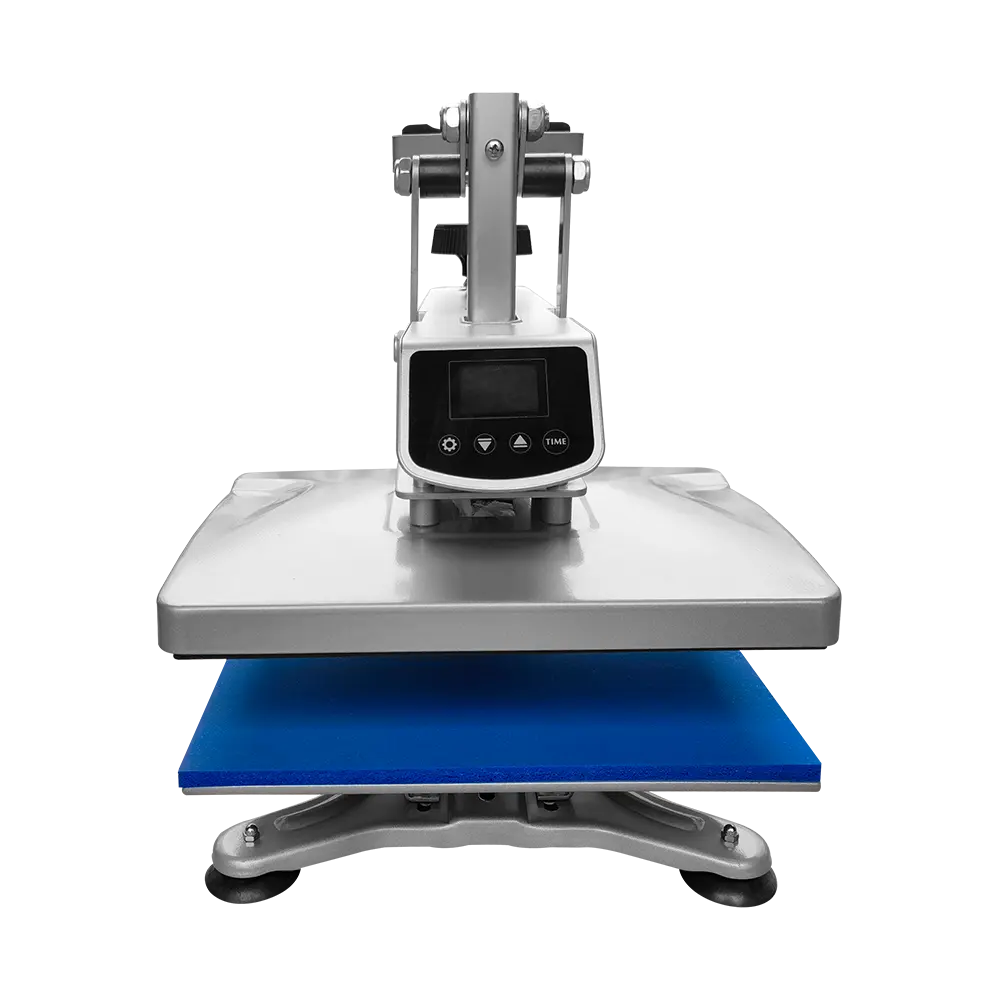
A machine that costs $150 on an open retail marketplace sounds cheap until it ruins twenty blank hoodies in your first week. If a heat press ruins $300 worth of inventory and costs you three repeat clients, that press was not cheap. It was an expensive liability.
Commercial operators define cost through Total Cost of Ownership (TCO). True affordability balances three simple factors:
Initial Capital Outlay: The direct purchase price of the hardware.
Scrap Rate: The percentage of garments ruined due to uneven heat or insufficient pressure. Professional setups keep this below 1%.
Production Speed & Duty Cycle: How many shirts the press can cure per hour without dropping platen temperature.
The best affordable heat press is not the cheapest box on the shipping pallet. It is the machine with the lowest cost per successful press over twelve months of continuous daily operation.
To avoid scrap and customer complaints, evaluate any prospective press against two non-negotiable physical standards: heat distribution and clamping pressure.
Consumer craft presses use thin aluminum platens with spaced-out heating coils. This creates severe hot and cold spots. The center might read 320°F (160°C), while the outer edges hover at 285°F (140°C).
Modern transfer methods, especially Direct-to-Film (DTF) and screen print transfers, require precise heat activation. If your temperature drops by more than 10°F on the edges, the hot-melt adhesive powder will not liquefy completely. The design will stick temporarily, only to detach in the washing machine.
Commercial-grade equipment incorporates dense, serpentine heating elements cast directly into thick aluminum platens. Look for platens with a thickness of at least 0.75 inches (19 mm). This thickness retains thermal mass, ensuring temperature fluctuations remain within a tight window of ±3°F across the entire pressing surface.
Pressure drives the melted adhesive deep into the weave of the fabric. Without high, even pressure, transfers sit loosely on top of the garment fibers rather than anchoring into them.
Lightweight machines flex under load. If the structural arm bends even two millimeters when you clamp the press shut, you lose downward force along the front edge of your platen. Look for heavy steel framework, reinforced pivot pins, and an over-the-center pressure adjustment knob that distributes mechanical force evenly across the surface.
Choosing the best affordable heat press requires matching the mechanical motion of the press to your production space and garment lineup.
Clamshell designs feature a top platen that opens and closes on a rear hinge, much like a jaw. They represent the classic entry point for screen printers and apparel decorators.
Pros: Extremely compact footprint; fast open-and-close cycle times; ideal for high-speed runs of standard cotton t-shirts.
Cons: Limited clearance when loading garments; rear-hinge design applies pressure unevenly to thick items like heavy fleece hoodies.
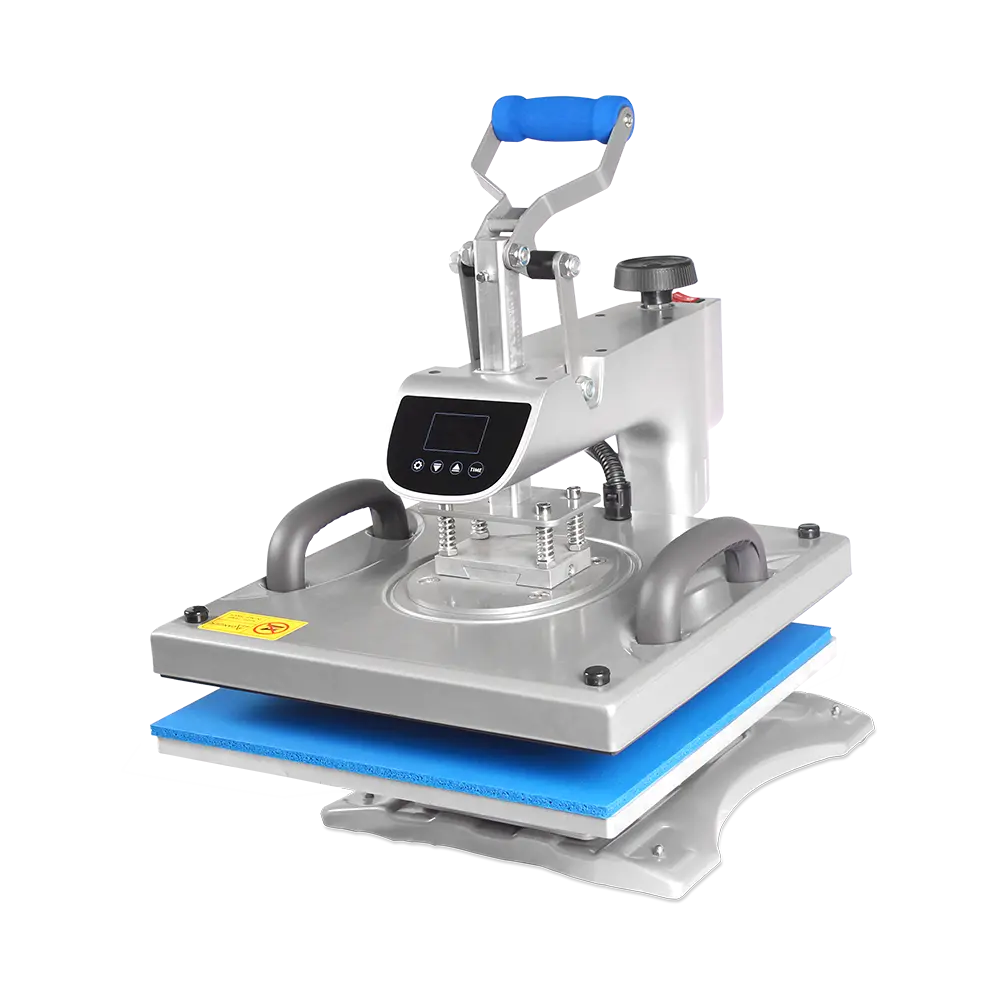
On a swing-away machine, the top heating platen lifts straight up and rotates horizontally 360 degrees out of the way. This leaves the lower platen completely open and clear.
Pros: Delivers strictly vertical, flat downward pressure; easily presses thick blanks like canvas totes, jackets, and hoodies; prevents accidental burns because the hot element swings away from your hands.
Cons: Requires nearly double the horizontal desk space to accommodate the swinging arc; slightly slower production speed per unit.
These hybrid commercial models take standard clamshell or swing-away platforms and add efficiency features. A pull-out "drawer" allows you to lay down your shirt without reaching beneath the hot platen. An electromagnetic latch holds the press shut and releases automatically when the timer reaches zero.
At Heat Press Leader, we consider auto-open functionality the single most effective upgrade for solo operators. It prevents scorched garments if you step away to prep your next transfer, and it easily lifts daily production throughput by 20% to 30%.
Every print shop operates under different physical and financial limits. Here is how to pick the best affordable heat press for your specific commercial stage.
If you are working from a spare bedroom or small garage with strict capital limits, do not buy a multi-attachment "5-in-1" craft combo. Those multi-use machines compromise on frame rigidity and platen flat-spot tolerances.
Instead, choose a dedicated, heavy-gauge 15"x15" manual clamshell press. Ensure the machine weighs at least 45 to 50 pounds (20-23 kg). Weight indicates steel thickness and platen mass. A dedicated 15"x15" frame covers adult t-shirt sizes from Small to XXL while keeping your startup costs low.
Direct-to-Film printing demands steady daily production and rapid turnarounds. For this operational model, invest in a 16"x20" Auto-Open Clamshell with a pull-out lower drawer.
The 16"x20" size accommodates oversized streetwear graphics, back-prints, and tall athletic uniforms. The magnetic release lets a single worker prepare the next transfer while the current shirt presses, reducing labor fatigue during runs of 50 to 100 shirts.
If your business model includes heavy fleece hoodies, thick workwear canvas, tote bags, and ceramic or metal signs, a heavy-duty industrial swing-away press is essential.
The vertical drop ensures zero transfer slippage. Because the top platen lowers parallel to the base, seams, zippers, and thick fleece pockets do not throw off your pressure balance. This eliminates peeling around thick collars and seams.
A production tool is an investment designed to generate cash flow. Let us look at the real production economics of a typical custom apparel startup to understand how quickly an entry-level commercial press pays for itself.
| Expense Category | Cost per Unit (USD) |
|---|---|
| Quality Blank T-Shirt (Ringspun Cotton) | $3.50 |
| Custom DTF Transfer Print (10" x 12") | $2.20 |
| Polybag, Label, & Packaging | $0.50 |
| Electricity & Equipment Depreciation | $0.15 |
| Total Production Cost per Garment | $6.35 |
If you sell this custom garment directly to your customer at a competitive retail price of $24.00, your net margin sits around $17.65 per shirt.
Now, consider the hardware cost:
Cost of a dependable mid-tier commercial heat press: $450.00
Net profit per pressed garment: $17.65
Break-even volume: $450 / $17.65 = 26 shirts
You only need to produce and sell 26 t-shirts to pay off the entire hardware purchase. If you secure a single order for a local landscaping crew, gym, or family reunion, you can pay for the machine in an afternoon. That is why choosing the best affordable heat press based on reliability beats saving $75 on a fragile hobby unit.
Dialing in your variables is the final step toward zero scrap. Keep this technical cheat sheet taped near your press to ensure high durability across different transfer media:
| Transfer Method | Platen Temp (°F / °C) | Dwell Time (Seconds) | Pressure Setting | Peel Method |
|---|---|---|---|---|
| Direct-to-Film (DTF) | 300°F - 320°F / 150°C - 160°C | 12 - 15 sec | Medium-Firm (6-7 Bar / 40-50 PSI) | Cold Peel (Wait until fully cool) |
| Screen Print Transfers (Plastisol) | 325°F - 350°F / 162°C - 177°C | 10 - 12 sec | High (7-8 Bar / 50-60 PSI) | Hot Peel (Immediate smooth pull) |
| Standard Heat Transfer Vinyl (HTV) | 305°F - 315°F / 151°C - 157°C | 10 - 15 sec | Medium (4-5 Bar / 30-40 PSI) | Warm / Cool (Follow film spec) |
| Dye Sublimation (Polyester) | 385°F - 400°F / 196°C - 204°C | 45 - 60 sec | Light-Medium (3-4 Bar / 25-30 PSI) | Immediate Hot Peel |
Note: Always run a test press on a scrap garment whenever you switch textile blends (e.g., from 100% cotton to an 80/20 poly-fleece blend).
Q1: Can I use a regular home iron or handheld craft press to start my
business?
A1: No. Handheld craft tools rely on manual body weight to
create pressure. This creates inconsistent force across the graphic, leading to
edge-peeling after a few washes. Hand irons also lack edge-to-edge heat
uniformity. For a commercial brand, you need a mechanical clamp press to ensure
consistent wash test results.
Q2: What platen size should I buy first?
A2: A 15"x15"
platen is the absolute minimum size for adult apparel. However, if your budget
allows, a 16"x20" platen is the commercial industry standard. It accommodates
oversized street-style graphics, hoodies, and back-prints without forcing you to
press designs in separate passes.
Q3: Why are my DTF transfers peeling off after
washing?
A3: Peeling usually stems from three errors: insufficient
clamping pressure, low pressing temperatures, or peeling the carrier film too
early. Check your heat platen with an external pyrometer to verify temperature
accuracy, increase your downward clamp pressure, and let the transfer cool
completely before peeling if using cold-peel film.
Q4: How much power does a commercial heat press draw?
A4:
Most standard 15"x15" and 16"x20" presses draw between 1,400 and 1,800 Watts. In
North America, this runs on a standard 110V/15-Amp circuit, though running it on
a dedicated 20-Amp breaker is ideal to prevent tripping. In European and other
international markets, standard 220V/240V outlets handle this draw with
ease.
Q5: What is the benefit of a threaded base lower
platen?
A5: A threadable lower platen allows you to slide a t-shirt
over the base just like you would on an ironing board. This keeps only one layer
of fabric on the pressing area. It prevents buttons, zippers, and thick rear
seams from interfering with your press pressure, cutting production errors down
to zero.
Building a respected apparel brand takes hard work, smart design, and consistent execution. Do not let unreliable hardware compromise your business reputation before your brand has a chance to grow.
When selecting the best affordable heat press, look past flashy marketing gimmicks and thin craft machines. Focus on structural mass, even platen temperatures, and verifiable clamping force. A reliable machine pays for itself quickly, keeps your scrap rates close to zero, and ensures that every customer receives a durable, professional-quality shirt.
Are you ready to equip your apparel startup with high-durability, factory-tested heat press equipment? Our technical team at Heat Press Leader helps growing print shops choose reliable, cost-effective machinery built for real daily volume.
Send an inquiry today to speak with an equipment specialist, request our comprehensive commercial machinery catalog, or ask for direct factory pricing on our clamshell, swing-away, and auto-open collections.