The custom apparel market in 2026 runs on speed, consistency, and precision. Direct-to-Film (DTF) technology and high-grade plastisol transfers allow single operators to produce retail-ready apparel from home garages or small industrial bays. Yet, many new business owners stall out right at the start.
They buy handheld craft irons or flimsy hobby presses. These tools lack calibrated downward pressure and suffer from severe temperature swings. After three washes, the graphics lift, leading to angry refund requests and burnt inventory. If you want to build a viable apparel brand, you need machinery engineered for repeatable production.
Choosing the best heat press machine for beginners means picking a system that prevents costly misprints while staying within your startup budget. At Heat Press Leader, we help entrepreneurs bridge the gap between hobby tools and high-output machinery. If you are sourcing commercial-grade equipment for your startup, contact our team today for factory-direct consultations and custom machinery specs.
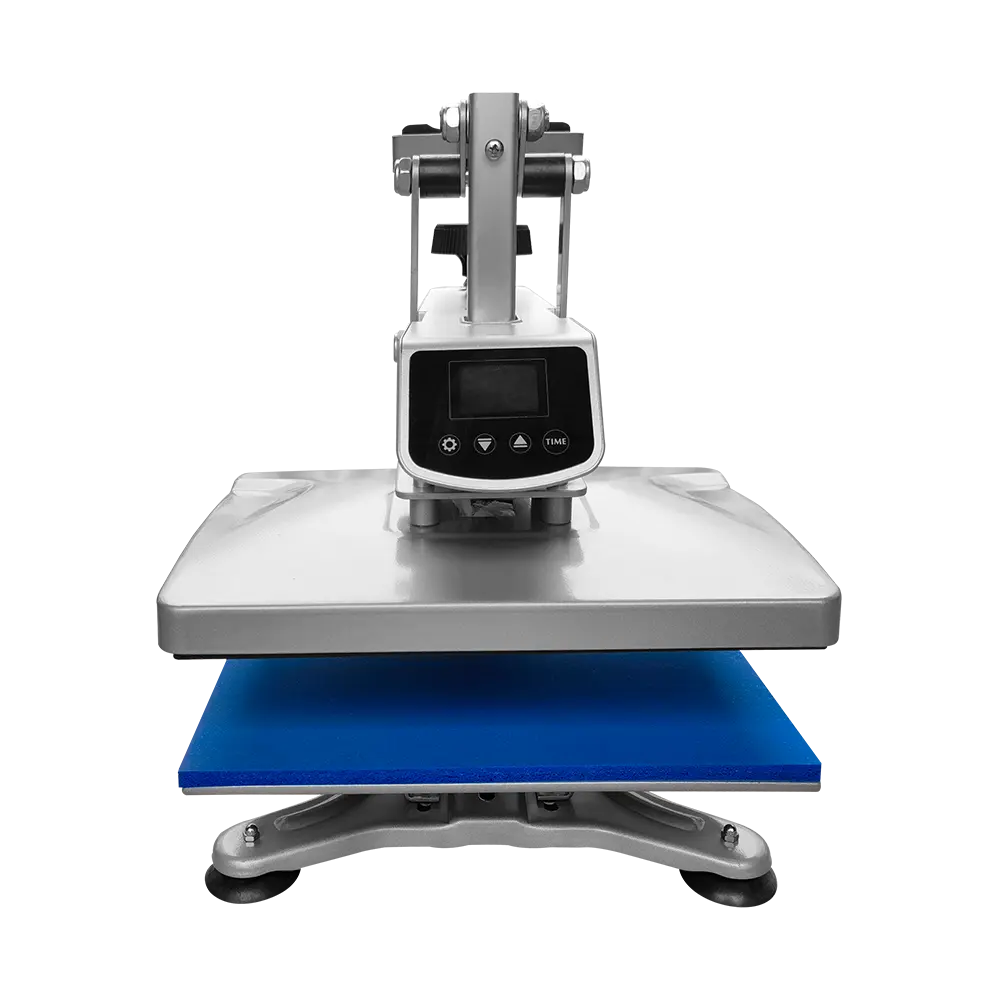
Commercial printing differs drastically from occasional weekend crafting. When evaluating machinery for an apparel startup, look past marketing claims and evaluate these four technical benchmarks:
Temperature Uniformity (±5°F Tolerance): Cheap heating platens contain sparse, snaking heating elements that cause cold edges. Industrial machines utilize dense, cast-in tubular heating coils to keep temperature variance under ±5°F across the entire surface. This variance determines whether your DTF powder melts correctly or washes out.
Mechanical Pressure Systems: A machine must generate firm, repeatable physical pressure (40 to 60 PSI for commercial screen transfers). Clamshell units save floor space, swing-away units provide completely flat downward pressure, and drawer-style platens protect operators from heat exposure.
Duty Cycle and Operator Fatigue: Pressing 50 hoodies on a manual press requires real physical effort. Look for magnetic auto-open mechanisms and gas-spring assists. These features stop operators from burning shirts when multitasking, while reducing back strain during long runs.
Platen Scalability: While a 12x15-inch platen works for pocket graphics and baby onesies, a 15x15-inch plate serves as the bare commercial baseline. For retail streetwear, oversized designs, and 2XL hoodies, a 16x20-inch platen is required.
This unit represents the gold standard for entrepreneurs who need to print standard orders quickly without burning garments. An electro-magnetic latch holds the upper platen down under mechanical lock and releases automatically once the digital timer hits zero.
If you step away to weed vinyl, peel a cool DTF transfer, or pack an invoice, the press opens on its own. It eliminates scorched inventory. The heavy steel chassis minimizes frame flex, ensuring center-to-edge pressure uniformity across typical 15x15-inch runs.
Platen Size: 15x15 inches or 16x20 inches
Mechanism: Clamshell with magnetic auto-assist and gas-shock opening
Primary Advantage: Eliminates human error and prevents burnt apparel during multi-tasking
Scrap Rate: Extremely low (under 1.5% during production runs)
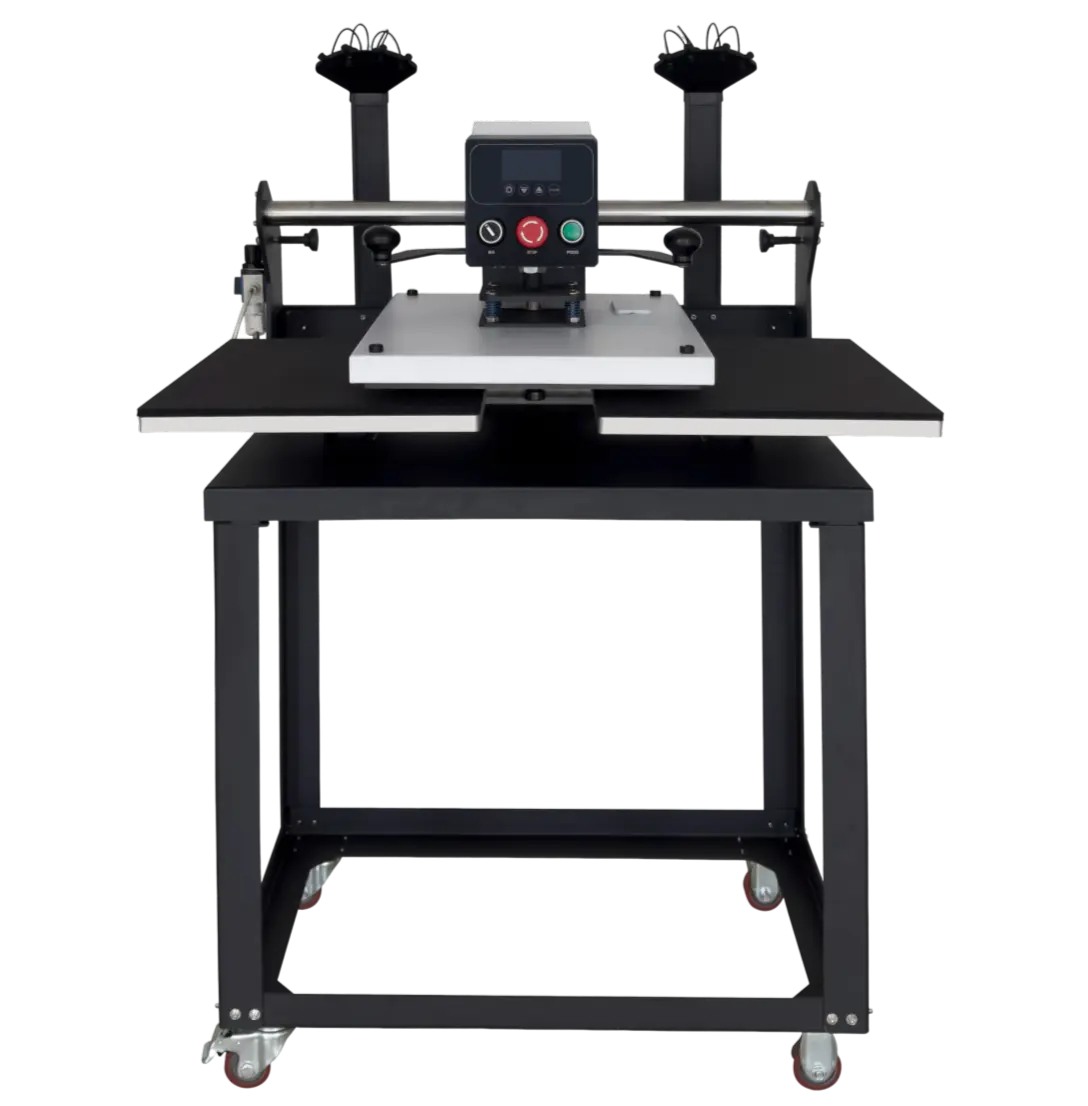
For operations launching on razor-thin capital, this machine delivers commercial stability without unnecessary bells and whistles. Its key feature is the pull-out lower drawer bed, which slides out toward the operator.
This layout lets you align your transfer onto the garment without placing your hands beneath the 350°F upper heating platen. It lowers safety risks and speeds up collar-to-chest alignment. It remains the best heat press machine for beginners aiming to break even within their first month.
Platen Size: 15x15 inches
Mechanism: Forward-pull drawer clamshell
Primary Advantage: Burn prevention, precise garment placement, minimal footprint
Target Application: Startup Etsy stores running standard t-shirts, tote bags, and flat goods
Modern streetwear demands oversized graphic prints, drop-shoulder seams, and heavyweight fleece hoodies. Clamshell presses can pinch thicker fabrics unevenly at the hinge. A swing-away machine solves this by swinging the top platen away 180 degrees.
The top plate lowers flat onto the garment, applying equal vertical pressure across the entire surface. This handles thick hoodie seams, kangaroo pockets, and heavy canvas jackets without creating pressure dead zones.
At Heat Press Leader, we regularly steer streetwear startups toward swing-away mechanics because they easily support thick garments and specialty materials.
Platen Size: 16x20 inches
Mechanism: 360-degree swing-away arm
Primary Advantage: Accommodates thick garments with completely vertical, uniform pressure
Production Drawback: Demands a larger workspace to swing the arm clear safely
If your shop takes on corporate uniform contracts, school sport apparel, or live event batches, manual clamping slows you down. High-efficiency electro-magnetic presses bridge the gap between manual levers and expensive industrial air compressors.
These machines generate consistent high pressure at the push of a button or foot pedal, locking securely and releasing instantly when the dwell time ends. The reduced physical effort lets one operator run two presses at once, doubling your output per hour.
Platen Size: 16x20 inches
Mechanism: Electronic assist / dual push-button lock
Primary Advantage: Cuts physical strain by 80%, supports 4+ hour production runs
Best For: Fast-growing print-on-demand brands printing 100+ shirts daily
Mobile events, festival booths, and pop-up retail setups require a reliable heat press that runs on standard venue circuits. Small hobby tools lack the thermal mass to maintain heat during back-to-back presses, but a portable industrial mini-press fixes that problem.
Built with solid aluminum cast plates and a rugged, direct-pressure lever, this unit travels safely in a Pelican case. It heats up in under five minutes, handling neck tags, left-chest logos, sleeve prints, and hat patches right on site.
Platen Size: 6x6 inches or 9x12 inches
Mechanism: Compact manual clamshell
Primary Advantage: Low power draw, mobile footprint, fast initial heat-up
Best For: On-site custom merch, festival printing, private label neck-tag swaps
Startups often need to test multiple product types before focusing on a single market. Combo presses come with interchangeable attachments for flat apparel, trucker caps, ceramic mugs, and aluminum drinkware.
You can print a matched t-shirt, hat, and mug collection for a local corporate customer on a single machine. While swapping platens takes five to ten minutes, the flexibility helps you secure diverse print jobs without buying several machines early on.
Platen Configuration: 12x15 main bed, hat platen, mug clamps, plate rings
Mechanism: Modular swing-away frame
Primary Advantage: Tests multiple revenue streams for under $500 total startup capital
Best For: Custom gift studios, promotional item suppliers, creative boutiques
Using different material types like DTF transfers, vinyl (HTV), screen-printed transfers, and sublimation means constantly changing your time, temperature, and pressure settings. Human error often leads to ruined garments when an operator forgets to drop the heat from 385°F (sublimation) to 290°F (low-temp DTF).
Smart memory presses solve this issue with programmable digital presets. Operators simply hit a preset button to load the correct temperature and dwell time. This cuts training time for new hires down to minutes.
Platen Size: 15x15 inches
Mechanism: Auto-opening clamshell with multi-channel digital logic board
Primary Advantage: Saves multiple material profiles to prevent operator setup errors
Best For: Print shops that cycle between DTF, embroidery patches, and HTV daily
Investing in the best heat press machine for beginners is a financial decision, not a hobby purchase. Let us look at a realistic production budget using modern DTF transfers and standard retail-weight blank shirts:
Initial Capital Outlay: Commercial starter press ($450) + basic laser guide & accessories ($80) = $530 total entry cost.
Unit Production Cost: Quality ringspun cotton blank ($3.50) + gang-sheet DTF graphic ($2.20) + clear packaging bag ($0.30) = $6.00 per finished shirt.
Retail Price: Conservative direct-to-consumer price = $24.00 per finished shirt.
Net Profit Margin: $24.00 sale − $6.00 unit cost = $18.00 gross margin per shirt.
Payback Calculation: $530 startup cost ÷ $18.00 margin = 30 shirts.
You can break even on your equipment purchase after landing a single small order for a local landscaping crew, gym, or family reunion. That fast return makes commercial heat pressing one of the safest apparel printing models to start.
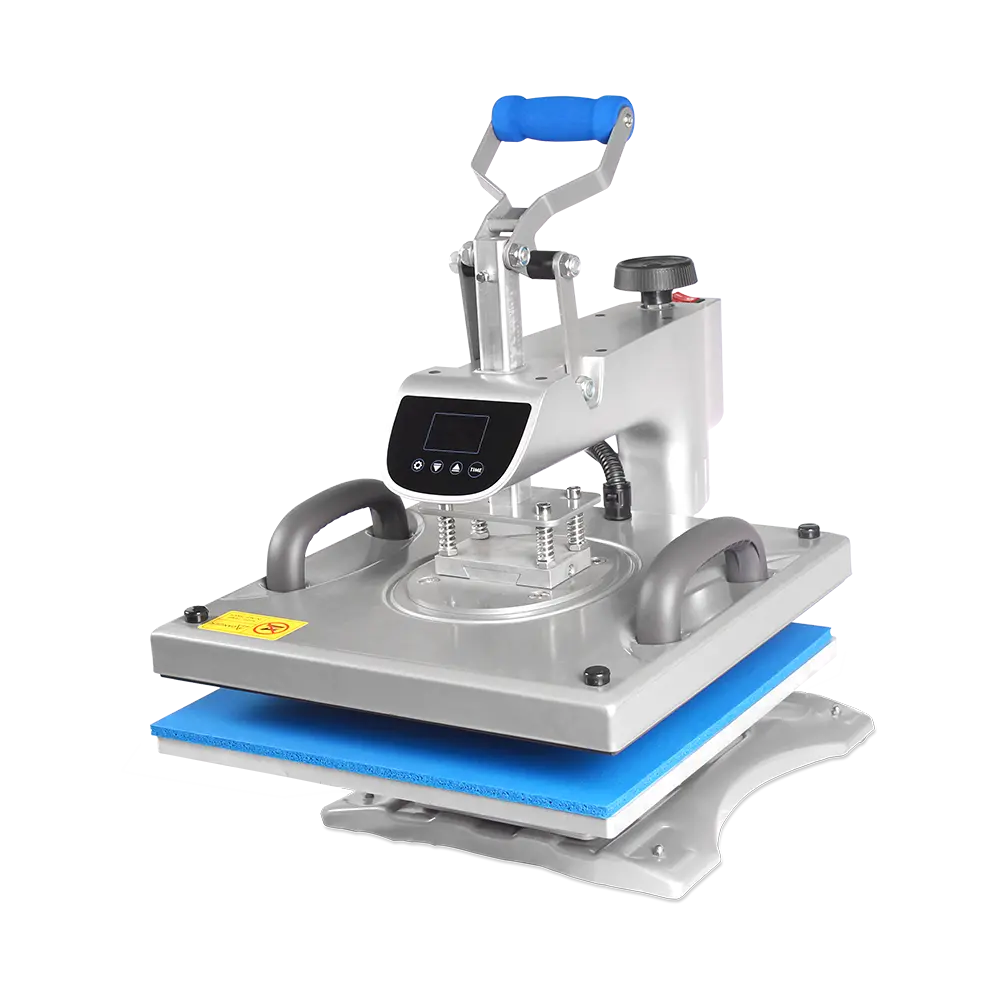
A reliable press gives you accurate heat and pressure, but you need a few practical shop accessories to maintain steady, retail-ready output:
Laser Alignment Module: A desk-mounted crosshair laser casts clean guidelines down your shirt's platen, ensuring every logo sits level and centered across different sizes.
Teflon Covers and Heavy Silicone Sheets: Fitting a fitted Teflon cover over your bottom platen lets garments slide on and off easily, speeding up production by several seconds per press.
Foam Pressing Pillows: These high-density foam pads lift the print area above buttons, heavy side seams, and thick collars, preventing pressure drops that weaken the transfer bond.
Infrared Surface Thermometer: Digital displays can drift over time. Use an external surface probe or digital pyrometer monthly to confirm your heating platen stays within spec.
Q1: Clamshell vs. Swing-Away: Which is better for a small garage
workshop?
A1: A clamshell press works best if space is tight. It
opens straight up, fitting cleanly on standard 24-inch workbenches. Swing-away
presses need clear clearance to the side to swing the heated platen away safely.
However, if your work focuses on thick hoodies, heavy work jackets, or canvas
bags, pick a swing-away or drawer press. They ensure even, vertical pressure
across heavy fabric seams.
Q2: Can I use a craft iron to sell custom t-shirts
professionally?
A2: No. Craft irons lack the heavy metal platens
needed to hold steady heat across an entire design. They also rely on your body
weight, which yields uneven pressure. Transfers pressed with household irons
often peel after just a few laundry cycles. That leads directly to poor reviews
and lost sales. A dedicated mechanical press is essential for long-lasting
prints.
Q3: What heat press features are needed for modern DTF
transfers?
A3: DTF transfers need stable, low-to-medium heat
(typically 280°F to 315°F) and consistent, firm pressure (around 45 to 55 PSI).
Look for a machine with accurate digital temperature controls, a thick aluminum
heat plate, and a smooth clamping design. An auto-open feature also keeps
transfers from over-baking while waiting for cold-peel film to cool down.
Q4: Why does my heat press burn or leave shiny marks on polyester
shirts?
A4: Scorching and sheen marks happen when you apply too much
heat directly to synthetic fibers. Use low-temp transfers, drop your press
temperature to 275°F-285°F, lighten your mechanical pressure, and place a
protective Teflon sheet or clean kraft paper over the garment.
Q5: How often should I calibrate the temperature on an entry-level
commercial press?
A5: Check your platen surface once a month with an
infrared thermometer or thermal test strips. Check nine distinct points: the
center, four corners, and four edge points. If your readings drift more than
10°F from the control display, adjust the digital calibration settings according
to your user manual.
Buying the best heat press machine for beginners protects your new brand from customer returns, wasted inventory, and physical strain. Pick a platform that matches your immediate apparel formats, calculate your daily production target, and focus on solid mechanical build quality over flashy cosmetic features.
At Heat Press Leader, we manufacture and supply commercial-grade heat presses designed for real production environments. Whether you need an entry-level auto-open clamshell or high-volume pneumatic hardware, our team can help you build the right production setup.
Ready to configure your shop? Send our engineering team an inquiry today to request wholesale pricing, machinery catalogs, and dedicated operational support for your business.