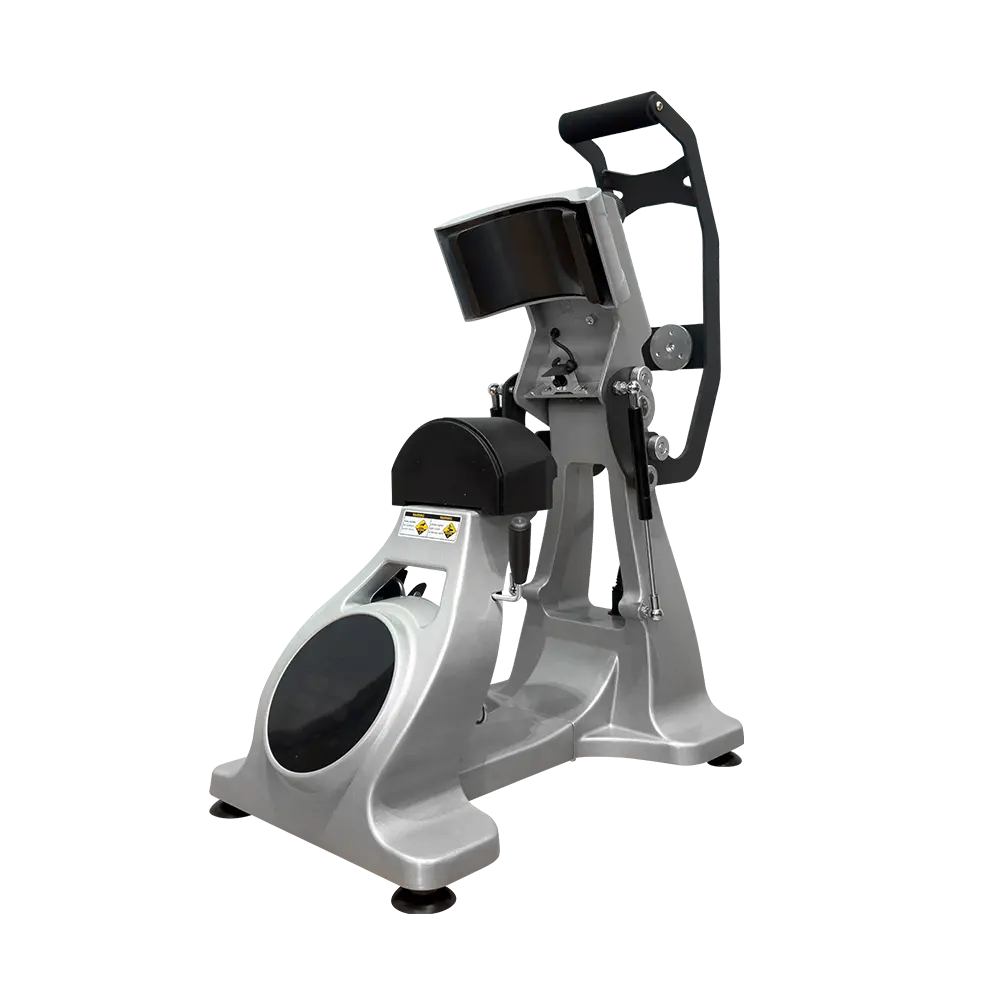
Rising labor costs and shrinking delivery windows challenge commercial apparel decorators worldwide. Relying on manual clamshell presses or basic twin-shuttle units creates production bottlenecks that restrict shop margins. High-volume textile printing requires repeatable mechanical consistency, automated handling, and minimal idle time.
A multi-station carousel heat press resolves these challenges. Once considered a luxury reserved for massive contract decorators, rotary heat presses are now standard equipment for any operation targeting scalable commercial volume. Heat Press Leader (XinHong Group Limited) has engineered industrial transfer systems since 2002. Over two decades of factory manufacturing demonstrate that tailored machinery configurations deliver significantly higher yields than off-the-shelf equipment.
Investing in a rotary press requires a clear understanding of mechanical and thermal specifications. Below are the critical configuration parameters you should demand in 2026 to ensure continuous output, clean peel integrity, and maximum return on investment.
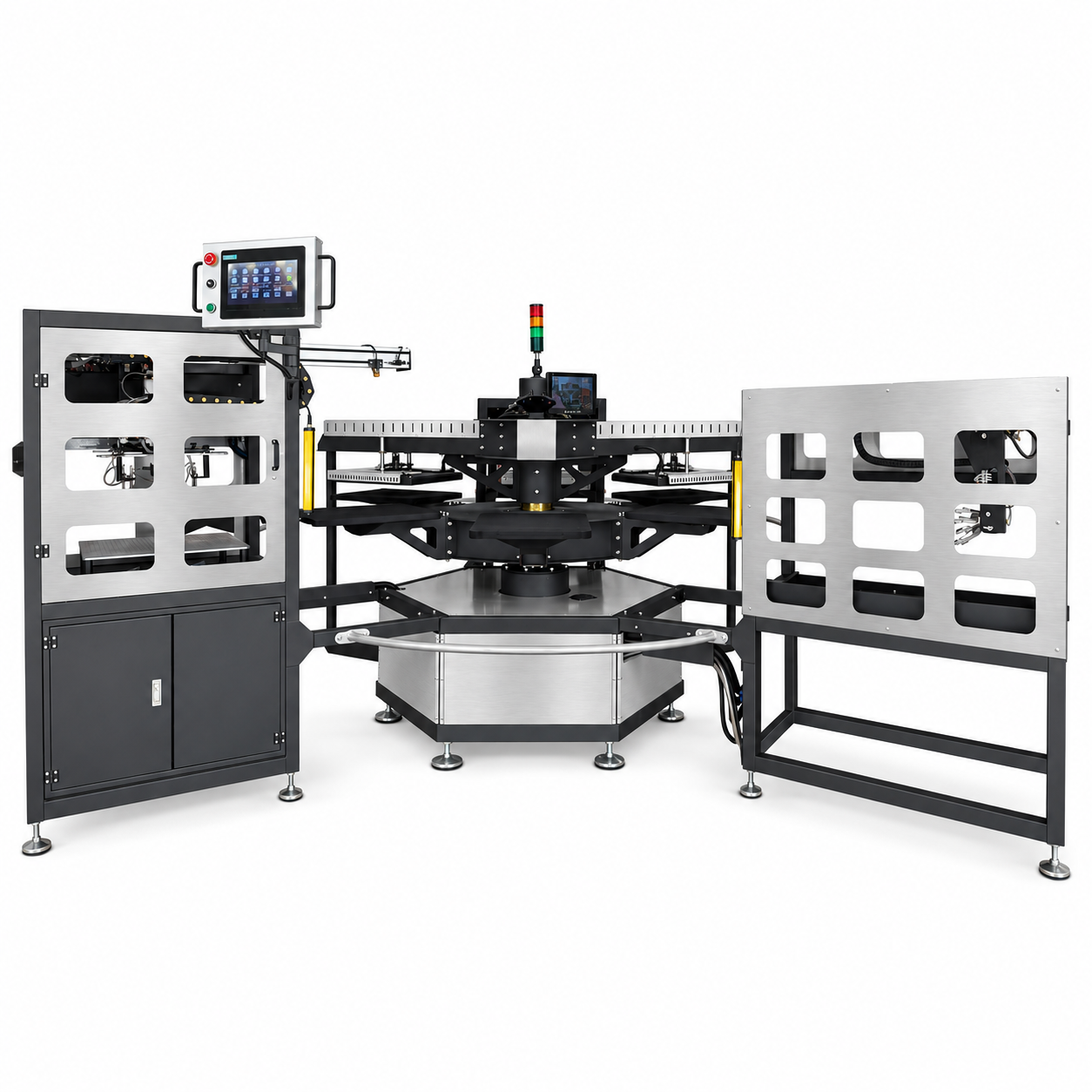
Industrial machinery must balance raw power with precision control. When you specify a custom rotary press for modern workflows—including Direct-to-Film (DTF), plastisol transfers, and screen-printed transfers—evaluate the machine across four engineering categories.
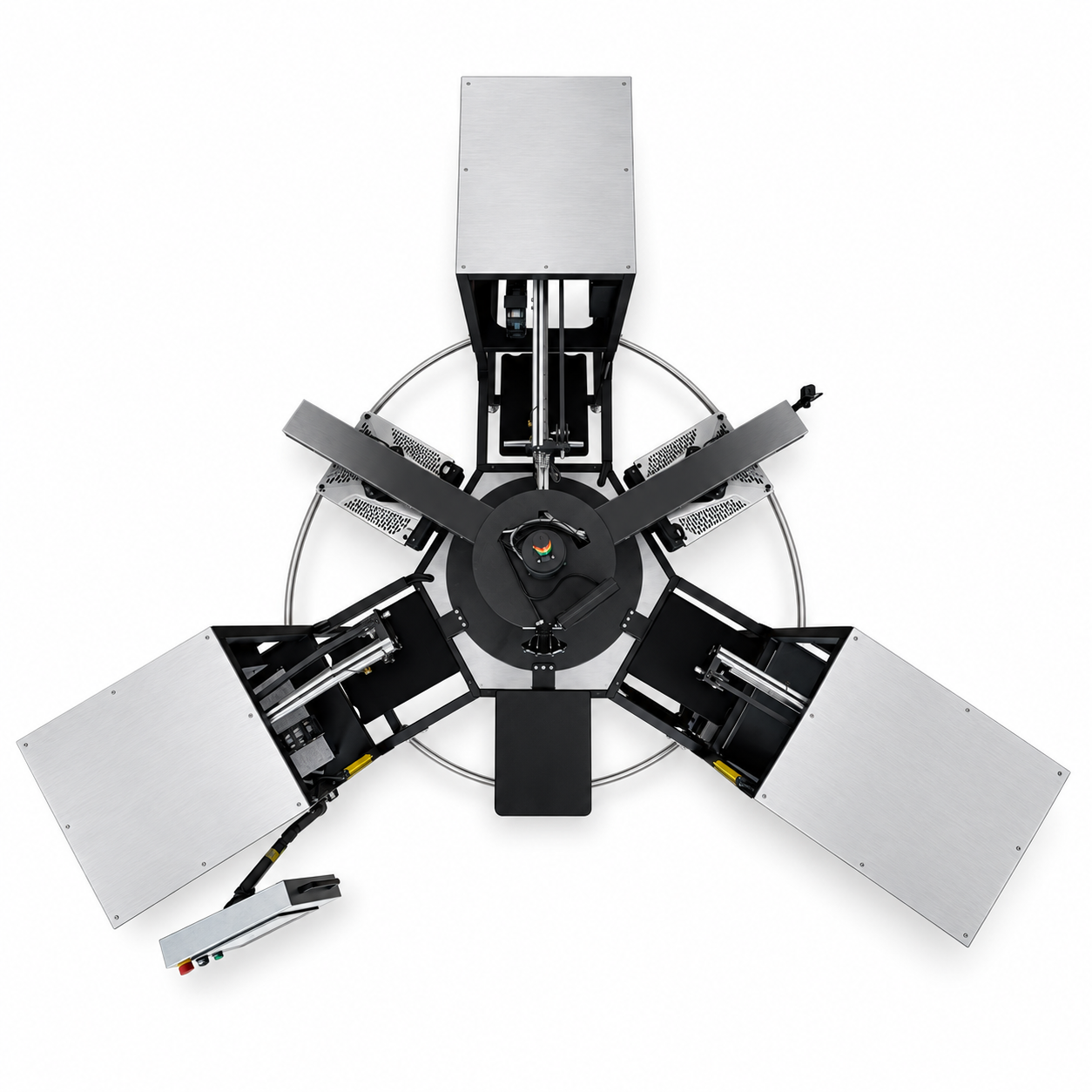
Rotary systems come in four, six, or eight stations. For industrial apparel manufacturing, the six-station configuration remains the gold standard. A four-station machine often forces an operator to rush garment alignment or wait while a pressing cycle finishes. An eight-station machine can increase floor space requirements without improving cycle efficiency on standard apparel runs.
A six-station setup creates a smooth, continuous sequence across distinct operations:
Garment loading and manual or laser-guided positioning
Transfer film alignment
Main dwell stage under high heat and pneumatic pressure
In-line cooling zone for adhesive stabilization
Peeling stage (manual or mechanical)
Automated garment discharge onto an exit conveyor
This layout ensures the heating element stays down and working continuously, while operators or automated mechanisms prepare garments simultaneously.
Modern transfer methods, particularly high-volume DTF decoration, require consistent handling. In 2026, a static press that requires manual film placement, manual peeling, and manual unloading wastes valuable cycle time. High-volume environments benefit from custom integration options:
Auto-alignment systems: Project crosshair lasers or edge-detecting optical sensors to ensure operators place transfers squarely on target garments.
Controlled peeling mechanisms: DTF adhesives often peel best within strict temperature windows. Mechanical peelers eliminate human variance, pulling the film back at a consistent angle and speed to prevent edge tearing.
Pneumatic unloading: Automated mechanical pickers or vacuum sweeps grab the finished garment and drop it onto a takeaway conveyor or sorting bin, freeing the operator to focus entirely on precision garment loading.
Inconsistent heat application leads directly to wash-durability failures. According to textile quality standards outlined by organizations like the PRINTING United Alliance, maintaining uniform temperature and correct mechanical pressure across the entire platen surface is critical for adhesive activation.
Ensure your machine features these core mechanical metrics:
Pressure capacity: Industrial work requires steady pneumatic pressure reaching at least 0.8 MPa (approximately 116 to 120 PSI). Dual pneumatic cylinders distribute force more evenly across the platen than single-piston designs.
Cast-in heating elements: Specify dense, serpentine aluminum casting for the heating platen. The internal wiring should maintain a tolerance of ±2°C to ±3°C across the full pressing surface. Surface cold spots ruin film adhesive adhesion.
Independent station monitoring: Top-tier carousels monitor platen temperatures continuously, alerting technicians through audio or visual cues if temperature drops past specified thresholds during rapid cycling.
Switching from heavy cotton hoodies to lightweight poly-spandex performance wear requires quick parameter adjustments. Operators should never spend ten minutes turning dials and checking stopwatches between production runs.
Specify an industrial PLC touch interface featuring multi-language display options, digital air pressure regulators, and digital recipe storage. A supervisor can save dwell times, pressure levels, and temperatures for specific garments. Once saved, a press operator selects the recipe with one touch, reducing setup errors and ruined garments.
For operations processing hundreds of garments per hour, Heat Press Leader developed the Cyber Carousel 6 (Model: B5-6). Designed to handle contract runs, high-capacity print shops, and dynamic print-on-demand fulfillment hubs, the B5-6 combines rugged structural steel with automated material handling.
The unit features a standard 16" × 20" (40 × 50 cm) platen footprint, accommodating standard adult t-shirts, sweatshirts, performance wear, and tote bags. When configured with automated unloaders, the system sustains continuous production rates between 300 and 450 finished pieces per hour, depending on film dwell requirements.
The B5-6 model streamlines production across six dedicated stations:
Station 1: Garment Loading and Prep: The operator slides the blank garment onto a quick-release platen. An integrated laser-guide system aids fast, straight collar alignment.
Station 2: Transfer Placement: The operator positions the transfer film onto the target area. Static cling strips or light hold-down tabs prevent film displacement during index rotation.
Station 3: Pneumatic Thermal Pressing: The heavy-duty 5,300W platen descends automatically. Dual cylinders deliver up to 0.8 MPa of consistent pneumatic down-force at temperatures up to 210°C (410°F).
Station 4: Active Cooling: The platen opens, and the carousel rotates the pressed garment under a forced-air cooling blower. This lowers the film temperature, stabilizing the adhesive layer for clean removal.
Station 5: Automated Peeling: A mechanical gripping assembly catches the transfer carrier sheet, pulling it back smoothly across the surface to complete the peel without operator intervention.
Station 6: Automated Garment Discharge: Pneumatic grip arms lift the decorated garment from the lower platen, depositing it onto a side conveyor belt for quality inspection, folding, and packaging.
| Parameter | Factory Standard Specification | Custom Engineering Options |
|---|---|---|
| Platen Dimensions | 16" × 20" (40 × 50 cm) | Custom platen sizes, sleeve, or pocket platens |
| Workstation Count | 6 Stations (Rotary Indexing) | 4, 6, or 8 Station configurations |
| Power Consumption | 5,300 Watts | Configurable heating density |
| Voltage Standards | 220V 1-Phase / 380V 3-Phase | 3×220V, 3×380V, 3×480V industrial tailoring |
| Operational Pressure | Up to 0.8 MPa (116 PSI) | Heavy-duty reinforced cylinders available |
| Temperature Range | 0°C – 210°C (32°F – 410°F) | Uniform accuracy ±2°C across platen area |
| Max Production Speed | 300 – 450 garments / hour | Varies by transfer dwell time |
| Machine Dimensions | Approx. 280 × 280 × 160 cm | Footprint adaptable to factory spatial layouts |
Investing in a high-volume carousel heat press is a major capital equipment decision. Off-the-shelf equipment rarely aligns perfectly with existing factory layouts, power drops, or specific product lines. Working directly with an experienced OEM/ODM manufacturer allows print operations to configure machinery for their exact floor conditions.
Heat Press Leader brings over twenty years of industrial manufacturing experience to custom machinery design:
Deep Manufacturing Heritage: Founded in 2002, our engineering teams understand mechanical wear points, thermal cycle stresses, and production durability. We use solid structural steel and industrial-grade electronics to withstand multi-shift factory operations.
Dedicated Engineering Project Teams: We do not simply ship standard units from a warehouse. Our engineering teams review your shop layout, air supply metrics, and local electrical grids to configure wiring, platen layouts, and safety footprints for your facility.
Global Compliance and Quality Certifications: Our manufacturing processes adhere to the quality standards defined by the International Organization for Standardization. We maintain audited ISO 9001 and ISO 14001 certifications. All machines comply with strict CE directives (MD, LVD, EMC) verified by SGS, along with RoHS compliance for safety and environmental requirements.
End-to-End Operational Lifecycle Support: We supply replacement parts, specialized platens, and dedicated engineering documentation throughout the machine's operational life. Our remote diagnostic systems help your maintenance teams troubleshoot quickly, protecting your daily production schedules.
Q1: Why should our shop choose a 6-station carousel heat press over a twin-shuttle machine?
A1: Twin-shuttle presses improve efficiency over manual clamshells, but the operator must load, press, wait, peel, and unload within the same immediate workspace. A 6-station carousel separates these tasks across distinct stations. The platen presses continuously without waiting for human operators to finish unloading or lining up transfers. This operational separation yields sustained output speeds of 300 to 450 pieces per hour, compared to twin-shuttle limits of 120 to 180 pieces per hour.
Q2: Can the Cyber Carousel 6 run both cold-peel and hot-peel DTF transfer films?
A2: Yes. The B5-6 offers programmable dwell settings and configurable station modules. For hot-peel films, the automatic peeler can engage at station 4 or 5 immediately following pressing. For cold-peel materials, an active cooling blower unit drops the transfer temperature before mechanical peeling, preserving clean transfer edges and adhesive bonds.
Q3: What electrical infrastructure and compressor capacity are required for the B5-6?
A3: The machine requires a 5.3 kW power supply, wired for 220V single-phase, 380V three-phase, or customized to your regional plant requirements. Pneumatically, the system operates up to 0.8 MPa (116 PSI). We advise connecting the press to an industrial air compressor capable of delivering clean, dry air at a minimum of 10–12 CFM to sustain high-speed rotational cycling throughout long production shifts.
Q4: How does Heat Press Leader customize platens for specialty garments?
A4: Our engineering team designs custom quick-release platens using high-grade, heat-resistant aluminum and thick silicone padding. We build platens for youth sizes, pant legs, sleeves, tote bags, and zippered outerwear. Operators can swap standard platens for custom configurations in minutes using toolless clamping brackets.
Q5: What is the estimated ROI timeline for an apparel plant adopting an automated carousel system?
A5: Most contract decorators running standard single-shift operations offset equipment costs within six to nine months. Increased output per hour, reduced misprints from automated alignment, and lower labor overhead contribute to measurable monthly cost savings. For double-shift fulfillment centers, payback periods often drop below five months.
Modern garment decoration rewards shops that prioritize automation, thermal accuracy, and high operational uptime. Running commercial volume on underpowered equipment inflates labor costs and limits your ability to take on large customer contracts. Specifying an industrial carousel heat press gives your facility the mechanical speed and thermal consistency needed to handle high-volume DTF and transfer work efficiently.
Heat Press Leader delivers field-tested engineering, certified safety compliance, and bespoke machinery tailored to your facility's operational workflow. Step away from manual bottlenecks and establish dependable production output across every shift.
Ready to increase your factory's production capacity? Contact the Heat Press Leader engineering team today to request a direct quote on the Cyber Carousel 6 (B5-6) or discuss custom OEM/ODM technical specifications for your facility.