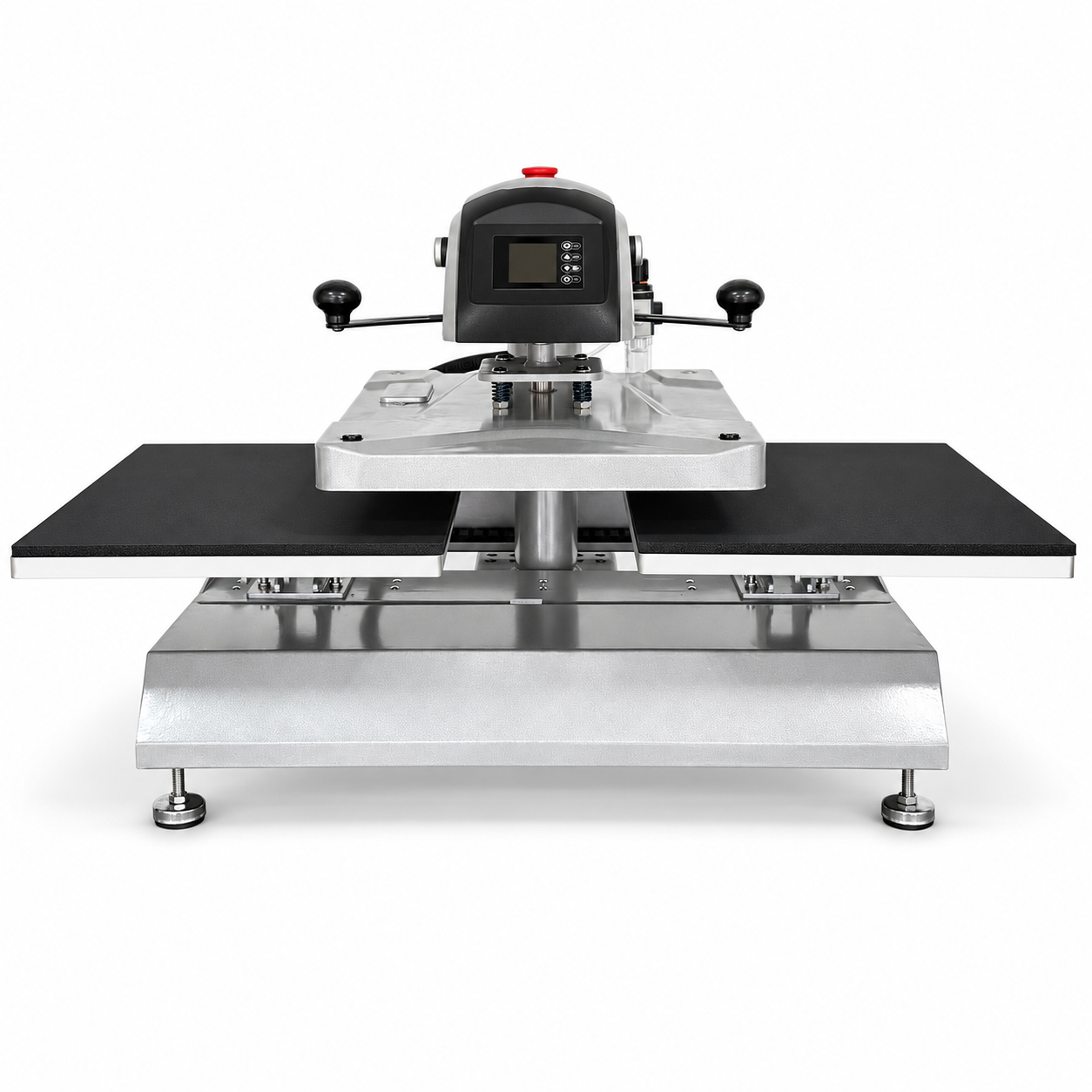
A tshirt presser is the piece of equipment that turns a blank shirt into a finished product. It applies heat, pressure, and time to bond a transfer to the fabric.
For a new shop, the first purchase is not about finding the biggest machine. It is about finding the machine that matches the shirts you sell and the space you have.
This guide is written for first-time buyers who need a practical starting point, not a catalog tour.
Heat Press Leader builds manual, semi-automatic, and dual-station presses for apparel decorators. If you are setting up a shop, send your shirt mix and weekly target early. A short brief gets you a machine recommendation and a quotation instead of a generic spec sheet.

What a tshirt presser needs to do
At minimum, a tshirt presser needs to hold temperature, apply even pressure, and count dwell time. Those three functions decide whether a transfer bonds or fails.
Heat: the platen should hold the set temperature across the surface, not only at the sensor.
Pressure: the clamp should apply even force and return to the same setting.
Time: the controller should count dwell time and signal the end of the cycle.
Platen size: the surface should cover the largest common design with room to position it.
Repeatability: the next operator should be able to repeat the same result.
Safety: the loading area, clamp, and heated surface should be designed for safe use.
A machine that misses one of these makes the operator compensate. Compensation becomes inconsistency, and inconsistency becomes remakes.
Press safety also deserves a structured review. ISO 12100:2010 sets the general principles for identifying hazards and reducing risk in machine design, including the clamp, the heated platen, and the loading area.
Tshirt presser recommendations by user group
New buyers often fit one of these profiles. Use the closest one to narrow the field, then test with your own shirts and transfers.
Home-based start-up
A manual 16 x 20 swing-away press is the simplest fit. It costs less, takes one operator, and gives direct feedback through the handle. For low volume and mixed jobs, that feel is useful.
Put the budget into a stable frame and a controller that holds temperature. Those details affect reject rates more than extra features. Write down the pressure setting and dwell time, and check the first piece from every batch.
Market and event sellers
You need a machine that survives repeated setup and still holds its settings. A manual press with a clear controller is often enough, especially if one person runs the booth.
Check the warm-up time and the space needed for loading. A crowd does not wait while the operator searches for a setting or clears a cramped table.
Print-on-demand side business
A semi-automatic press reduces the physical work of every cycle. The operator still loads and positions the shirt, but the machine applies the clamp. That helps when the same person also handles orders, packing, and customer service.
A 16 x 20 platen covers most adult fronts and backs. If space is tight, measure the swing arc before you buy; the machine needs room to move, not only room to sit.
Small retail apparel brand
A semi-automatic or dual-station press gives more consistency than a manual handle, especially when several people share the work. The brand promise is easier to protect when every shirt gets the same pressure and dwell time.
A dual station helps when order volume grows. One platen can be loaded while the other presses, so the operator does not wait through every cycle.
School and community studio
Shared equipment needs clear controls and predictable behavior. A manual swing-away lets a new operator see the whole load and unload step, which makes it easier to teach.
Label the settings and keep a sample shirt beside the press. A simple checklist prevents a beginner from changing the temperature or pressure by accident.
Screen printer adding t-shirt service
A semi-automatic or dual-station press fits an existing production floor better than a manual unit. The press should match the shop's throughput, not become a second bottleneck.
Measure the floor space and the loading path. A press that blocks the screen-print area slows down both processes, even if the machine itself is fast.
Five decisions for a first tshirt presser
These five choices set the cost and the ceiling of the machine. Make them before you compare prices.
1. Platen size
A 16 x 20 inch platen covers most adult fronts and backs. A 15 x 15 inch platen suits smaller spaces and lighter work. Measure your largest common design and add a margin for positioning.
2. Manual or semi-automatic
Manual presses cost less and give direct feedback. Semi-automatic presses apply the clamp with a controlled stroke, which reduces operator-to-operator variation. For repeat orders and multiple operators, the semi-automatic is usually the better fit.
3. Swing-away or clamshell
A swing-away clears the loading area and keeps heat away from the hands. A clamshell may fit a tighter footprint. Compare the full operating envelope, not only the machine dimensions.
4. Heat, pressure, and controller
Ask for a temperature map, a repeatable pressure control, and a timer that counts dwell time. A clear display and a lockable setting reduce training time.
5. Space, power, and workflow
The tshirt presser needs a stable surface, a dedicated circuit, ventilation, and room for the loading table. Keep blank shirts on one side and finished pieces on the other, so the operator does not cross the swing path. Electrical equipment should follow IEC 60204-1, the international reference for the electrical equipment of machines, including emergency-stop and protective bonding requirements.

Starter workspace checklist
A new press needs more than a clear table. It needs a work area that supports the full cycle.
Stable surface: the bench should not flex when the clamp closes.
Dedicated circuit: confirm voltage and current before the machine arrives.
Ventilation: heat and fumes need room to clear, especially in a small room.
Loading zone: leave space for the shirt and the operator's hands.
Finished-goods area: keep pressed shirts away from the loading zone.
Records: keep a setup sheet for each fabric and transfer combination.
No tshirt presser works well in a cramped, poorly powered corner. Fix the workspace before you upgrade the machine.
First 90 days
The first three months are for building a repeatable process, not for chasing maximum speed.
Build a test matrix: press each fabric and transfer combination you plan to sell.
Record settings: temperature, pressure, dwell time, and peel method.
Train one method: make sure every operator loads and unloads the same way.
Track rejects: count peeled edges, scorch marks, and off-center prints.
Review volume: add capacity only when loading is the bottleneck, not before.
A small shop that records its settings can grow into a larger one without relearning the process. A shop that relies on memory starts over with every new hire.
Where Heat Press Leader fits
Heat Press Leader, operated by Fujian Mech & Elec Co., Ltd., manufactures heat transfer equipment for apparel decorators. The tshirt presser range covers manual, semi-automatic, and dual-station configurations.
Manual 16 x 20 swing-away press: flexible small-batch work, sampling, and shops with one main operator.
16 x 20 semi-automatic swing-away press: repeat orders and teams that need consistent clamp pressure.
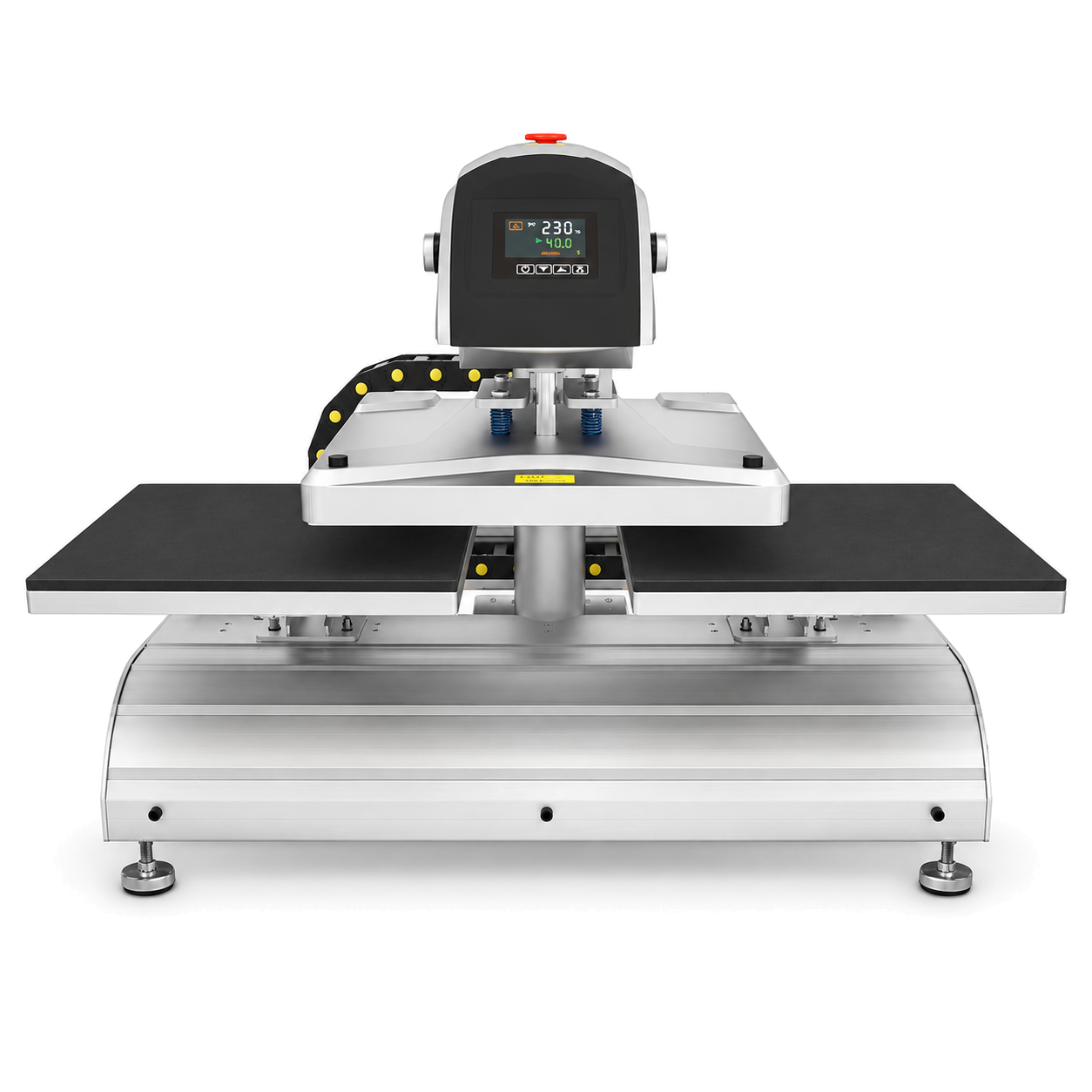
16 x 20 automatic electric dual platen press: higher throughput and overlapping load/press cycles.
Ask about voltage, plug type, lead time, and OEM or private-label options for your market. Those details affect installation and resale more than a headline speed number. The company's manufacturing background is worth reviewing before you shortlist.
Common mistakes
Most first purchases go wrong in predictable ways.
Buying the biggest machine first. A press that is oversized for daily work sits idle and takes up space.
Ignoring the shirt mix. A press that suits cotton tees may struggle with polyester performance wear.
Setting pressure by feel. Without a recorded setting, the next operator starts from zero.
Skipping a temperature map. The display can be right at the sensor and wrong at the edge of the platen.
No wash test. A transfer that looks good on the bench can fail after a few laundry cycles.
Forgetting training. The same press gives different results when nobody agrees on load position and dwell time.
No room to load. A press that fits the wall but not the operator becomes a daily frustration.
A sample run and a written setup sheet prevent most of these problems. Neither takes long, and both make the next order easier.
Frequently asked questions
Q1: What is a tshirt presser?
A1: It is a heat press used to bond transfers to t-shirts. It applies controlled heat, pressure, and dwell time. Common types include manual swing-away, semi-automatic, and dual-station presses.
Q2: What platen size should a first-time buyer choose?
A2: A 16 x 20 inch platen covers most adult fronts and backs. A 15 x 15 inch platen suits smaller spaces and lighter work. Measure your largest common design and add a margin.
Q3: Manual or semi-automatic for a new shop?
A3: For low volume and one operator, manual is often enough. For repeat orders, multiple operators, or consistent pressure, semi-automatic is the better fit. The price difference buys consistency, not just speed.
Q4: Can one press handle cotton and polyester shirts?
A4: Yes, if the temperature and pressure are adjustable and you test each fabric. Polyester usually needs lower heat and lighter pressure than cotton. Record separate settings for each fabric family.
Q5: How do I check heat, pressure, and wash durability?
A5: Ask for a temperature map at production heat, test pressure with your own fabric, and record the settings that work. For wash durability, follow a recognized method such as ISO 105-C06, then wash a sample the way your customer will.
Request a machine recommendation
A useful inquiry includes more than a request for price. Tell the team what you press and how the work flows.
The shirt fabrics you handle most often, such as cotton, polyester, blends, or fleece.
The largest transfer size you sell, in inches or centimeters.
Average and peak weekly volume, plus the number of operators per shift.
Available floor space, including the swing arc, loading table, and cooling area.
Voltage, plug type, and circuit capacity at the installation site.
Destination country, expected delivery date, and any OEM or private-label requirement.
Send those details to Heat Press Leader and ask for a comparison of two or three suitable models. The right tshirt presser is the one that fits your shirts, your floor, and your team, not the one with the longest feature list.
Sources and further reading
ISO 12100:2010: Safety of machinery — General principles for design — Risk assessment and risk reduction — the basis for press hazard identification and risk reduction.
IEC 60204-1:2016/AMD1:2021: Safety of machinery — Electrical equipment of machines — Part 1: General requirements — the international reference for machine electrical equipment.
ISO 105-C06:2010: Textiles — Tests for colour fastness — Colour fastness to domestic and commercial laundering — a recognized wash-test method for transfer durability.