


A transfer heat press is a general-purpose tool, but transfers are not general. HTV, DTF, sublimation, and screen-print transfers ask for different pressure, heat, and loading.
The machine that presses a cotton tee well may not be the best match for a polyester performance shirt or a sublimation panel. The transfer type changes the recipe.
This guide breaks the category down by transfer type, buyer group, and the checks that matter before you buy.
Heat Press Leader builds manual, semi-automatic, and dual-station presses for apparel decorators. If you are sourcing for a mixed shop, send your transfer types and weekly volume early. A short brief gets you a machine recommendation and a quotation instead of a generic spec sheet.

What a transfer heat press actually does
It applies heat, pressure, and time to bond a transfer to a substrate. The basic process is simple; the variables are not. The technical overview of a heat press covers the basic mechanism.
Heat: the platen must hold the set temperature across the surface, not only at the sensor.
Pressure: the clamp must apply even force and return to the same setting.
Dwell time: the controller must count the seconds and signal the end of the cycle.
Cooling and peel: the transfer type decides whether the liner comes off hot, warm, or cold.
Substrate: cotton, polyester, blends, and coated surfaces behave differently under the same setting.
Transfer: HTV, DTF, sublimation, and screen-print transfers have different chemistry and thickness.
A machine is only as good as its ability to repeat those variables. A press that drifts forces the operator to compensate, and compensation becomes inconsistency.
Transfer heat press recommendations by user group
Different shops need different balances. These profiles help narrow the field before you compare prices.
Home and small custom shops
A manual 16 x 20 swing-away press is the simplest fit. It costs less, takes one operator, and gives direct feedback through the handle. For low volume and mixed transfers, that feel is useful.
Put the budget into a stable frame and a controller that holds temperature. Those details affect reject rates more than extra features. Write down the pressure setting and dwell time for each transfer type.
Apparel brands and print-on-demand sellers
A semi-automatic press reduces the physical work of every cycle. The operator still loads and positions the shirt, but the machine applies the clamp. That helps when the same person also handles orders, packing, and customer service.
A 16 x 20 platen covers most adult fronts and backs. If designs change often, a slide-out drawer or a clear loading area reduces reach and makes the next piece easier to position.
Screen printers and embroidery shops
These shops add heat transfer for names, numbers, and short runs. A semi-automatic or dual-station press gives more consistent pressure than a manual handle, especially when several staff members share the work.
The press should fit the existing workflow, not fight it. A dual station needs room for two loading positions; a swing-away needs clearance for the arm. Measure before you move the table.
Promotional suppliers and team dealers
Repeat orders expose small differences. A dual-station or semi-automatic press with a stable frame and a clear controller keeps pressure and dwell time closer across batches.
Look for simple controls and a loading area that does not slow down the next piece. Operator turnover is common, so training time matters as much as top speed.
Training studios and sampling labs
Shared equipment needs clear controls and predictable behavior. A manual swing-away lets a new operator see the whole load and unload step, which makes it easier to teach.
A semi-automatic model reduces fatigue during all-day classes, but only if the controls are simple enough for occasional users. Label the settings for each transfer type.
Shops with limited floor space
A swing-away machine needs side clearance for the arm, but it can take less front-to-back depth than a larger dual-station press. A clamshell may fit a narrower bay.
Compare the full operating envelope, not only the machine footprint. The loading table and the finished-goods bin need space too.
Match the machine to the transfer type
The transfer type decides the pressure, heat, and peel. A transfer heat press that works for one material may need a different setup for another.
HTV and vinyl
HTV usually needs medium pressure and a short dwell. The platen should be flat and the pressure even, because a high spot can cut into the carrier or leave a weak edge. Follow the vinyl supplier's peel direction.
DTF
DTF needs firm, even pressure and a controlled peel. The adhesive layer is sensitive to temperature and dwell time, so record the recipe for each film and fabric. A press with a stable clamp is easier to repeat than a manual handle.
Sublimation
Sublimation usually needs higher heat and lighter pressure than HTV. Polyester content, fabric thickness, and the transfer paper all affect the result. Test for scorch, ghosting, and color shift before a full run.
Screen-print transfers
Screen-print transfers carry a thicker ink layer and may need a longer dwell or a different pressure than HTV. The platen should support the full print area, and the operator should check the edges for lift.
Mixed work
Most small shops handle more than one transfer type. A press with adjustable pressure, a wide temperature range, and a clear controller is easier to switch between jobs. Keep a setup sheet for each combination.

What to check on a transfer heat press
The spec sheet should answer these questions before the machine arrives.
Platen size and flatness
A 16 x 20 inch platen covers most adult fronts and backs. A 15 x 15 inch platen suits smaller spaces and lighter work. Check the usable area and run a straight edge across the surface.
Pressure system
Manual presses rely on a knob, spring, or gas strut. Semi-automatic presses use a controlled stroke. In both cases, the setting must be repeatable. A numbered control helps operators record a recipe.
Heat uniformity
Ask for a temperature map at production heat. A display reading at the sensor does not guarantee the corners. Cold corners cause peeling; hot spots scorch polyester and leave shiny marks.
Controller and dwell time
The controller should hold temperature, count dwell time, and signal the end of the cycle. A clear display reduces training time. A lockable setting prevents accidental changes between shifts.
Frame and ergonomics
A transfer press takes repeated force. Check the frame, base, and handle. Set the work surface so the operator's forearms stay level during loading and unloading.
Safety and electrical
Press safety starts with risk assessment. ISO 12100:2010 sets the general principles for identifying hazards and reducing risk in machine design, including the clamp, the heated platen, and the loading area.
Transfer workflow and throughput
Throughput comes from the whole cycle: preheat, load, press, peel, and cool. The dwell time is only one part of the number.
Preheat: warm the shirt briefly to remove moisture and relax the fabric.
Load: center the transfer, secure it, and check seams before the platen closes.
Press: hold the temperature, pressure, and dwell time the transfer needs.
Peel and cool: follow the supplier's peel direction, then let the shirt cool before folding.
Batch: group similar fabrics and transfer types to reduce temperature changes and setup time.
A dual station helps when loading is the bottleneck. One platen can be loaded while the other presses, so the operator does not wait through every cycle. The gain comes from overlap, not from a higher peak temperature.
Where Heat Press Leader fits
Heat Press Leader, operated by Fujian Mech & Elec Co., Ltd., manufactures heat transfer equipment for apparel decorators. The transfer heat press range covers manual, semi-automatic, and dual-station configurations.
Manual 16 x 20 swing-away press: flexible small-batch work, sampling, and shops with one main operator.
16 x 20 semi-automatic swing-away press: repeat orders and teams that need consistent clamp pressure.
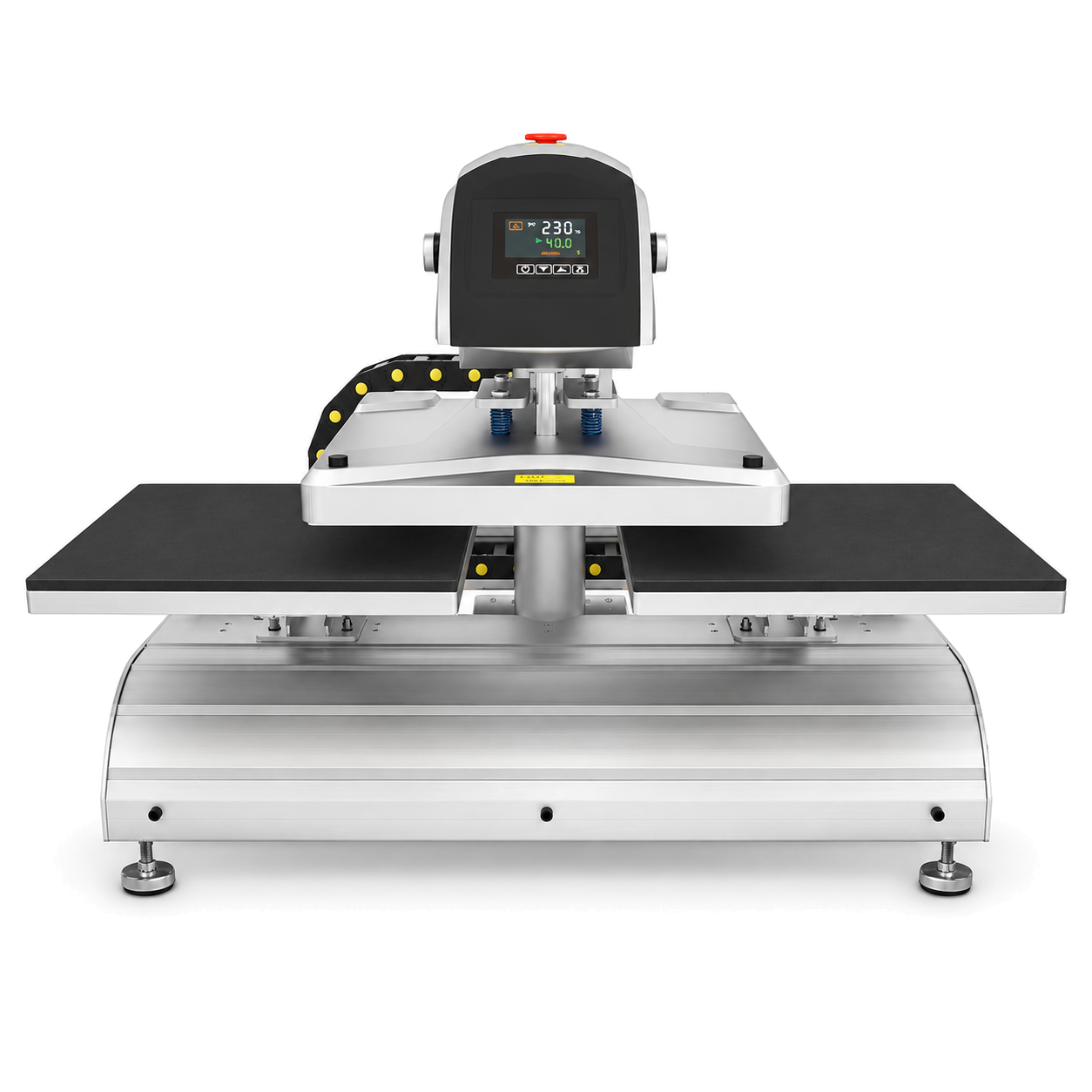
16 x 20 automatic electric dual platen press: higher throughput and overlapping load/press cycles.
Ask about voltage, plug type, lead time, and OEM or private-label options for your market. Those details affect installation and resale more than a headline speed number. The company's manufacturing background is worth reviewing before you shortlist.
Common mistakes
Most bad transfers trace back to a handful of avoidable choices.
Using one recipe for every transfer. HTV, DTF, sublimation, and screen-print transfers need different settings.
Setting pressure by feel. Without a recorded setting, the next operator starts from zero.
Skipping a temperature map. The display can be right at the sensor and wrong at the edge of the platen.
Testing on the wrong fabric. A stiff sample shirt hides problems that appear on soft blends and mesh.
No wash test. A transfer that looks good on the bench can fail after a few laundry cycles.
Buying for peak volume only. A machine that is oversized for daily work sits idle and takes up space.
Forgetting training. The same press gives different results when nobody agrees on load position and dwell time.
A sample run for each transfer type and a written setup sheet prevent most of these problems.
Frequently asked questions
Q1: What is a transfer heat press?
A1: It is a heat press used to bond a transfer to a substrate with heat, pressure, and dwell time. It can handle HTV, DTF, sublimation, and screen-print transfers, but each type needs its own settings.
Q2: Can one press handle HTV, DTF, and sublimation?
A2: Many flat presses can, as long as the temperature range and platen size fit the job. The settings are different, so keep a separate recipe for each transfer and fabric combination.
Q3: What pressure should a transfer heat press use?
A3: Enough pressure to bond the transfer without crushing the fabric or the transfer itself. The right setting depends on the transfer type, the fabric, and the platen. Test in small steps and record the result.
Q4: What platen size should I choose?
A4: A 16 x 20 inch platen covers most adult fronts and backs. A 15 x 15 inch platen suits smaller spaces and lighter work. Measure your largest common design and add a margin.
Q5: How do I check wash durability?
A5: Follow a recognized method such as ISO 105-C06, then wash a sample the way your customer will. A transfer that looks good on the bench can fail after a few cycles.
Request a machine recommendation
A useful inquiry includes more than a request for price. Tell the team what you press and how the work flows.
The transfer types you handle most often, such as HTV, DTF, sublimation, or screen-print transfers.
The fabrics you press, including cotton, polyester, blends, and fleece.
The largest transfer size you sell, in inches or centimeters.
Average and peak weekly volume, plus the number of operators per shift.
Available floor space, including the swing arc, loading table, and cooling area.
Voltage, plug type, destination, delivery date, and any OEM or private-label requirement.
Send those details to Heat Press Leader and ask for a comparison of two or three suitable models. The right transfer heat press is the one that fits your transfer mix, your fabrics, and your floor, not the one with the longest feature list.
Sources and further reading
Wikipedia: Heat press — a technical overview of the heat-press process.
ISO 12100:2010: Safety of machinery — General principles for design — Risk assessment and risk reduction — the basis for press hazard identification and risk reduction.
ISO 105-C06:2010: Textiles — Tests for colour fastness — Colour fastness to domestic and commercial laundering — a recognized wash-test method for transfer durability.


