High-volume manufacturing facilities and textile converters require equipment capable of delivering consistent thermal energy and mechanical load across expansive working envelopes. In production environments where throughput, dimensional stability, and dye penetration define product margins, the integration of a big heat press into the production line represents a pivotal operational milestone. Industrial heating equipment must transition from standard desktop dynamics to complex mechanical structures governed by structural rigidity, multi-zone thermodynamics, and uniform force distribution.
Modern production facilities demand cycle repeatability down to single-digit percentages in heat variance and pressure delivery. As an established machinery innovator, Heat Press Leader manufactures configurations capable of resolving typical manufacturing bottlenecks, moving past typical manual assembly constraints into high-tonnage, automated operations. Exploring the engineering foundations of these thermal machines reveals how structural design directly dictates final product quality across industrial textiles, composite materials, and rigid signage panels.

Transitioning from standard footprint formats to oversized working beds requires a fundamental rethinking of load-bearing architecture. A standard commercial press typically operates within dimensions up to 16 by 20 inches, relying on single-point pivot mechanisms or central lead screws. Conversely, heavy-duty machinery operates on surface footprints spanning 40 by 60 inches, 60 by 80 inches, and larger custom dimensions, requiring a completely distinct structural philosophy.
The bed and upper platen support structures undergo immense mechanical stress during the clamping phase. Welded heavy-gauge tubular steel and solid cold-rolled plate construction form the foundation of these assemblies. Structural deflection occurs when the central cylinder applies downward thrust while the outer extremities of the platen flex upward due to resistance from the lower bed. Industrial manufacturing dictates finite element analysis (FEA) during the drafting stage to ensure frame deflection remains under 0.05 millimeters per linear meter under full load.
Without sufficient chassis mass, the center of the bed receives adequate pressure while the perimeter suffers from pressure falloff, leading to faded dye transfer, incomplete adhesive activation, or partial composite lamination. Dual-plate gusseting, reinforced torque tubes, and normalized stress-relieved steel components prevent structural creep over millions of operating cycles.
Generating uniform pressure across a vast surface area requires powerful mechanical actuators. Depending on application requirements, facilities select between pneumatic and hydraulic driving systems.
Pneumatic Systems: Compressed air actuators operate cleanly and rapidly, making them suitable for activewear, light soft signage, and continuous garment decoration. They employ multi-cylinder designs to distribute force evenly across the upper platen assembly. Air accumulators stabilize pressure supply, preventing system drops during rapid cycle sequences.
Hydraulic Systems: For rigid panel transfer, high-pressure laminate consolidation, or heavy industrial felt processing, hydraulic circuits provide the elevated tonnage necessary to close microscopic surface gaps. Operating via closed-loop hydraulic power units (HPUs), these systems easily generate working forces exceeding 5 to 10 kilograms per square centimeter across thousands of square inches. Dual-proportional directional valves modulate ramp-up speeds, protecting delicate substrates from sudden impact shock.
Operating a big heat press for heavy textiles demands stable pressure delivery; engineers often implement multi-point electronic level sensing to monitor cylinder sync in real-time, preventing platen tilting during high-speed actuation.
Achieving uniform temperature across oversized working areas presents substantial engineering challenges. External edges radiate energy directly into ambient shop-floor air, creating natural thermal gradients where edges run cooler than the central core. Overcoming this physical behavior requires advanced heating element design and intelligent feedback loops.
Cast aluminum platens represent the standard choice for dye sublimation and general textile work due to aluminum's high thermal conductivity. Heating elements are cast directly into high-density aluminum alloy slabs, minimizing air gaps that cause localized hot spots. The thickness of these platens typically ranges from 35 to 50 millimeters, providing sufficient thermal mass to prevent sudden drops when cold substrates enter the work zone.
Drilled steel platens with continuous circulating hot oil (thermal fluid) or high-wattage cartridge heaters are deployed for ultra-high temperature applications, such as advanced composite curing or aerospace component forming. These platens undergo precision ground-finishing to achieve sub-millimeter flatness tolerances across the entire length and width of the assembly.
Single thermocouple feedback loops are inadequate for large surface heating. Operating zones are divided into modular grids, each monitored by isolated Resistance Temperature Detectors (RTDs) paired with independent Proportional-Integral-Derivative (PID) controllers. Maintaining edge-to-edge equilibrium across a big heat press requires precise zoned heating, where outer heating circuits run at higher duty cycles to offset ambient thermal radiation, while inner circuits cycle minimally to conserve power.
Solid-state relays (SSRs) or silicon-controlled rectifiers (SCRs) govern current delivery to the heating circuits. SCR controllers offer zero-crossing switching, eliminating electromagnetic interference and providing smooth, linear power output rather than basic on/off pulses. This technical approach guarantees thermal deviations remain within plus or minus 1.5 degrees Celsius across the complete operational plane.
Substrates processed on a big heat press range from flexible polyester knits to ultra-rigid aluminum sheeting, high-density fiberboards, and vulcanized rubber compounds. Material behaviors dictate specific operational parameters, cycle sequences, and handling mechanics.
Visual communications sectors deploy large format printing systems requiring matching post-processing equipment. Fabric tension displays, silicone edge graphics (SEG), trade show backdrops, and acoustic dampening panels require deep ink sublimation under precise heat and dwell times. Uneven heat across an 8-foot panoramic banner ruins entire graphics runs, causing visible color shifts across panel joints. Flatbed systems allow operators to press complex multi-layered banners without the dimensional distortion sometimes introduced by rotary calenders.
Chromaluxe-style aluminum photo panels and coated ceramic surfaces present high thermal mass and zero compressibility. Unlike textiles, which compress slightly to compensate for minor mechanical irregularities, rigid materials require micro-machined, flat platen surfaces and high-density, heat-resistant silicone or Nomex pads. Pad composition serves as a dynamic hydraulic equalization layer, distributing surface energy across micro-variations in substrate thickness.
Beyond traditional dye-sublimation print shops, heavy industrial sectors integrate flatbed thermal presses into composite production lines. Carbon-fiber pre-preg consolidation, ballistic plate pressing, interior automotive panel forming, and technical textile bonding rely on stable heat under pressure to induce resin cross-linking without material degradation.
Throughput optimization in industrial settings relies heavily on loading and unloading logistics. Machine downtime occurs primarily while waiting for operators to stage transfer papers, align substrates, and apply heat tapes. Machinery configurations focus on maximizing platen duty cycles via modular mechanical handling systems.
Dual Shuttle Beds: A single upper heating head operates between two alternating lower worktables. While Station A is actively cycling under the heat platen, operators unload and prep the next job on Station B. Integrated electric drive motors cycle the beds horizontally along heavy-duty linear guide rails, tripling output capacity compared to static configurations.
Roll-to-Plate Configurations: Some systems integrate motorized roll unwinds at the staging end and rewinds at the discharge end. This setup allows continuous fabric rolls to index through the flatbed press sequentially for large orders of modular banners or repeatable parts.
Automated Drawer Platens: For installations with limited facility footprints, motorized slide-out drawer designs allow unobstructed overhead access via overhead cranes or robotic pick-and-place arms, facilitating the loading of thick, dense sheets.
To eliminate manual labor and mechanical wear, engineering teams at Heat Press Leader prioritize heavy-duty structural frames, linear motion guides, and heavy-load capacity bearings capable of withstanding hundreds of kilograms of substrate weight without binding.
Consistent output from industrial press machinery requires systematic maintenance procedures focused on mechanical alignment, thermal calibration, and fluid maintenance.
Mechanical assemblies drift over prolonged usage due to thermal cycling and heavy vibrational forces. Technicians verify platen parallelism periodically using high-precision digital load cells distributed at multi-point grid intersections across the lower bed. Alternatively, thermal imaging cameras verify that internal resistance coils continue to distribute energy evenly without localized element failure.
Air filtration systems require regular inspection to keep particulate and moisture away from high-speed proportional valves and cylinders. On hydraulic equipment, oil clarity, viscosity, and operating temperatures must align with ISO cleanliness codes. Hydraulic seals require regular inspection to avoid gradual pressure loss during long dwell cycles.
Teflon coatings, release sheets, silicone sponge layers, and high-temperature felt underlays experience material fatigue. Degradation of lower silicone pads introduces uneven density zones that compromise transfer quality. Establishing strict preventative maintenance intervals ensures operational consistency and prevents unplanned downtime during peak shifts.
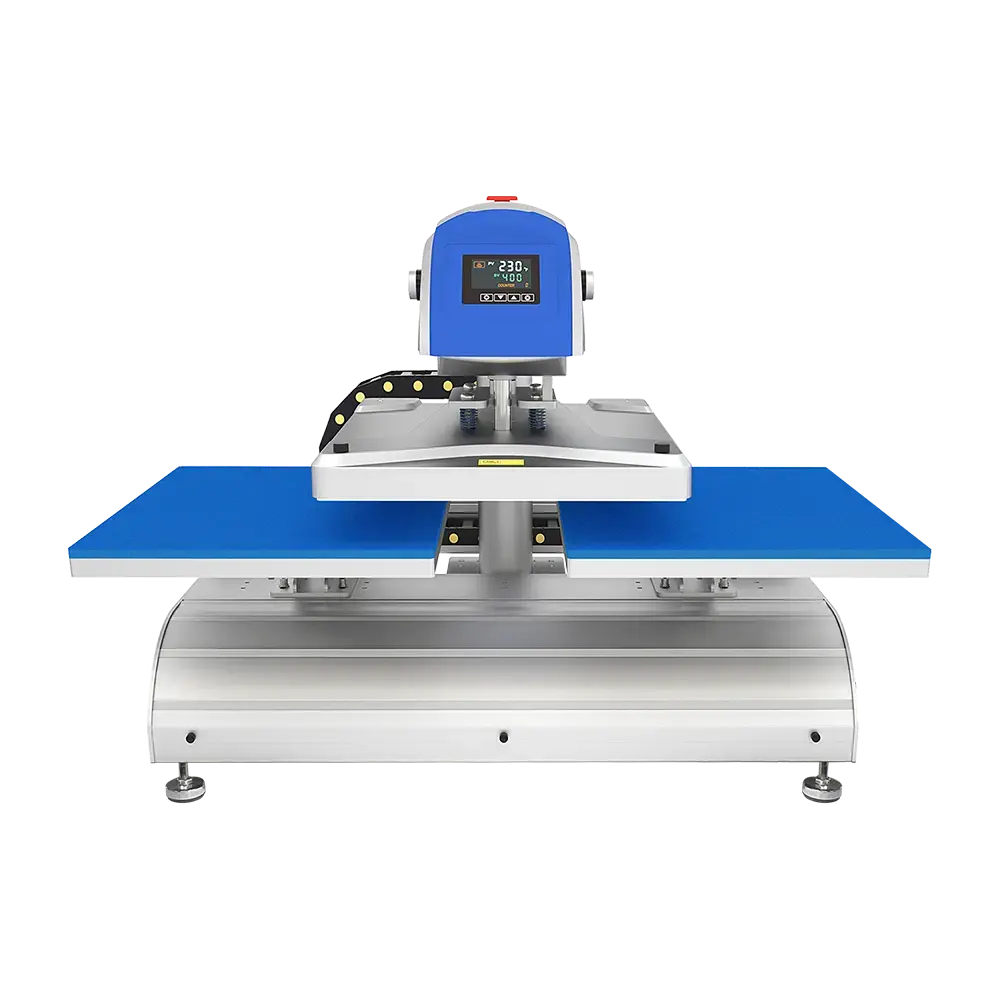
Rotary calenders excel at roll-to-roll production of continuous, flexible polyester fabrics at rapid throughput. Flatbed systems provide precise control over dwell time, temperature, and high-tonnage pressure on rigid, thick, or precut materials like hardboard, metal panels, sports jersey blanks, and multi-layered technical textiles that cannot feed through a continuous drum mechanism.
Due to the massive thermal mass of oversized platens, these systems typically run on three-phase industrial power (208V, 240V, 380V, or 480V, depending on region). Power requirements range from 12 kW up to 45 kW or more on larger multi-zone systems. Facilities must have properly rated distribution panels and dedicated breakers to accommodate the heavy continuous amp draw during heating phases.
Ghosting occurs when transfer paper shifts against the substrate while the material is still releasing gas, typically during platen opening. On large platens, rapid opening creates a suction effect that lifts the paper. Industrial presses resolve this using dual-stage pneumatic release valves, which open the platen slowly for the first few millimeters to normalize ambient air pressure before accelerating upward.
Standard machines generally accommodate material thicknesses from thin films up to 50 millimeters. Heavily customized hydraulic systems feature adjustable daylight openings that expand from 100 millimeters to 300 millimeters or more, managed via motorized lead screws, allowing operators to accommodate thick composite blocks, structural wood cores, or thick acoustic architectural baffles.
Thicker platens have higher thermal mass, requiring longer initial warm-up periods at the start of a shift. Once up to temperature, thick aluminum holds thermal energy steady, preventing the temperature drops that happen when cold substrates are introduced. This thermal stability reduces cycle times and maintains consistent color quality during nonstop production runs.
Selecting and deploying the right machinery determines long-term production profitability, operating reliability, and process throughput. Whether configuring a high-tonnage hydraulic platen for industrial laminating or integrating an automated dual-shuttle layout for textile dye-sublimation, procuring a custom-engineered big heat press requires alignment on technical tolerances, cycle times, and substrate dynamics.
Detailed engineering evaluation ensures mechanical specifications align with precise factory requirements. Consulting with engineering specialists at Heat Press Leader ensures that your machinery meets structural tolerances, electrical infrastructure parameters, and floor-plan configurations. For detailed equipment specifications, custom platen dimensions, and comprehensive commercial proposals, submit an engineering inquiry detailing your substrate dimensions, daily volume requirements, and material classifications.