
Every print shop owner knows the frustration of inconsistent transfers. Cold spots on a platen ruin expensive garments. Uneven pressure produces ghosted sublimation prints. Cheap equipment leads to high scrap rates and wasted labor.
When your production scales, standard hobby presses become bottlenecks. Commercial apparel decorators, promotional product suppliers, and machinery distributors require heavy-duty performance. Sourcing an industrial swing heat press directly from an OEM factory bridges the gap between high reliability and healthy profit margins.
At Heat Press Leader, we manufacture professional heat transfer equipment built to handle rigorous shift work. If you are preparing to scale your current capacity or expand your branded product line, contact our OEM team today for direct manufacturing quotes and technical specifications.
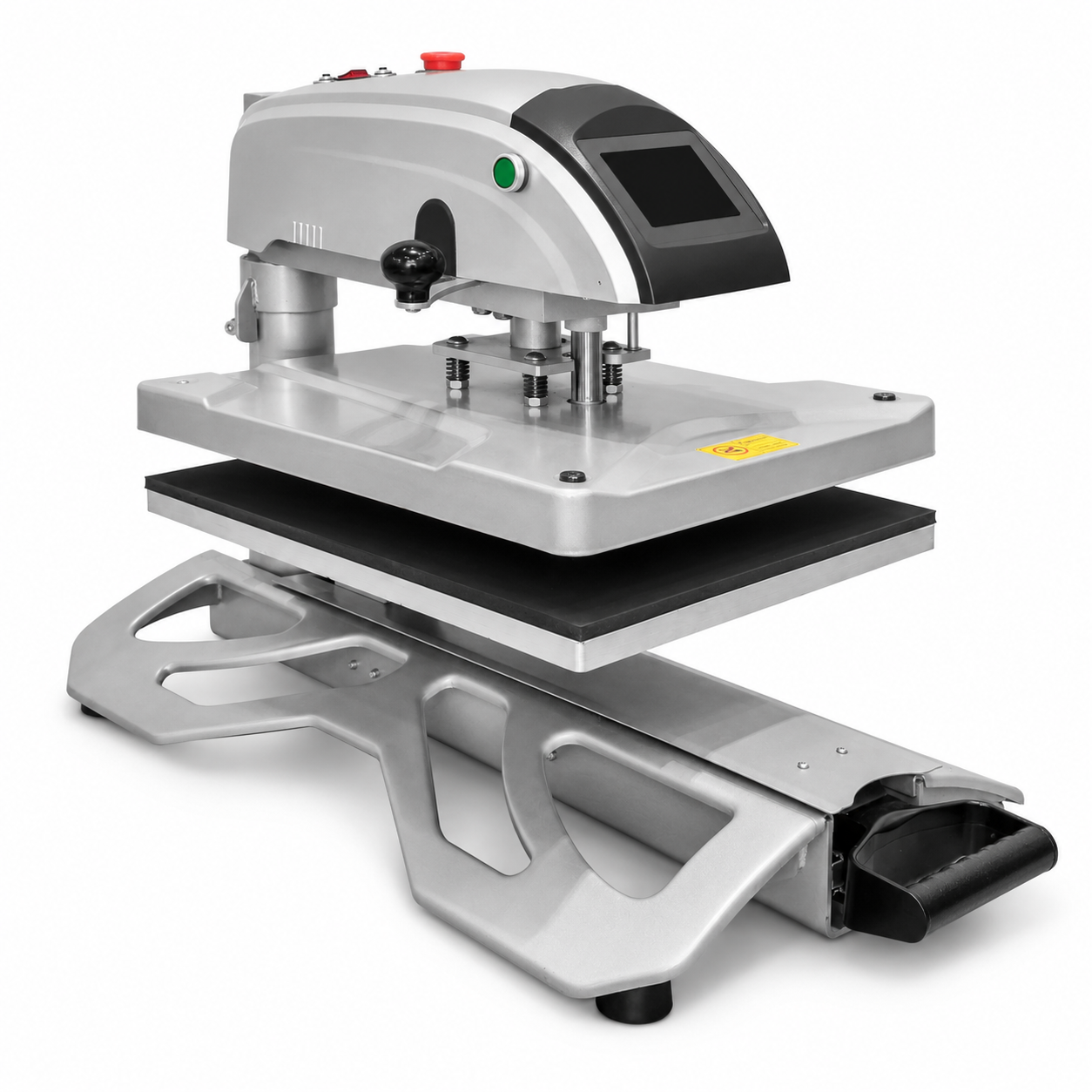
Apparel decorators and transfer specialists frequently debate between clamshell and swing-away designs. While clamshell units save counter space, a swing-away heat press remains the industry benchmark for commercial durability and application consistency.
A clamshell closes at an angle, like a jaw. This scissor action can push transfers forward or apply unequal force between the front and back of the platen. In contrast, a swing heat press drops the heating element straight down in a true perpendicular line.
This vertical approach distributes mechanical force evenly across the entire working surface. It eliminates shifting when pressing thicker substrates such as heavyweight fleece, hoodies, ceramic tiles, and aluminum sign blanks.
Accidental burns slow down production and create shop hazards. With a swing-away mechanism, the operator rotates the heated top platen 180 to 360 degrees out of the work zone.
This creates a clear, heat-free workspace over the lower platen. Workers can inspect their transfer alignment from directly above without hovering their arms under a 400°F metal plate. Precise placement reduces alignment errors and improves workplace ergonomics.
Modern print houses rarely rely on a single process. A commercial swing heat press handles a diverse range of modern garment decoration techniques:
Direct-to-Film (DTF): Requires stable, even contact to melt powder adhesive without crushing garment fibers.
Dye Sublimation: Demands uniform, edge-to-edge heat to prevent blurred lines and uneven color density on polyester and rigid blanks.
Heat Transfer Vinyl (HTV) and Screen-Printed Transfers: Demands firm pressure to bond plastisol or polyurethane adhesives deep into textiles.
Procuring an OEM machine requires a deeper inspection than retail buying. You must analyze the core engineering choices that separate disposable hobby gear from industrial machinery.
The heating platen is the core engine of your press. Insist on platens made of dense, die-cast aluminum with closely spaced, serpentine-pattern heating elements. Cheap platens leave wide gaps between heating wires, causing cold perimeters.
Look for commercial-grade platens with a thickness of at least 0.75 inches (19mm). Thicker platens retain heat during high-volume production cycles. They should maintain temperature variations within ±3°C across the entire surface.
Structural flexing ruins transfer consistency. High pressure forces thin sheet-metal frames to bow slightly, which concentrates force in the center while leaving edges loose. A proper industrial heat transfer machine utilizes reinforced structural steel and heavy-gauge tubular uprights.
Examine the central pressure spindle. Heavy-duty pivot points and acme-threaded adjustment rods ensure smooth adjustments without stripping under intense, repeated mechanical loads.
Modern transfer adhesives require strict temperature windows. Mechanical thermostats fluctuate too wildly for professional output. Choose machines equipped with digital microprocessors and solid-state relays (SSR).
Digital controllers monitor real-time thermal recovery and trigger heat bursts instantly when cold garments touch the platen. According to equipment testing standards published by organizations like Underwriters Laboratories (UL), solid-state electronics minimize arcing and extend the working lifespan of thermal machinery.
Platen dimensions dictate your product range:
15" x 15" (38 x 38 cm): Well-suited for standard chest prints, tote bags, and compact shop footprints.
16" x 20" (40 x 50 cm): The gold standard for commercial apparel. It easily accommodates adult XL graphics, sports jerseys, and all-over tote prints.
Oversized and Custom: Large-format units designed for specialized production lines like banners, cut-and-sew panels, and multi-piece gang sheets.
Electrical safety is non-negotiable for commercial shops and distributors importing equipment. Ensure your OEM supplier manufactures in compliance with global standards, including CE, RoHS, and FCC marks. Grounding wiring, high-temperature silicone wiring sleeves, and easily accessible emergency stop switches are mandatory baseline features.
Partnering with an OEM heat press manufacturer is a long-term business commitment. Equipment distributors and growing apparel brands need an engineering partner, not just a middleman.
A true OEM/ODM provider can adapt machinery to your market requirements. Look for manufacturers that provide complete private-label programs, including custom powder-coat color schemes, laser-cut branding, bespoke user interface software, and tailored lower platen quick-swap systems.
Engineering teams at Heat Press Leader work directly with brands to configure platen profiles, custom base plates, and branded digital displays to match distinct regional needs.
Clarify production capacity and order minimums early. A flexible manufacturer accommodates test runs for product evaluation while maintaining the factory tooling capacity to manufacture full container loads (FCL) on tight delivery timelines.
High-volume scrap rates ruin profit margins. Request clear documentation on the factory's quality assurance process. Industry guidance from the PRINTING United Alliance emphasizes that standardized machine calibration directly prevents transfer failure.
Every commercial machine should undergo:
A 48-hour continuous electrical burn-in test to expose faulty wiring or heating elements.
Multi-point infrared thermal mapping to confirm balanced heat dispersion.
Laser level testing on lower and upper platens to ensure flat, uniform contact.
Downtime drains cash flow. Ensure your custom heat press supplier stocks critical consumable parts, such as gas struts, digital control boards, silicone base pads, and solid-state relays. Verify their warranty terms: an industrial platen should come with a multi-year coverage commitment.
To invest capital wisely, analyze how each design aligns with your floor space, application variety, and production pace.
| Feature | Swing-Away Heat Press | Clamshell Heat Press |
|---|---|---|
| Platen Movement | Lifts and swings laterally 180°–360° | Opens upward on a fixed rear hinge |
| Pressure Distribution | Completely uniform, vertical force | Higher pressure at the hinge, lower at the front edge |
| Substrate Thickness | Supports thick items (hoodies, signs, plaques) | Best for thin garments; struggles with thick blanks |
| Floor / Bench Space | Requires side clearance to swing the head | Compact; fits tight counters and production vans |
| Safety / Burn Prevention | High: hands stay far from the heat platen | Moderate: hands work directly beneath the hot plate |
| Cycle Speed | Moderate: requires swinging the arm back and forth | Fast: quick pull-down and push-up motion |
Choose a swing heat press if you regularly print diverse substrates, handle thick winter wear, or focus on zero-tolerance transfer methods like DTF and dye sublimation. If you run a mobile live-printing booth in tight quarters or produce simple flat t-shirts exclusively, a clamshell remains an acceptable alternative.
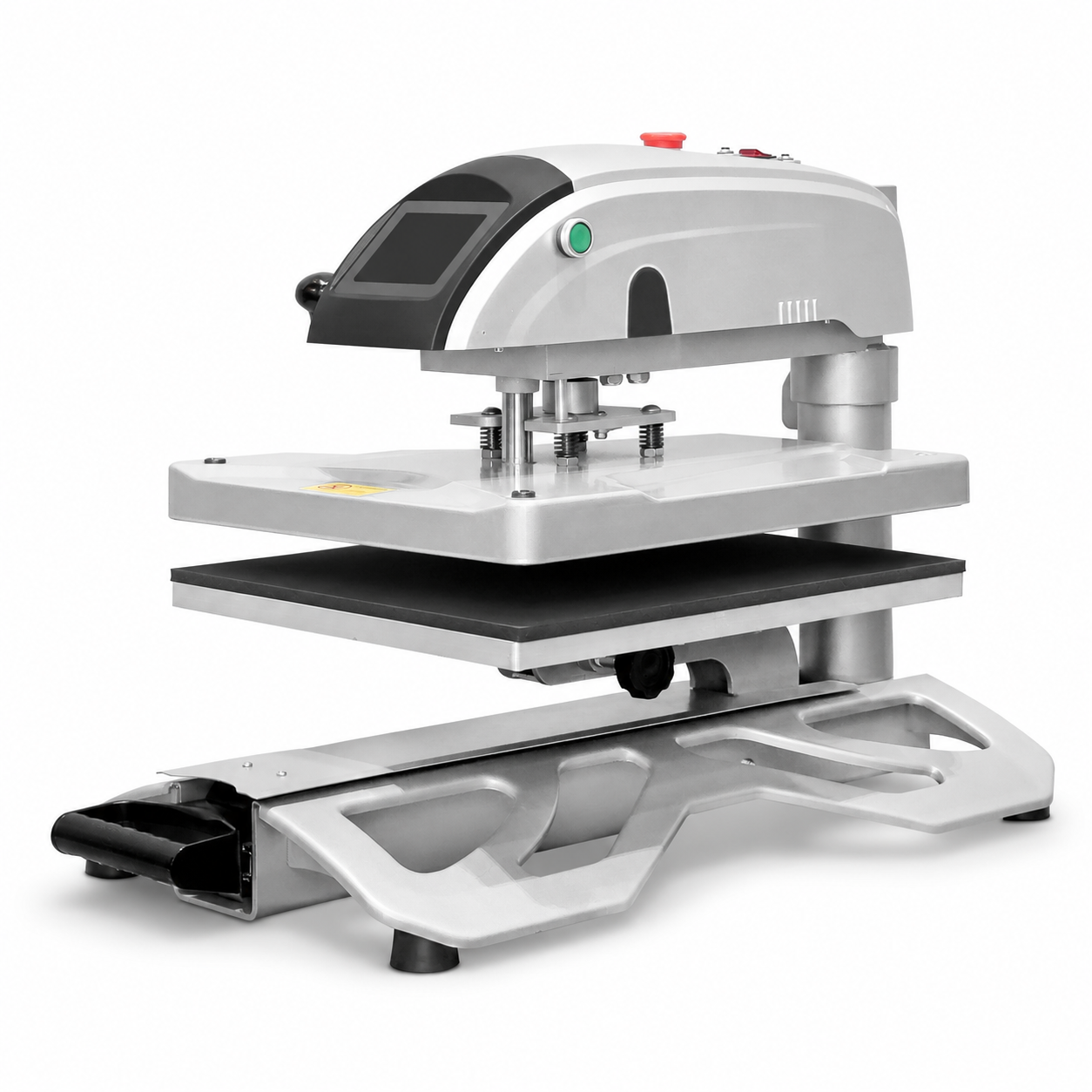
A machine is only as valuable as the revenue it generates. Maximizing your return on an industrial heat transfer machine requires a balanced approach to procurement, preventative maintenance, and line efficiency.
Sourcing your hardware directly from an experienced OEM factory eliminates the multi-tier markup charged by retail brands. This lower capital entry cost lets you upgrade to heavy-duty engineering without draining operating capital.
Keep your equipment running efficiently with these straightforward maintenance habits:
Clean Platens Regularly: Remove adhesive residues and ink deposits using a non-abrasive platen cleaner while the machine is warm.
Lubricate Pivot Points: Apply high-temperature white lithium grease to the swing arm spindle and pressure screws every month.
Inspect the Silicone Pad: Replace the lower rubber pad if it shows pits, depressions, or hardening, as uneven pads cause transfer dropouts.
Q1: Why is my swing heat press producing faded edges on sublimation
transfers?
A1: Faded edges usually stem from cold
perimeter edges on a thin platen, or insufficient downward pressure. Ensure your
platen has a perimeter heating loop, or increase pressure to maintain full
contact across your substrate.
Q2: How much clearance does a swing-away heat press
require?
A2: Because the upper platen pivots out to
the side, you generally need an operating area that is at least double the width
of the machine frame. A 16" x 20" press typically requires a counter surface 35
to 40 inches wide.
Q3: What electrical capacity does a commercial swing-away machine
need?
A3: Most commercial 15" x 15" and 16" x 20"
units draw between 1,400 and 1,800 watts. In North America, this requires a
dedicated 15-amp or 20-amp, 110V/120V circuit. Outside North America, 220V/240V
circuits are standard and draw lower amperage.
Q4: Can a swing heat press handle automatic high-speed
production?
A4: Standard models are manual, but
many industrial operations use pneumatic swing heat presses. Pneumatic units use
air compressors to swing, press, and release automatically via push-button or
foot-pedal controls, eliminating operator fatigue.
Q5: Can Heat Press Leader customize heat presses with our brand
identity?
A5: Yes. We provide end-to-end OEM and
ODM support. We handle customized metal framing, specific platen dimensions,
branded digital controller interfaces, custom paint colors, and retail-ready
packaging designed for international shipping.
Selecting the right machinery supplier sets the foundation for your print business. A properly built swing heat press reduces scrap, improves print quality, and keeps your production schedules running smoothly day after day.
At Heat Press Leader, our engineers build durable, high-precision thermal transfer machines for commercial shops, distributors, and global brands. Whether you need a standard commercial model or a full private-label manufacturing run, we deliver the structural quality your business demands.
Ready to upgrade your production or launch your own branded line? Contact our technical sales team now to request a tailored quote, review our manufacturing minimums, and receive our full commercial product catalog.


