A commercial heat press machine does more than apply heat and pressure to a transfer.
In daily apparel production, the operator repeatedly loads garments, positions artwork, starts a pressing cycle, removes the product, completes peeling or re-pressing when required, and prepares the next item. The efficiency of these actions can be just as important as the technical specifications of the heating platen.
This is why two heat presses with similar platen sizes can perform very differently in a real workshop.
One machine may require more manual movement. Another may provide a pull-out drawer or swing-away structure that improves loading access. A dual-station design can allow garment preparation to continue during pressing. Interchangeable platens can make sleeves, bags, labels, patches, and other applications easier to handle.
For commercial users, machine selection should therefore consider how the equipment works with the operator, not only what appears on the specification sheet.
A practical commercial heat press machine should combine appropriate heat and pressure control with an efficient loading method, suitable platen configuration, repeatable controls, and a workflow that matches the products being produced. Higher automation is useful only when it removes a real production constraint.
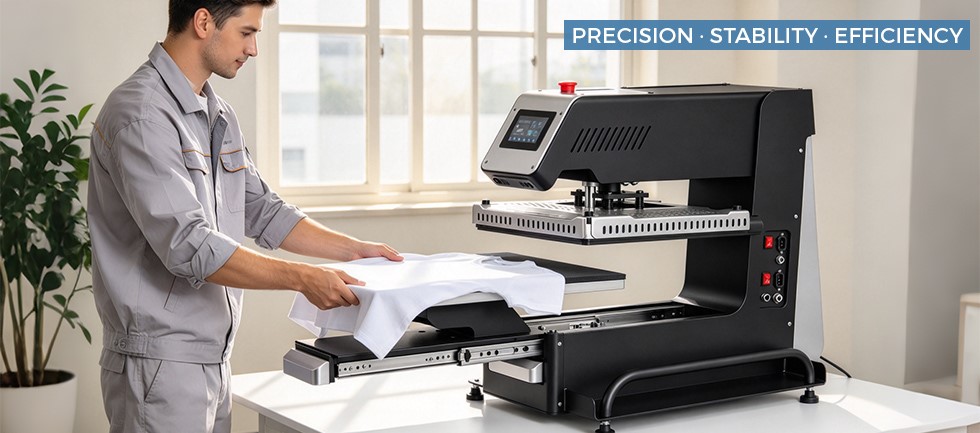
A commercial heat press needs to perform the same process repeatedly throughout the working day.
That means buyers should look beyond maximum temperature or maximum pressure and evaluate whether the machine supports a stable operating routine.
Important considerations include:
· How easily the garment can be loaded;
· How clearly the transfer can be positioned;
· Whether the lower platen can accommodate the product;
· How the press opens and closes;
· How pressure and temperature are adjusted;
· Whether operators can save or repeat settings;
· How quickly different products can be changed;
· How safely and comfortably the operator can access the work area.
For occasional projects, a few extra seconds of handling may not matter.
In commercial production, the same extra movement repeated hundreds of times becomes part of labor cost and production capacity.
This makes machine ergonomics and workflow design important commercial factors.
Consider two machines with similar working areas and heating capability.
The first requires the operator to reach beneath the upper platen to arrange every garment.
The second uses a slide-out loading area that allows the garment to be prepared in a more accessible position.
The specification tables may appear similar, but the operator experience is different.
Commercial heat press workflow can be divided into several steps:
Garment Loading → Transfer Positioning → Pressing → Unloading → Peeling / Finishing → Next Product
The machine affects several of these steps directly.
For example, the Flex AutoPress I B2-N combines electric operation with a swing-away and pull-out drawer arrangement. The catalogue also identifies a threadable lower platen and interchangeable platen system, allowing garments and different product areas to be positioned in different ways.
These features matter because the heat press is not operating alone. It is part of an operator workstation.
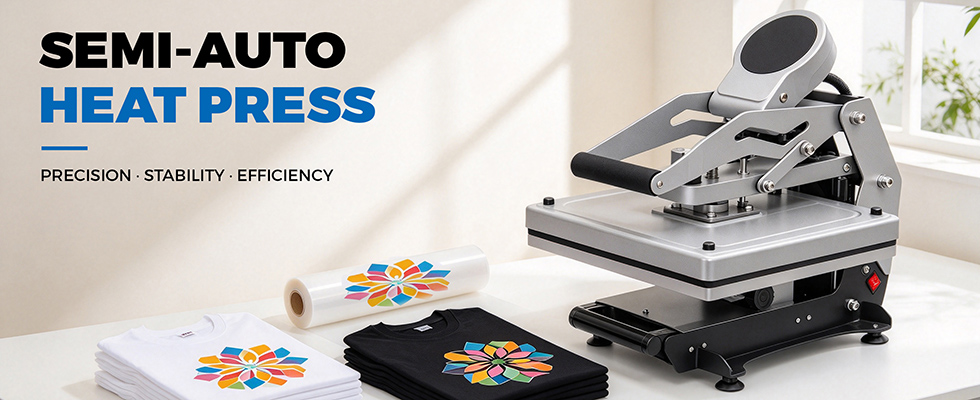
The heating platen receives most of the attention when buyers compare machines, but the lower platen and loading structure strongly influence daily usability.
A threadable platen allows part of the garment to slide over the platen rather than placing multiple fabric layers between the upper and lower surfaces.
This can simplify positioning for certain garments and help the operator isolate the transfer area.
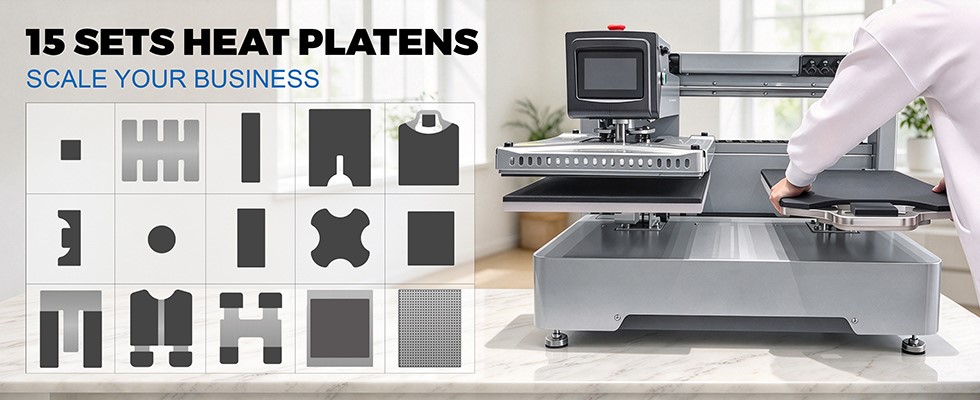
Standard T-shirts may work well on a full-size platen, but commercial decorators often produce more than shirts.
Typical applications may include:
· Sleeves;
· Bags;
· Labels;
· Patches;
· Smaller garment areas;
· Specialty products.
A quick-change platen system allows the heat press to adapt to these applications without requiring a completely separate machine for every product category.
The XINHONG catalogue lists interchangeable platen options across several commercial heat press platforms, including the B2-N, B2-2N and MATE450 series.
Loading method also affects operator movement.
A pull-out drawer moves the garment preparation area away from the upper heating platen. A swing-away arrangement moves the upper assembly away from the loading area.
The practical question is not simply:
Which structure is better?
It is:
Which structure makes loading and positioning easier for the products your team handles every day?
One of the biggest workflow differences in commercial heat pressing is the number of working stations.
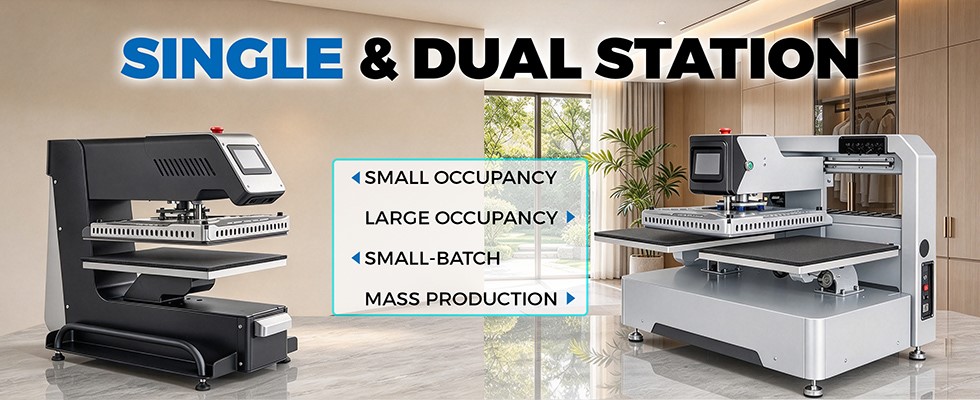
A single-station machine can be highly practical when:
· Product types change frequently;
· Batch sizes are relatively small;
· One operator handles the complete process;
· Floor space is limited;
· Flexibility matters more than continuous loading.
For many commercial printing businesses, this is enough.
A dual-station heat press changes the operator sequence.
While one garment is being pressed, another can be loaded and positioned on the second station.
The process becomes:
Station A: Pressing
at the same time as:
Station B: Loading and Positioning
The Cyber Auto Press II MATE450-2E uses this type of dual-station fully electric arrangement. Its catalogue-listed features include laser positioning, touchscreen control, real-time pressure feedback, interchangeable platens, and operation without an external air compressor.
The Flex AutoPress II B2-2N also uses twin lower platens and an electric drive system, with interchangeable platens and selectable operating modes.
Not necessarily.
The machine removes some waiting between pressing cycles, but total output still depends on:
· Garment loading;
· Transfer preparation;
· Operator speed;
· Peeling;
· Re-pressing;
· Inspection;
· Packaging.
Dual stations are most useful when the pressing cycle is one of the main causes of operator idle time.
Drive system is another important equipment decision.
Electric and pneumatic heat presses can both support commercial production, but their installation and operating environments differ.
Electric systems use motor-driven mechanisms for pressing or platen movement.
Depending on the model, this can provide:
· Automatic pressing cycles;
· No requirement for an external air compressor;
· Reduced compressor-related noise;
· Digital pressure adjustment or feedback;
· Easier installation in workshops without compressed-air infrastructure.
For example, the MATE450-E and MATE450-2E are fully electric platforms, while the B2-N and B2-2N use electric motor operation.
A pneumatic heat press uses compressed air to drive pressing movement.
It may be practical when:
· The factory already operates a central compressor;
· Pneumatic equipment is already part of the production line;
· Technical staff are familiar with pneumatic maintenance;
· Air supply is readily available at the workstation.
The question should not be whether electric or pneumatic is universally better.
Buyers should compare installation requirements, maintenance resources, operating environment, production workflow, and utility availability.
Commercial production requires repeatability.
A good transfer produced once is not enough. The same process needs to be repeated across many garments and potentially across different operators.
Control systems can help standardize that process.
Depending on the machine, useful functions may include:
· Temperature control;
· Time control;
· Pressure adjustment;
· Saved operating settings;
· Multiple timing stages;
· Pressure feedback;
· Touchscreen workflow control.
The MATE450-E and MATE450-2E catalogue specifications include real-time pressure feedback and touchscreen control. The HP3804D-3 includes multi-timer functions designed to manage different stages of the transfer process.
Artwork positioning can also influence consistency.
Laser alignment does not replace operator judgement, but it can provide a visible reference for repeated positioning.
This can be useful when:
· Logo position needs to remain consistent;
· Many garments use the same artwork placement;
· Different operators work on the same order;
· Repeated alignment errors create rework.
The value of these tools is not that they make every job automatic. Their purpose is to reduce avoidable variation in repetitive production.
There is no single platen or machine layout that is ideal for every heat transfer application.
Standard apparel production generally benefits from easy loading, adequate working area, stable pressure, and straightforward positioning.
DTF production may include:
Pre-Press → Transfer Positioning → Main Press → Peel → Re-Press
As volume increases, workflow between these stages becomes increasingly important.
Smaller transfer areas may benefit from dedicated platen sizes that allow the product to sit more naturally on the working surface.
Seams, zippers, edges, and product construction may make standard flat loading less convenient. Platen flexibility becomes more important.
The correct equipment choice therefore starts with the physical product, not only the transfer technology.
At higher volume, machine selection changes again.
The problem may no longer be the performance of an individual heat press. It may be the number of manual steps surrounding it.
A DTF production line can involve:
· Feeding garments;
· Positioning transfers;
· Pre-pressing;
· Main pressing;
· Peeling;
· Re-pressing;
· Unloading.
If operators repeatedly move products between independent workstations, adding another standalone heat press may increase equipment capacity without solving the coordination problem.
This is where multi-station systems become relevant.
The Nexon Carousel IV range is designed around coordinated heat transfer workflows. Catalogue configurations include functions such as garment detection, positioning assistance, pressing, peeling, re-pressing, and station control, depending on the model.
For XH, this represents a shift from evaluating machine performance to evaluating production flow.
A multi-station system should therefore be considered only when the workload is stable enough to keep those stations productive.
Before replacing or upgrading a heat press, collect data from the existing workstation.
Useful measurements include:
· Garment loading time;
· Artwork positioning time;
· Press cycle time;
· Operator waiting time;
· Peeling time;
· Re-pressing time;
· Platen changeover time;
· Rework frequency;
· Number of completed pieces waiting for the next process;
· Finished orders per hour.
This data helps distinguish a machine bottleneck from a workflow bottleneck.
For example, if the press is idle while the operator prepares transfers, a faster heat press may provide little improvement.
If the operator is waiting during every pressing cycle, a dual-station layout may provide more value.
If several presses are operating but garments accumulate during peeling or re-pressing, the business may need workflow integration rather than another standalone machine.
More pressure is not automatically better. The required pressure depends on the transfer material and application.
A fully automatic machine is not automatically more productive if the surrounding workflow cannot supply garments quickly enough.
The way a garment enters the press can affect daily usability as much as platen size.
Specialty products may require smaller or differently shaped platens.
They reduce waiting but cannot remove bottlenecks in printing, peeling, inspection, or packaging.
Electrical supply, compressed air, footprint, service space, and operator access should be checked before purchase.
XH focuses on commercial heat press equipment designed around practical heat transfer workflows.
The product range includes equipment with different operating structures and levels of automation, including:
· Semi-automatic heat presses;
· Fully electric single-station presses;
· Electric and pneumatic configurations;
· Dual-station heat presses;
· Cap heat presses;
· Interchangeable platen systems;
· Alignment and workflow accessories;
· Multi-station heat transfer automation.
Rather than evaluating a machine only by its maximum specifications, XH places emphasis on how equipment design affects loading, positioning, pressing, changeover, operator movement, and continuous production.
This equipment-focused approach helps buyers compare machines according to the tasks they need to perform every day.
Commercial heat press equipment should support frequent operation, repeatable settings, practical loading, suitable platen options, and a workflow that matches regular business production.
No. Dual stations provide the most value when operators can prepare the next garment during the pressing cycle. Small batches and frequent product changes may favor a single-station setup.
An electric system can automate pressing movement without requiring an external air compressor. The practical benefit depends on the machine design and production environment.
Different platen sizes and shapes can improve loading for sleeves, labels, patches, bags, and specialty products that do not fit naturally on a standard T-shirt platen.
Not for every job. It can be useful for repetitive artwork placement where consistent positioning is important.
A multi-station carousel system becomes relevant when production volume is high enough that feeding, positioning, pressing, peeling, re-pressing, and unloading need to be coordinated rather than handled as separate manual steps.
Measure loading time, positioning time, press cycle time, operator waiting, peeling, re-pressing, product changeover, and downstream delays. Upgrade the stage that is creating the largest measurable constraint.
Selecting a commercial heat press machine requires more than comparing specifications.
The equipment becomes part of a repeated production sequence involving garment loading, positioning, pressing, unloading, and finishing.
A practical single-station press can provide flexibility for varied commercial orders.
An electric system can reduce repetitive manual movement and remove the need for an external compressor.
A dual-station heat press can allow garment preparation and pressing to happen at the same time.
Interchangeable platens can extend the same platform to different product shapes and transfer areas.
Digital controls, pressure feedback, and positioning assistance can improve repeatability when they address real production needs.
At higher volume, multi-station automation can coordinate processes that are difficult to manage efficiently with individual machines.
For XH, the right heat press is not simply the machine with the most features. It is the machine whose structure, controls, loading method, platen configuration, and operating workflow fit the job being performed every day.
Before selecting equipment, identify:
· What products you press;
· How operators load them;
· Where positioning time is lost;
· Which applications require different platens;
· Whether the operator waits during the pressing cycle;
· Whether electric or pneumatic infrastructure is available;
· Which step currently limits finished output.
Suggested CTA Button:
Find the Right Heat Press Configuration


