Mass production in heat transfer printing requires sheer platen surface, thermal uniformity, and heavy clamping force. When a shop outgrows standard 16" x 20" clamshell units, operations quickly stall without industrial-grade equipment. Investing in a commercial large heat press machine changes operational capacity completely, shifting your business from piecemeal customization to serious volume manufacturing.
Modern print houses face expanding demands: all-over dye sublimation jerseys, architectural soft signage, oversized aluminum panels, and high-density DTF (Direct-to-Film) gang sheets. Achieving consistent, sellable transfers across these wide footprints requires uncompromising machine design. At Heat Press Leader, testing and engineering industrial-scale presses reveals a simple truth: platen mass, continuous pressure, and precision temperature regulation dictate your true profit margin.
This technical guide evaluates the best large heat press machines on the market. We break down the mechanical realities of heavy-duty presses, examine core engineering requirements, and detail the equipment that yields reliable commercial throughput.
Many desktop presses market themselves as "commercial," yet true industrial machinery lives in a different category. Once surface dimensions scale up, physics creates substantial manufacturing hurdles that consumer-grade parts cannot survive.
The transition to a genuine large heat press machine begins when platen dimensions exceed 24" x 30". Below this line, standard cantilever clamshells or manual swing-away frames function adequately. Once a platen hits 32" x 40", 40" x 48", or larger, mechanical demands spike drastically.
These dimensions are not arbitrary. A 32" x 40" platen matches standard cut-and-sew garment panels, cut flags, and medium signage boards. A 40" x 48" or 40" x 60" bed accommodates oversized fabric widths, Chromaluxe aluminum panels, and full apparel runs pressed in a single strike. At these dimensions, equipment weights routinely surpass 1,500 pounds to prevent metal fatigue.
Deploying a wide-format press supports multiple high-margin applications:
All-Over Dye Sublimation: Cut panels for sportswear, cycling jerseys, and streetwear require uninterrupted heat to prevent ghosting lines.
Soft Signage and Trade Show Displays: Silicone edge graphics (SEG), table throws, and trade show banners need long, flat presses to lock in deep colors.
High-Batch DTF Transfers: Instead of pressing one shirt at a time, operators lay out full-width gang sheets containing dozens of designs across multiple garments simultaneously.
Rigid Substrates: Imprinting ChromaLuxe metal photo panels, dense hardboard, or custom ceramic tiles demands completely flat heat beds.
You cannot operate an industrial-format press by pulling down a manual lever. The mechanical leverage required to exert 40 to 80 PSI across a 1,200-square-inch platen would snap standard manual hinges or exhaust any operator within minutes.
Industrial machinery relies entirely on fluid power. Pneumatic systems harness compressed air for rapid, repeatable movement, ideal for textile manufacturing. Hydraulic systems utilize pressurized oil to generate intense downward force, which is mandatory when bonding rigid substrates or thick laminations where structural density demands extraordinary pressure.
When selecting a large heat press machine , evaluating the exterior frame is not enough. You must look into the electrical, pneumatic, and structural design. Weak engineering here leads to uneven colors, peeling transfers, and wasted substrate inventory.
The primary point of failure in poorly built large platens is pressure drop-off at the perimeter. Physics dictates that force applied from a single central point naturally dissipates as it reaches the corners, causing dull sublimations and under-cured adhesives along the outer edges.
Heavy-duty machines counter this by using multi-cylinder pneumatic arrays or center-mounted self-leveling mechanical yokes. Splitting actuation across two or four pneumatic cylinders distributes direct, perpendicular tonnage across every square inch. Rigid structural ribs behind the platen resist deflections under maximum loads.
Surface heat variance ruins long production runs. Standard small presses use simple wire heating loops laid beneath an aluminum sheet, often showing hot and cold swings of 15°F or more. On an oversized transfer, that differential causes spotty color vibrancy.
A professional large heat press machine utilizes cast-in tubular heating elements. Molten aluminum is cast directly around dense heating coils, eliminating air gaps and turning the entire upper assembly into a massive heat sink. Look for multi-zone PID temperature controllers that measure heat across independent zones (such as outer perimeter vs. center). This keeps edge-to-edge variance within a strict ±3°F tolerance window.
Downtime ruins shop efficiency. When operating a single-bed stationary press, the operator waits through the entire press cycle (30 to 60 seconds) before loading the next item. The machine sits idle during alignment, taping, and unloading.
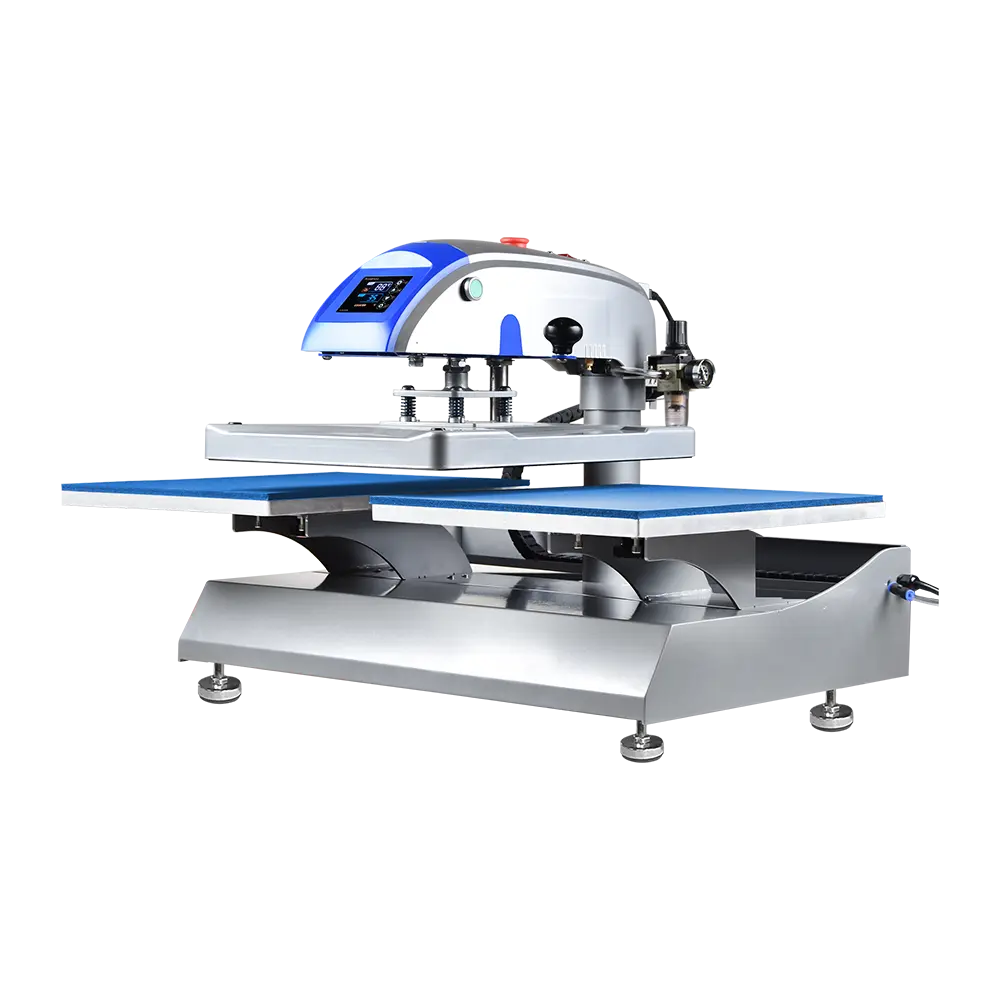
Dual shuttle designs solve this bottleneck completely. While one station cycles under the hot platen, the operator works on the second tray outside the heat zone, completely unencumbered. Once the cycle finishes, the head swings or the shuttle shifts automatically. This setup cuts labor downtime by 50% and dramatically doubles daily output.
Before purchasing oversized machinery, review your facility's physical infrastructure. These machines demand serious shop utilities:
Electrical Power: Large platens draw between 9 kW and 25 kW. You will need dedicated single-phase 220V lines or industrial three-phase power (208V/240V/480V) depending on platen square footage.
Compressed Air: Pneumatic models require a dedicated compressor delivering 80 to 120 PSI, with an airflow capacity of at least 5 to 10 CFM. An inline moisture separator and particulate filter are mandatory to keep condensation out of the air cylinders.
To help guide capital investments, we reviewed the top machine configurations across core commercial categories. As noted by field technicians at Heat Press Leader, matching the right drive system and bed configuration to your target product line determines your final return on investment.
For sports jersey manufacturers, large-run DTF printers, and cut-and-sew shops, a 32" x 40" pneumatic dual shuttle press offers the highest daily throughput. The automated bed moves smoothly along linear guide rails, alternating between left and right stations.
Performance Profile:
Drive System: Heavy-duty twin pneumatic cylinders.
Safety: Dual anti-tie-down cycle buttons prevent press activation unless both of the operator's hands are out of harm's way.
Throughput: Capable of cycling 100 to 160 transfers per hour with two operators managing load and peel duties.
Ideal For: Full apparel panels, continuous uniform production, and oversized team gear.
Fabric displays, architectural hard surfaces, and high-end photo metal demand massive pressure and unyielding structural integrity. A 40" x 60" flatbed press uses a hydraulic ram system to provide the continuous, intense tonnage necessary to eliminate air pockets across expansive sheets.
Performance Profile:
Drive System: Integrated high-pressure hydraulic pump with independent pressure gauges.
Thermal Build: Solid cast-iron or heavy-gauge aluminum platen reinforced with structural steel gussets to prevent bowing.
Precision: Multi-zone digital controllers compensate for heat loss near the front edge of the loading bay.
Ideal For: ChromaLuxe photo panels, wood signs, custom composite floor mats, and retail SEG displays.
When printing continuous fabric runs rather than pre-cut panels, a flatbed large heat press machine creates bottlenecks. A calender rotary press feeds continuous textile webs and sublimation transfer paper tightly around an oil-heated drum cylinder.
Performance Profile:
Heating Mechanism: Electrically heated thermal oil cylinder ensures totally identical temperatures along the entire drum width.
Tension Controls: Pneumatic expansion shafts with magnetic particle brakes maintain flawless web tension, completely preventing wrinkles.
Throughput: Continuous processing speeds up to 2–5 meters per minute.
Ideal For: Continuous fabric yardage, trade show drapery, athletic ribbon rolls, and industrial flag printing.
Small-to-midsize custom shops often need to press large items like hoodies, tote bags, and oversize graphics, but lack three-phase wiring or room for a massive air compressor. Semi-automatic electromagnetic units bridge this operational gap cleanly.
Performance Profile:
Drive Mechanism: Manual pull-down handle coupled with an industrial electromagnetic clamp that automatically releases via timer.
Utility Needs: Standard high-amp single-phase 220V power; zero compressed air required.
Footprint: Compact footprint that sits comfortably on reinforced shop workbenches.
Ideal For: Boutique streetwear brands, medium DTF gang sheet runs, and mid-volume workwear customization.
Industrial machinery represents a major capital expenditure. However, when shop owners compare unit labor hours against production volume, an industrial large heat press machine rapidly proves its value over standard equipment arrays.
Consider a print run of 500 oversized hoodies featuring wide 14" chest graphics and lower-hem branding. On a traditional 16" x 20" manual press, an employee must align, press, wait, peel, and repeat 500 distinct times. At 45 seconds total handling time per shirt, that job takes more than 6 hours of straight physical labor.
On a 32" x 40" dual shuttle large heat press machine , an operator arranges four to six garments per tray, or presses wide cut pieces in single passes. Combining setup time on Station B while Station A presses slashes labor hours down to under 2.5 hours. You save hard labor costs, clear jobs faster, and can take on same-day custom orders without adding staff.
Sublimating onto an expensive 30" x 40" aluminum panel or a tailored polyester performance jacket leaves no room for mistakes. If a small press requires multiple overlapping strikes, ghosting and harsh heat lines ruin the blank. A single scrapped metal panel can cost $40 to $80 in raw materials alone.
Industrial presses eliminate tile lines by covering the entire graphic in a single, controlled strike. With precision heat distribution keeping platen temperatures uniform to within ±3°F, scrap rates consistently drop below 1%. The material savings alone can recover a significant portion of your machine lease payments each month.
Large platens combine crushing force with thermal loads reaching 400°F (204°C). Ensuring shop safety and protecting your investment demands rigorous floor procedures and regular machine upkeep.
Modern industrial equipment must integrate strict active safety systems to protect floor staff:
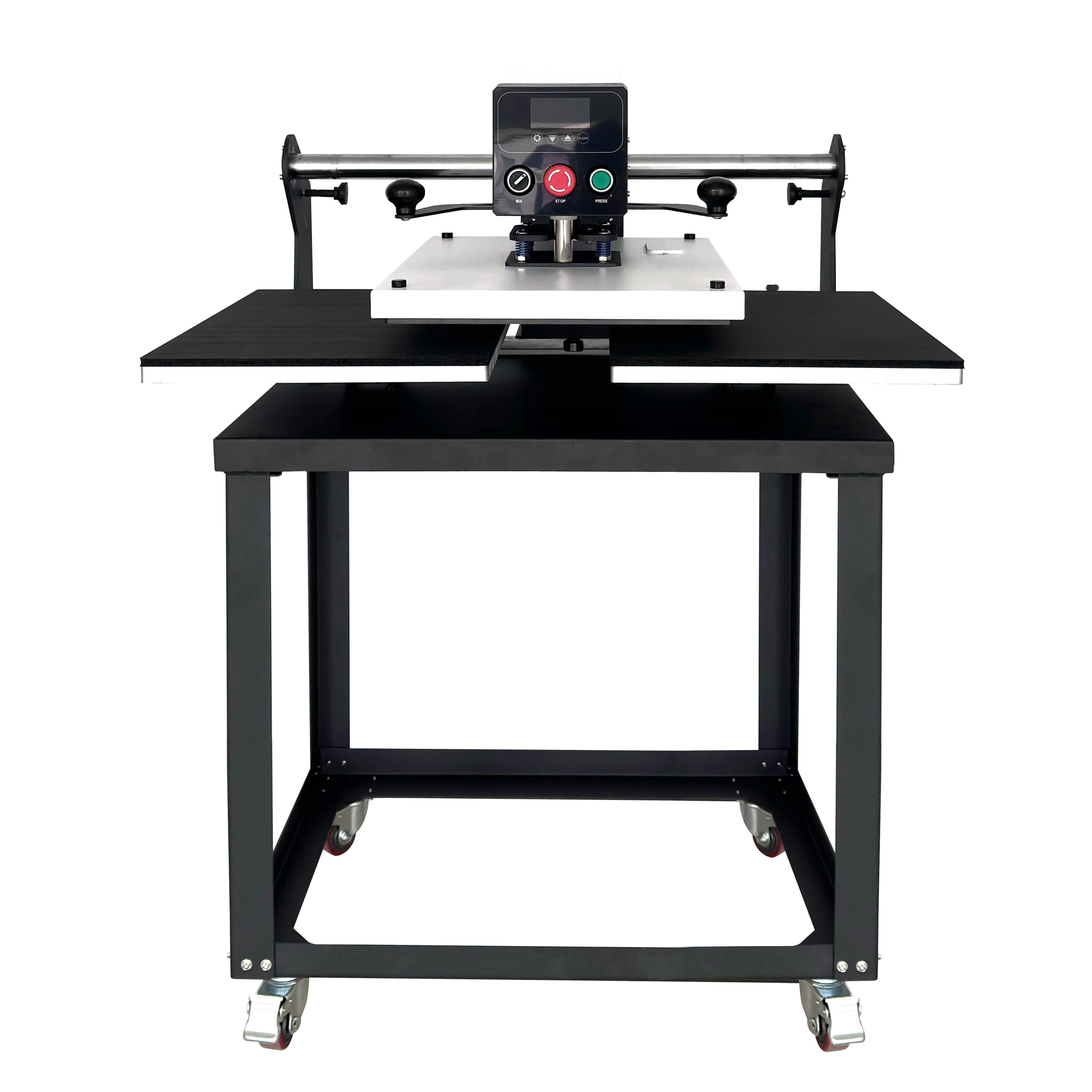
Dual Anti-Tie-Down Buttons: Requires the operator to press two isolated buttons simultaneously using both hands to lower the platen, preventing hand-crush hazards.
Emergency Stop Latches: Prominent mechanical E-stop switches must be located immediately within arm's reach of the loading stations.
Optical Safety Barriers: High-end flatbed machines feature infrared light curtains across the perimeter. If an arm breaks the invisible beam while the platen is closing, the hydraulics freeze instantly.
Keep your large heat press machines operating at peak performance by following this simple maintenance checklist:
Daily: Drain water traps on pneumatic regulator filters. Wipe down the upper platen's non-stick fluoropolymer cover using a soft cloth to clear away adhesive mist and sublimation dyes.
Weekly: Check air line connectors for microscopic pressure leaks. Inspect silicone lower pads for burns, gouges, or low spots that could cause pressure drops.
Monthly: Lubricate linear shuttle bearings, guide rails, and pivot bushings using high-temperature industrial grease.
Quarterly: Perform a thermal wire probe survey across nine points of the platen face to verify that PID controllers are reading true temperatures.
Q1: What is the typical weight and footprint of an industrial large heat press machine ?
A1: True industrial models
range from 800 pounds for a semi-automatic 24" x 30" unit to upwards of 2,500 to
4,000 pounds for a fully hydraulic 40" x 60" dual shuttle system. They generally
require a minimum floor footprint of 8' x 10' to account for shuttle travel, air
compressors, and operator clearance. Always verify your facility's floor load
capacity before installation.
Q2: What size air compressor do I need to support a pneumatic large
heat press machine?
A2: Most pneumatic presses need
a clean supply of 80 to 120 PSI. We recommend an air compressor capable of
delivering at least 5 to 10 CFM, ideally paired with a 30-to-60-gallon tank. A
screw-type or quiet dual-piston cast-iron compressor paired with a refrigerated
air dryer is best to keep water out of your valves.
Q3: Can a large heat press machine handle both DTF transfers and dye
sublimation?
A3: Yes, provided the press offers
accurate digital temperature and pressure controls. Dye sublimation requires
high temperatures (typically 380°F to 400°F) and moderate-to-firm pressure over
30 to 60 seconds. DTF requires lower heat (280°F to 320°F) with short, precise
10-to-15-second cycles. A machine with multi-zone PID control switches between
these profiles seamlessly.
Q4: Why can't I run an industrial-format press on standard 110V wall
power?
A4: A platen measuring 32" x 40" contains
thousands of square inches of aluminum that require 9,000 to 15,000 watts of
heating power. A standard 110V/15A wall breaker maxes out at 1,650 watts.
Heating a massive platen on 110V would take hours and struggle to recover heat
between strikes. Industrial presses require dedicated 220V single-phase or
208V/480V three-phase circuits.
Q5: How often should I replace the silicone rubber pad on the lower
platen?
A5: In an active production facility, an
industrial silicone pad lasts between one and two years. If you notice
persistent cold spots, uneven transfer adhesion, or physical pitting on the pad,
replace it immediately. Uneven base pads compromise transfer quality across wide
prints.
Stepping up to a heavy-duty large heat press machine unlocks production capacity that small manual presses cannot achieve. Whether you are outfitting an active sportswear manufacturing line, printing architectural graphics, or speeding through gang-sheet DTF orders, having the right combination of balanced pressure, stable platen heat, and automated shuttles keeps your shop profitable.
Selecting the ideal press configuration depends on your target products, shop power supply, and planned output. Contact the machinery specialists at Heat Press Leader today to discuss custom sizing, technical specifications, and direct factory quotes for your manufacturing floor.