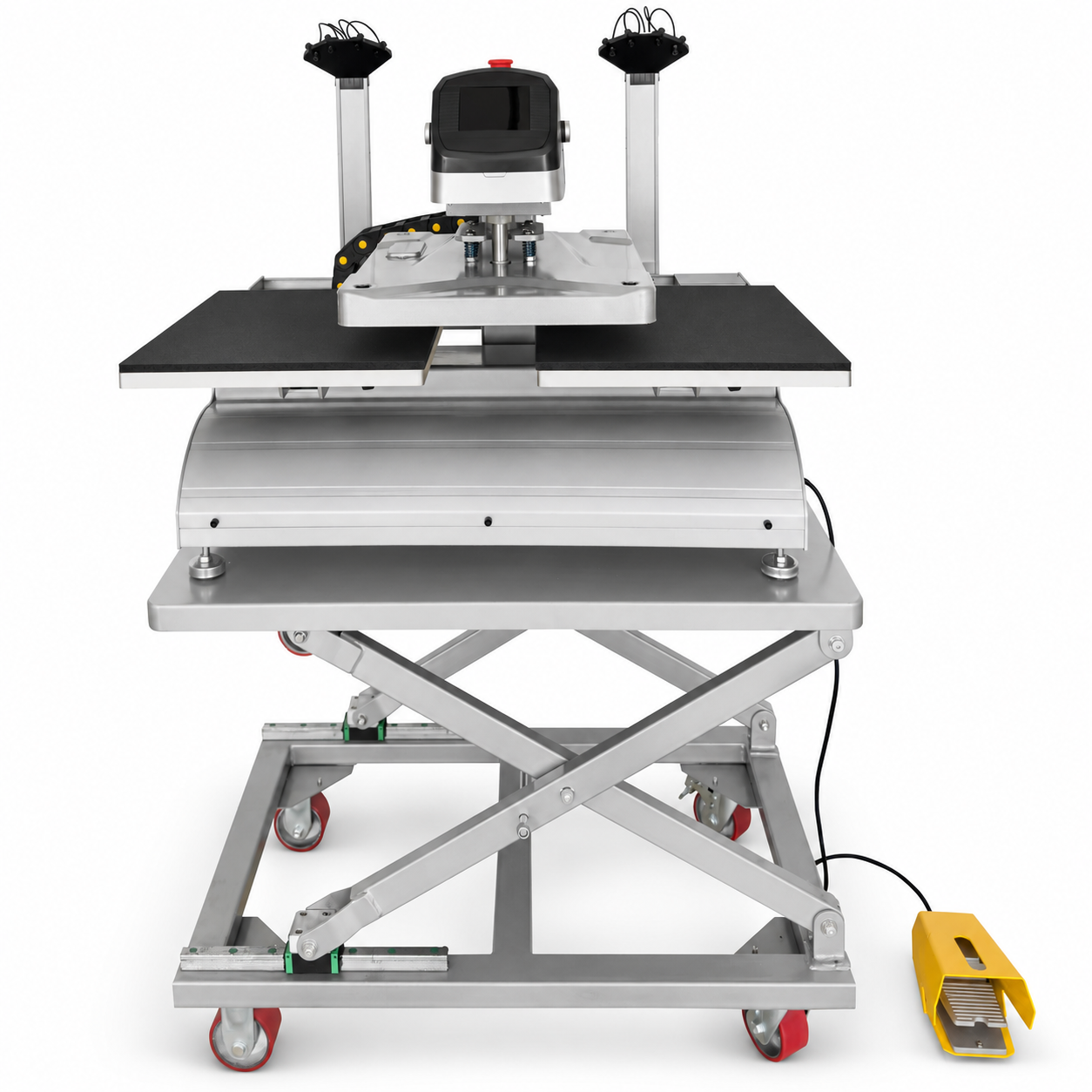
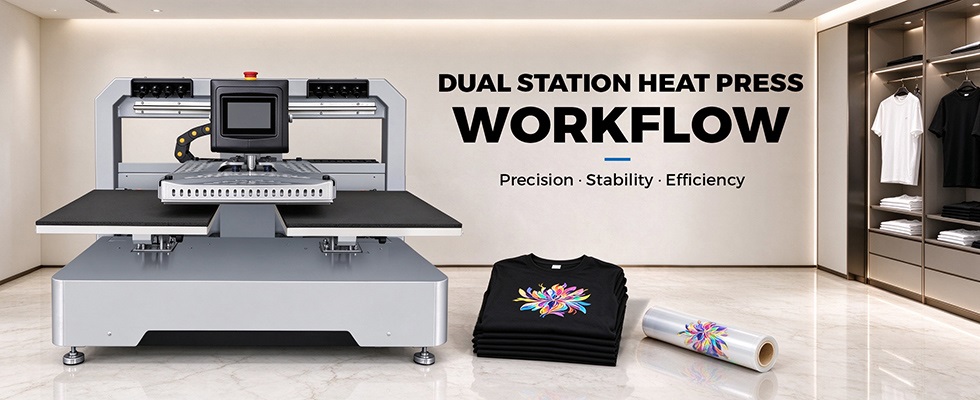
A dual station heat press is often described simply as a heat press with two lower platens.
That description is technically useful, but it does not explain why the layout matters in commercial production.
The main difference is workflow.
With a conventional single-station press, garment preparation and heat pressing usually happen in sequence. The operator loads a garment, positions the transfer, starts the pressing cycle, waits for the machine to finish, removes the product, and then prepares the next garment.
A dual station heat press allows part of that sequence to happen at the same time.
While one station is being pressed, the operator can use the second station to load and position the next garment.
This changes the machine from a stop-and-wait workstation into a more continuous production tool.
A dual station heat press improves workflow by separating pressing time from garment preparation time. The greatest benefit appears when an operator can actively prepare one workstation while the other is completing the heat press cycle.
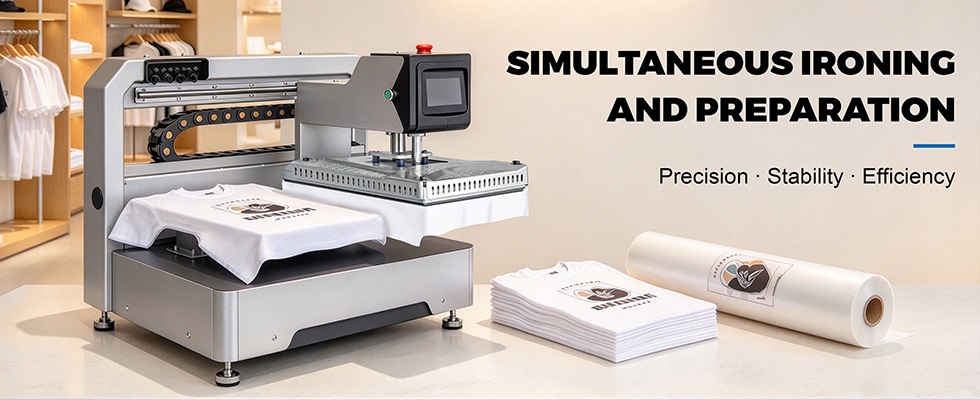
A dual station heat press uses two lower working stations with one pressing system.
Instead of preparing every garment in the same location where the previous garment is being pressed, the operator can alternate between two workstations.
A simplified sequence looks like this:
Station A: Pressing
Station B: Loading and positioning
After the pressing cycle is complete, the machine moves to or operates over Station B.
The operator then unloads and prepares Station A while Station B is pressing.
The cycle repeats.
This alternating workflow is the main reason dual-station machines are used in repeated commercial production.
The design is particularly relevant when:
· Garments are similar from one order to the next;
· Transfers are prepared in advance;
· Press cycles create measurable operator waiting;
· One operator can keep the second workstation supplied;
· Daily production is large enough to benefit from continuous loading.
The second station is therefore not valuable simply because it increases the number of platens. It is valuable because it gives the operator useful work to perform during the pressing cycle.
A typical dual-station production cycle can be divided into six steps.
The operator places the garment onto the lower platen and prepares the transfer area.
The DTF film, HTV graphic, transfer paper, patch, or other transfer material is aligned on the garment.
The heat press moves into position and applies the programmed heat, pressure, and time.
Instead of waiting for the press cycle to finish, the operator loads another garment onto Station B and positions the next transfer.
After the first cycle is complete, the pressing system moves to the prepared second station.
While Station B is pressing, Station A becomes available for unloading, peeling or inspection, and preparation of the next garment.
The production cycle therefore becomes repetitive:
A Presses → B Prepares → B Presses → A Prepares
This alternating pattern is the foundation of dual-station productivity.
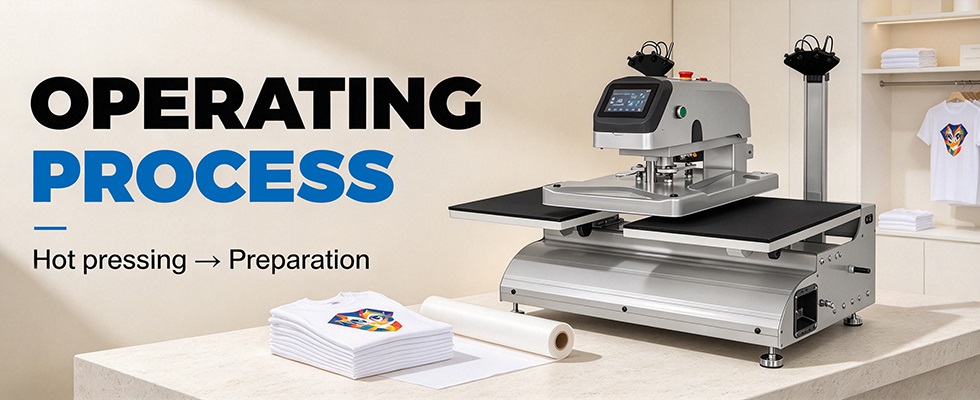
The time saved by a dual-station system mainly comes from overlapping operations.
Consider a single-station workflow.
If pressing takes a certain amount of time, the operator may have limited access to the active workstation during that cycle. Garment preparation for the next item often begins only after the current item is removed.
With two stations, preparation can move outside that waiting period.
This does not shorten the programmed transfer time. Instead, it changes how the operator uses that time.
The improvement can come from overlapping:
· Garment loading;
· Transfer positioning;
· Order checking;
· Product unloading;
· Visual inspection;
· Preparation for the next cycle.
This distinction is important.
A dual station heat press does not necessarily make the heating system itself faster. It can make the production sequence more efficient.
For commercial operations, that difference matters because operator idle time is part of the total production cost.
Dual-station machines can use different mechanical layouts.
The important question for an operator is how the heat press moves between Station A and Station B.
Depending on the design, movement may be motor-driven, pneumatic, semi-automatic, or manually controlled.
The layout influences:
· Where the operator stands;
· How far the operator reaches;
· Whether garments can be threaded onto the platen;
· How easily transfers are positioned;
· How much space is required around the machine;
· How the operator switches between the two stations.
A practical machine should allow the operator to use the inactive station without interfering with the active pressing cycle.
When comparing machines, buyers should therefore look beyond the phrase “dual station” and observe the complete operating sequence.
A product demonstration should show:
1. Garment loading;
2. Transfer positioning;
3. Machine movement;
4. Pressing;
5. Workstation change;
6. Product unloading.
This provides more useful information than watching the machine perform an empty press cycle.
Electric dual station heat presses use electric motors rather than an external air compressor to drive key machine movements.
This can simplify installation in commercial workshops that do not already use compressed-air systems.
The Cyber Auto Press II MATE450-2E is one example. According to the 2026 product catalogue, it combines a dual-station layout with fully electric operation, touchscreen control, precision laser positioning, real-time pressure feedback, and interchangeable platens. The catalogue lists a 40 × 50 cm heating platen and identifies the machine for professional high-volume production.
The Flex AutoPress II B2-2N uses another electric dual-station arrangement. Its catalogue-listed features include twin lower platens, semi-auto and full-auto operating modes, threadable lower platens, an interchangeable platen system, and electric motor operation without an external air compressor.
These two examples illustrate an important point:
Dual station describes the workstation arrangement, not one universal machine design.
Different dual-station machines may use different control systems, platen structures, positioning tools, movement mechanisms, and loading approaches.
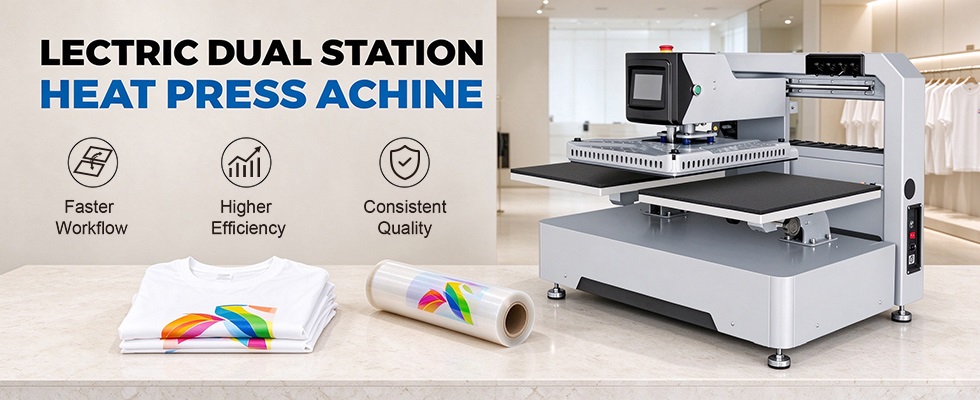
The second workstation is useful only if garments can be loaded efficiently.
This makes lower platen design an important part of a dual-station system.
A threadable lower platen allows the operator to slide part of a garment over the platen.
For compatible products, this can help isolate the printing area instead of placing multiple garment layers between the pressing surfaces.
The B2-2N catalogue specifically lists threadable lower platens as part of its design.
Commercial apparel businesses may process more than standard T-shirts.
Other applications can include:
· Sleeves;
· Labels;
· Bags;
· Patches;
· Smaller garments;
· Specialty products.
Interchangeable platens allow the same machine platform to adapt to different working areas.
The MATE450-2E and B2-2N both list interchangeable platen capability in the current catalogue.
For buyers, this means platen flexibility should be evaluated together with dual-station productivity.
A fast alternating workflow provides limited value if every specialty job is difficult to load.
Commercial heat pressing requires more than speed.
Repeated orders also require consistent placement and process settings.
If the same logo needs to appear in the same location across many garments, manual alignment can introduce variation.
Laser positioning can provide a visual reference for repeated garment or transfer placement.
The MATE450-2E includes integrated laser positioning according to the catalogue.
This does not eliminate the need for an operator to check garment orientation and transfer placement, but it can support a more repeatable setup.
Pressure is another important variable in heat transfer production.
Real-time pressure feedback allows the operator to monitor the machine’s applied pressure through the control system rather than relying only on subjective judgement.
The MATE450-2E lists real-time pressure feedback as one of its control features.
Digital control can also simplify repeated jobs when the production team needs to return to known settings.
However, saved machine settings do not replace application testing.
Transfer material, fabric construction, garment thickness, and process requirements still need to be verified for each application.
DTF is one of the applications where dual-station workflow can be particularly easy to understand.
A simplified DTF heat press process may include:
Garment Preparation → Pre-Press → Transfer Placement → Main Press → Peel → Re-Press
The exact process depends on the film, powder, fabric, and transfer supplier instructions.
In repeated T-shirt production, the operator may already have multiple printed transfers ready for application.
During the main press cycle on Station A, the operator can prepare the next garment on Station B.
This can reduce the stop-and-start rhythm associated with a single workstation.
However, the heat press is only one part of DTF production.
Actual output can also be limited by:
· DTF printing;
· Powder application and curing;
· Transfer cutting or organization;
· Garment preparation;
· Film peeling;
· Re-pressing;
· Inspection;
· Folding and packaging.
Therefore, a dual station heat press improves DTF production most effectively when pressing is one of the main workflow constraints.
A common mistake is to estimate production capacity from press cycle time alone.
Real output depends on the complete workstation.
Useful variables include:
Production Factor | Why It Matters |
Press cycle time | Determines how long the active station is occupied |
Garment loading time | Affects whether the second station is ready on time |
Transfer positioning time | Can become the real bottleneck for complex artwork |
Operator movement | Influences how efficiently stations alternate |
Peeling / re-pressing | Adds steps after the initial cycle |
Product changeover | Different garments may require new platens or settings |
Transfer availability | The machine cannot run continuously without prepared transfers |
Inspection and packaging | Downstream delays can limit finished-order output |
This is why claims such as “dual station doubles production” should be treated carefully.
If preparation takes longer than pressing, the machine may still wait.
If pressing takes longer than preparation, dual stations can make much better use of the operator’s time.
The correct way to evaluate performance is to measure the complete cycle from one finished garment to the next.
A dual-station heat press is not automatically the best choice for every commercial user.
It may provide limited benefit when production involves very short batches and constant product changes.
For example, consider a workshop producing:
· One bag;
· Two sleeves;
· Three patches;
· One hoodie;
· Then a completely different product.
In this environment, platen changes, artwork preparation, and job setup may take more time than pressing itself.
A flexible single-station machine may be easier to manage.
Dual station equipment may also provide less benefit when:
· Transfer supply cannot keep up with the machine;
· Only occasional commercial orders are produced;
· Floor space is very limited;
· One operator manages several unrelated processes at the same time;
· Downstream peeling or packaging already creates a backlog;
· Most products require frequent platen changes.
The deciding question should be:
Is operator waiting during pressing a meaningful part of our current production cycle?
If the answer is no, the second workstation may not address the main bottleneck.
A practical equipment evaluation should involve more than reading a specification table.
Ask the supplier to demonstrate the machine with a realistic production sequence.
Observe how easily the operator can:
· Load a T-shirt;
· Thread or position the garment;
· Align the transfer;
· Start the cycle;
· Move between stations;
· Remove the finished product;
· Change platen configurations;
· Adjust time, temperature, and pressure;
· Access components for routine operation.
Also confirm factory requirements such as voltage, working space, operator clearance, and—in pneumatic configurations—compressed-air requirements.
If possible, test the equipment with the same garment and transfer types used in your own production.
That provides more useful information than evaluating the machine with an unfamiliar demonstration material.
XH approaches dual-station equipment from the perspective of operator movement and repeated commercial production.
The current product range includes different dual-station configurations rather than one fixed machine architecture.
For example, the Cyber Auto Press II MATE450-2E combines dual workstations with electric automation, positioning assistance, touchscreen control, pressure feedback, and interchangeable platens. The Flex AutoPress II B2-2N combines dual workstations with electric motor operation, threadable lower platens, interchangeable platens, and flexible operating modes.
The purpose of offering different structures is not simply to increase the number of features.
Different apparel businesses have different loading methods, product categories, operator routines, and production environments.
For XH, evaluating a dual station heat press starts with understanding what happens at the workstation before, during, and after every pressing cycle.
A dual station heat press alternates between two lower workstations. While one station is being pressed, the operator can prepare a garment on the second station.
It can improve total workflow because garment preparation and pressing can overlap. The programmed press cycle itself is not necessarily shorter.
Yes. Dual-station equipment is commonly designed so one operator can alternate between the two working areas. Actual efficiency depends on product type and preparation time.
It can be effective for repeated DTF garment production because the next garment can be loaded and positioned during the active pressing cycle.
Not automatically. Output also depends on loading, transfer preparation, peeling, re-pressing, inspection, operator speed, and downstream processes.
Neither system is universally better. Electric models avoid an external compressor, while pneumatic configurations may fit factories that already use compressed-air infrastructure.
Evaluate loading access, platen structure, machine movement, operating controls, pressure management, workstation space, application compatibility, utilities, and the complete garment production cycle.
A dual station heat press is best understood as a workflow machine.
Its main function is not simply to provide two lower platens. The two workstations allow one part of production to continue while another part of the machine is completing the heat press cycle.
That can reduce operator waiting and create a more continuous production rhythm.
However, the value of the design depends on the surrounding process.
Loading must be fast enough. Transfers must be ready. The operator must be able to move efficiently between stations. Peeling, inspection, and packaging must also keep pace.
Machine features such as electric drive, threadable lower platens, interchangeable platens, positioning assistance, touchscreen controls, and pressure feedback can further influence how the workstation performs in daily production.
For XH, choosing a dual station heat press begins with one practical question:
What does the operator need to do while the other station is pressing?
When that time can be used productively, two workstations can provide a meaningful improvement in commercial heat press workflow.
Before selecting a dual station heat press, identify:
· Your main garment types;
· Average batch size;
· Pressing time;
· Garment preparation time;
· Transfer positioning time;
· Peeling or re-pressing requirements;
· Required platen sizes;
· Available workspace;
· Electric or pneumatic infrastructure.
Suggested CTA Button:
Find the Right Dual Station Configuration