Single-platen heat presses create major bottlenecks during peak production runs. Operators wait idly while the heat cycle finishes, wasting precious minutes and burning through labor budgets. For apparel decorators handling large contract runs, downtime directly reduces operational profits.
Switching to a dual heat press machine solves this floor delay. By allowing the operator to prep a garment on one platen while the other presses, your shop can increase daily throughput by 80% to 100%. The machine runs continuously, operator movement becomes fluid, and your labor cost per piece drops.
Since 2002, Heat Press Leader (under the XinHong Group) has engineered industrial thermal transfer machinery. Backed by ISO9001 and ISO14001 facilities alongside SGS-verified certifications, we manufacture reliable equipment for commercial printing facilities worldwide. Here is our field-tested guide to the top dual-station systems engineered for high-volume customization in 2026.

Choosing the right heat press requires matching the mechanical drive system to your facility infrastructure and order volume. Investing in the wrong drive mechanism leads to unexpected power costs or operator strain.
Electric Dual Heat Press: These units run entirely on internal electric actuators. They require no noisy air compressor, run whisper-quiet, and offer plug-and-play setup. Pressure control is precise and easily monitored through a digital screen.
Pneumatic Heat Press: Powered by an external air compressor, pneumatic machines deliver heavy, uniform pressure across thick garments. They handle long, non-stop production shifts on dense textiles like fleece, canvas bags, and workwear.
Manual Dual Platen Press: These systems rely on human leverage and mechanical slides. They eliminate utility overhead and electronic failure points, making them cost-effective backup units for boutique runs.
Thermal Uniformity: Cast-in tubular heating elements spaced tightly across thick aluminum plates prevent cold spots on transfer edges.
Platen Clearance and Threadability: Open lower platens allow garments to slip on naturally without bunching seams or burning collar tags.
Alignment Systems: Integrated laser markers remove manual measuring, keeping prints straight even when running at top speed.
Safety Interlocks: Look for dual emergency stop buttons, physical safety bars, and two-hand activation switches to safeguard workers.
The AutoPress Dual V3 represents modern engineering for commercial garment decorators. Designed with a sleek futuristic profile, this unit runs on an advanced electric motor that completely removes the need for external air compressors.
Operators control every variable through an intuitive digital touchscreen. The machine head glides between platens on a smooth motorized rail, clamping down with exact tonnage. It works well inside boutique retail shops, DTF fulfillment centers, and clean indoor spaces where loud compressor noise is prohibited.
Drive: Pure Electric (Compressor-free)
Platen Size: 40 x 50 cm (16 x 20 inches)
Primary Advantage: Low noise emission, digital pressure memory, and zero air line maintenance.
This classic workhorse combines standard shop dimensions with an automated electric motor. Designed for daily wear production, it handles cotton tees, polyester jerseys, and fleece hoodies with constant pressure repeatability.
The automated cycle closes and pops open independently, cutting repetitive strain injury risks for operators. If you run a commercial DTF or screen-print transfer line, this industrial heat transfer machine keeps your operators moving comfortably without manual lever pulls.
Drive: Industrial Electric Actuator
Platen Size: 16 x 20 inches
Primary Advantage: Consistent vertical downforce without operator physical fatigue.
When high-volume apparel printing demands output beyond standard twin tables, the Cyber Carousel 6 steps in. This rotary machine expands the dual-station concept into an industrial production carousel.
With multiple stations rotating under automated heating zones, loading, pressing, cooling, and peeling occur at the exact same moment. Large apparel contract decorators and promotional supply factories use this configuration to print hundreds of garments per hour continuously.
Drive: Automated Rotary Carousel System
Platen Size: 40 x 50 cm per platen
Primary Advantage: Massive continuous garment output for contract manufacturers.
Engineered directly for custom apparel printing, this pneumatic heat press for t-shirts provides the consistent muscle required for commercial graphics. Air pressure drives the heat platen straight down, distributing force across every square inch.
The machine includes foot pedal engagement and twin push buttons for flexible triggering. Its open-base design allows operators to thread shirts straight over the lower tables, preventing back-print ghosting and collar scorch.
Drive: Industrial Pneumatic Cylinder
Platen Size: 16 x 20 inches
Primary Advantage: Exceptional pressure uniformity for heavy screen transfers and DTF films.
Not every shop wants to maintain motors or air hoses. This manual dual heat press machine relies on counterbalanced swing arms and heavy-duty manual linkages to deliver strong clamping force at a budget-friendly price point.
Operators set one shirt while the other side finishes its countdown, doubling the cadence of an ordinary clam press. It features a rugged frame, zero electronic drive components to repair, and an entry price suitable for startups scaling into wholesale work.
Drive: Manual Mechanical Lever
Platen Size: 16 x 20 inches
Primary Advantage: Low capital cost, zero maintenance down-time, and reliable performance.
Misaligned graphics quickly eat into shop profits. This intelligent automatic dual station heat press features an adjustable overhead cross-hair laser array directly integrated into the chassis.
The lasers cast crisp placement marks over both lower platens, letting staff place chest logos and neck tags in exact position within seconds. The machine executes the press cycle automatically, virtually eliminating crooked prints and scrap garments.
Drive: Automated Electric/Pneumatic hybrid options
Platen Size: 16 x 20 inches
Primary Advantage: Factory-level graphic precision with zero setup guesswork.
Built for demanding three-shift textile operations, this heavy-duty pneumatic model features a reinforced structural steel frame and high-bore air cylinders. It produces maximum clamping tonnage for thick work uniforms, canvas gear, and dense embroidered patches.
The interchangeable lower tables disconnect rapidly via modular locking pins. Operators can switch out adult platens for youth sizes, sleeve tables, or pocket setups in under two minutes, keeping your production schedule on track.
Drive: High-Bore Pneumatic System
Platen Size: 16 x 20 inches (Quick-change platen compatible)
Primary Advantage: Rugged durability designed for 24/7 continuous industrial processing.
This unit serves as the balanced industrial standard for commercial screen printers and fulfillment hubs. It pairs a rigid industrial chassis with a dependable electric motor, doing away with air lines and compressors.
Dual digital controllers oversee time and temperature settings accurately, ensuring repeatable thermal transfer parameters for sensitive synthetic sportswear. Its clean footprint fits easily into tight retail warehouses and modern print shops alike.
Drive: Standard Commercial Electric Drive
Platen Size: 16 x 20 inches
Primary Advantage: Simple utility hookup with rock-solid internal mechanics.
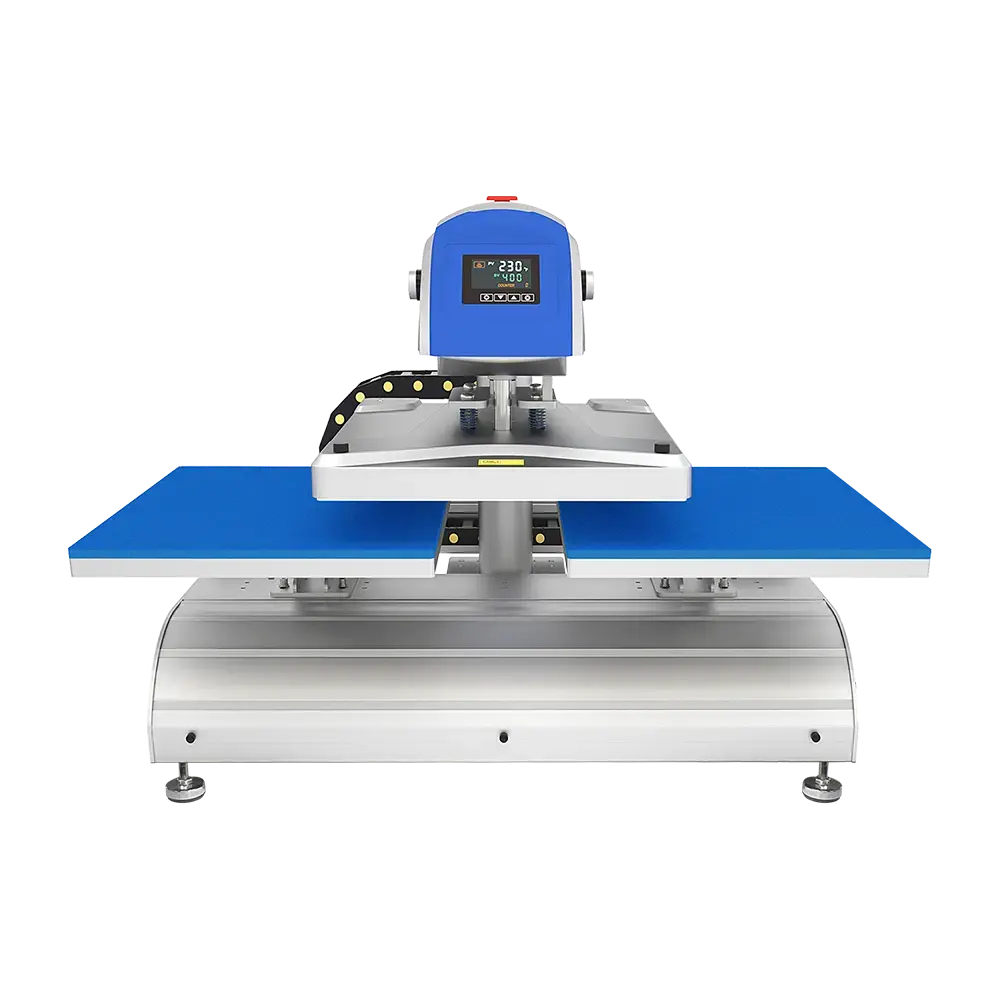
| Model Designation | Drive Type | Platen Dimensions | Key Distinct Feature | Volume Rating |
|---|---|---|---|---|
| AutoPress Dual V3 | Electric | 40 x 50 cm | Smart touchscreen, silent drive | High Volume |
| 16x20 Auto Electric Dual | Electric | 16 x 20 in | Hands-free automatic cycling | High Volume |
| Cyber Carousel 6 | Rotary Automatic | 40 x 50 cm (x6) | Multi-station rotary platen array | Ultra-High Volume |
| 16x20 Pneumatic Business | Pneumatic | 16 x 20 in | Foot pedal trigger, threadable platen | High Volume |
| 16x20 Double Side Manual | Manual | 16 x 20 in | Dual platen swing, zero motors | Medium Volume |
| 16x20 Laser Alignment | Automatic | 16 x 20 in | Integrated laser cross-hair guide | High Volume |
| 16x20 Pneumatic Heavy-Duty | Heavy Pneumatic | 16 x 20 in | Quick-swap lower platens, heavy tonnage | Industrial 24/7 |
| 16x20 Standard Industrial | Electric | 16 x 20 in | Self-contained electric actuator | High Volume |
Selecting a wholesale heat press manufacturer requires evaluating more than just the product shell. Commercial apparel decorators require engineering reliability, parts accessibility, and strict manufacturing standards to keep their lines running.
Over 20 Years of Specialized Manufacturing: Founded in 2002 as part of the XinHong Group, we have dedicated over two decades to developing industrial thermal application machinery.
Certified Production Facilities: Our manufacturing plants operate strictly under ISO9001 and ISO14001 guidelines. Our machines carry SGS-audited CE, MD, LVD, and RoHS safety certifications, ensuring seamless compliance across global markets.
Full OEM and ODM Customization: We assist equipment distributors and apparel brands with custom engineering. From specialized platen dimensions and control firmware to customized chassis styling, we tailor machinery directly to production needs.
Global Logistics & Field Support: Our testing protocols guarantee that every heating platen leaves the factory with verified thermal uniformity, protected by dedicated technical service teams.
Q1: How much production speed do I gain switching from a single to a dual heat press machine?
A1: Most commercial printing facilities see an 80% to 100% boost in finished shirts per hour. Because the operator loads one station while the other presses under heat, the machine operates without idle pauses, keeping labor productivity at its peak.
Q2: What is the main operational difference between electric and pneumatic models?
A2: Electric models operate via internal motor actuators, plug directly into the wall, and generate very little sound. Pneumatic machines require a dedicated air compressor and air hoses, delivering higher, brute-force pressure for thick textiles and contract production runs.
Q3: Can these dual station heat press units press modern DTF and screen printed transfers?
A3: Yes. DTF, sublimation, vinyl, and traditional screen transfers require exact temperatures and balanced pressure across the entire platen surface. All reviewed models feature heavy aluminum heat platens designed to prevent perimeter temperature drops.
Q4: How do laser alignment systems minimize production scrap?
A4: Laser markers project sharp horizontal and vertical cross-hairs directly onto the loading platen. Operators center garment collars and position designs instantly without manual rulers, reducing alignment mistakes to near zero during high-speed runs.
Q5: What maintenance routine is required for industrial heat transfer machines?
A5: Electric and manual machines require minimal maintenance beyond regular cleaning and occasional rail lubrication. Pneumatic systems require checking compressor air filters and draining water traps weekly to prevent moisture buildup inside the pneumatic valves.
Modern garment printing moves fast. Sticking with single-station equipment forces your workforce into unproductive waiting cycles that shrink your profit margins on high-volume print runs. Installing a rugged dual heat press machine keeps your operators active, optimizes shop floor workflow, and halves production time.
Whether you require electric plug-and-play simplicity or heavy-duty pneumatic compression, Heat Press Leader provides direct factory-backed machinery designed for industrial longevity.
Ready to expand your apparel customization business? Contact the Heat Press Leader engineering team today to request a factory-direct wholesale quote, inquire about custom OEM/ODM builds, or discuss the ideal machine specifications for your factory layout.