Industrial dye-sublimation and continuous thermal bonding demand precise control over three fundamental variables: temperature uniformity, surface-wide pressure distribution, and dwell time repeatability. As print widths expand beyond standard roll-to-roll limits to accommodate oversized banners, architectural interior panels, high-performance sportswear, and hard-surface aluminum sheets, thermal transfer machinery must evolve from conventional workshop equipment into heavy industrial machinery. Operating a large format heat press requires an understanding of mechanical deflection, multi-zone heating algorithms, and heavy pneumatic or hydraulic actuation systems capable of delivering uniform force across vast surface areas.
When engineering panels exceed standard dimensions such as 40 x 60 inches (1000 x 1500 mm) or 60 x 120 inches (1500 x 3000 mm), conventional thermodynamic principles face significant scaling challenges. A minor temperature deviation across an expanded platen causes color shifts in dye-sublimation, while uneven pressure drops lead to vapor escapes, resulting in ghosting or defective bonding. Industrial facilities must evaluate how platen composition, frame structural integrity, and drive mechanics intersect to maintain rigorous manufacturing standards.

Thermal stability across broad surface areas remains the primary engineering hurdle in thermal transfer manufacturing. Ambient room drafts, radiant heat loss along outer perimeters, and structural thermal bridges naturally generate a temperature gradient where edges run cooler than the platen core. Industrial dye-sublimation inks, formulated from dispersed dyes suspended in liquid carriers, convert to a gas phase between 180°C and 210°C. A discrepancy as narrow as 2.5°C across the pressing surface results in noticeable Delta-E color shifts, rendering soft signage or commercial acoustic paneling unusable.
Modern platen design relies on two primary heating architectures:
Cast-In Aluminum Elements: High-grade cast aluminum platens utilize heating elements embedded directly into the alloy mold prior to casting. This method ensures seamless metal-to-element contact, significantly reducing internal air pockets that cause localized cold spots. Cast assemblies offer high thermal conductivity and serve as efficient thermal sinks, dampening the rapid fluctuations that occur when cold substrates enter the cycle.
Multi-Zone Tubular Element Grids: For platens exceeding 100 inches in length, continuous casting becomes structurally inefficient due to thermal expansion warpage. Engineers implement precision-milled serpentine channels fitted with heavy-duty tubular heating rods. These grids operate under independent multi-zone PID (Proportional-Integral-Derivative) controllers. Outer zones operate at higher watt densities to counteract continuous radiative and convective edge cooling, while inner zones regulate baseline energy to maintain an isothermal surface.
Thermal expansion alters mechanical tolerances when platens cycle from ambient storage temperatures to 200°C. Standard commercial metals expand linearly according to their material coefficients. In an unconstrained or poorly engineered framework, this expansion induces platen bowing, where the center arcs upward or downward relative to the edges.
High-yield equipment designs utilize thick tooling-plate alloys (typically Mic-6 or equivalent cast aluminum) ranging from 1.5 to 3 inches in thickness. This thickness provides structural stiffness against thermal deformation and provides adequate thermal mass to prevent temperature drops when loading cold substrates such as dense ceramic sheets or raw aluminum. Equipment fabricated by Heat Press Leader incorporates stress-relieved platen mounts that permit horizontal expansion without exerting mechanical torque on the machine frame, preserving microscopic surface flatness under sustained thermal stress.
Transferring disperse dyes into dense polyester weaves or compressing thermoset resin matrices demands predictable, high-tonnage pressure. Total applied force must scale proportionally with surface area. A standard 16 x 20-inch hobbyist unit needs only fractional tonnage to achieve operational pressure; however, an industrial large format heat press handling a 60 x 100-inch platen requires substantially more power. Covering 6,000 square inches at a modest 30 pounds per square inch (PSI) requires an aggregate mechanical force of 180,000 pounds (90 US tons).
Pneumatic operations utilize clean, compressed air delivered to heavy-duty double-acting cylinders or industrial air bellows. Pneumatics remain the standard choice for textile-focused manufacturing, such as flags, backlit trade show fabrics, and apparel graphics.
Maintenance and Contamination: Air systems operate without liquid hydraulic oils, eliminating the risk of aerosolized fluid leaks that could ruin porous textiles.
Speed and Cycle Responsiveness: Pneumatic systems cycle rapidly, reducing platen approach and release times to preserve throughput efficiency.
Force Limitations: Because facility air systems generally operate between 80 and 120 PSI, pneumatic cylinders face practical limits regarding the maximum concentrated tonnage they can deliver without requiring oversized cylinder barrels.
When pressing dense rigid substrates—such as high-gloss ChromaLuxe metal prints, high-pressure laminates, or multi-ply ballistic composites—pneumatic pressure often proves insufficient to prevent micro-voids. Here, electro-hydraulic power units (HPUs) provide the necessary force.
Hydraulics utilize pressurized fluid at ratings routinely exceeding 2,500 PSI. This force density permits a large format heat press to achieve uniform surface compaction on stubborn, non-compressible materials. Proportional hydraulic valves modulate the platen closure, dampening the final millimeter of descent to prevent mechanical shock from shifting transfer papers or cracking delicate ceramic or composite layers.
The platen represents only one half of the mechanical equation; the supporting chassis must resist deflection under maximum tonnage. Structural deflection occurs when the upper and lower platens flex away from each other under pressure, concentrating clamping force on the outer corners while the center experiences reduced pressure. This mechanical failure leads to washed-out colors or incomplete resin bonding through the middle axis of the work area.
Mitigating chassis deflection demands heavy-gauge structural steel fabrication. Machine structures rely on wide-flange I-beams, box-section steel channels, and solid flame-cut carbon steel side plates. Following the welding process, these frames undergo thermal stress-relieving cycles to eliminate structural memory from the weld beads, followed by CNC bridge milling to true all mounting surfaces.
Industrial systems maintain a bed parallelism tolerance within ±0.003 to ±0.005 inches per square foot across the entire bed. To counter the natural micro-flexing of massive beds, Heat Press Leader engineers adjustable leveling suspensions beneath the lower loading tables. Using precision dial indicators or laser interferometer systems, technicians calibrate the bed to achieve mechanical parallelism before final field commissioning.
Operational efficiency in wide-format printing depends directly on minimizing machine idle time. Platens must not sit idle while operators position complex layouts, align transfer papers, or remove hot finished products. Consequently, table movement designs define overall factory throughput.
The manual or motorized pull-out drawer extends the lower platen out from under the heated upper assembly. This arrangement protects the operator from continuous radiant heat exposure during loading. Drawers work well in limited-space workshops or facilities focused on customized, low-to-medium batch runs where rapid continuous cycling is not the primary objective.
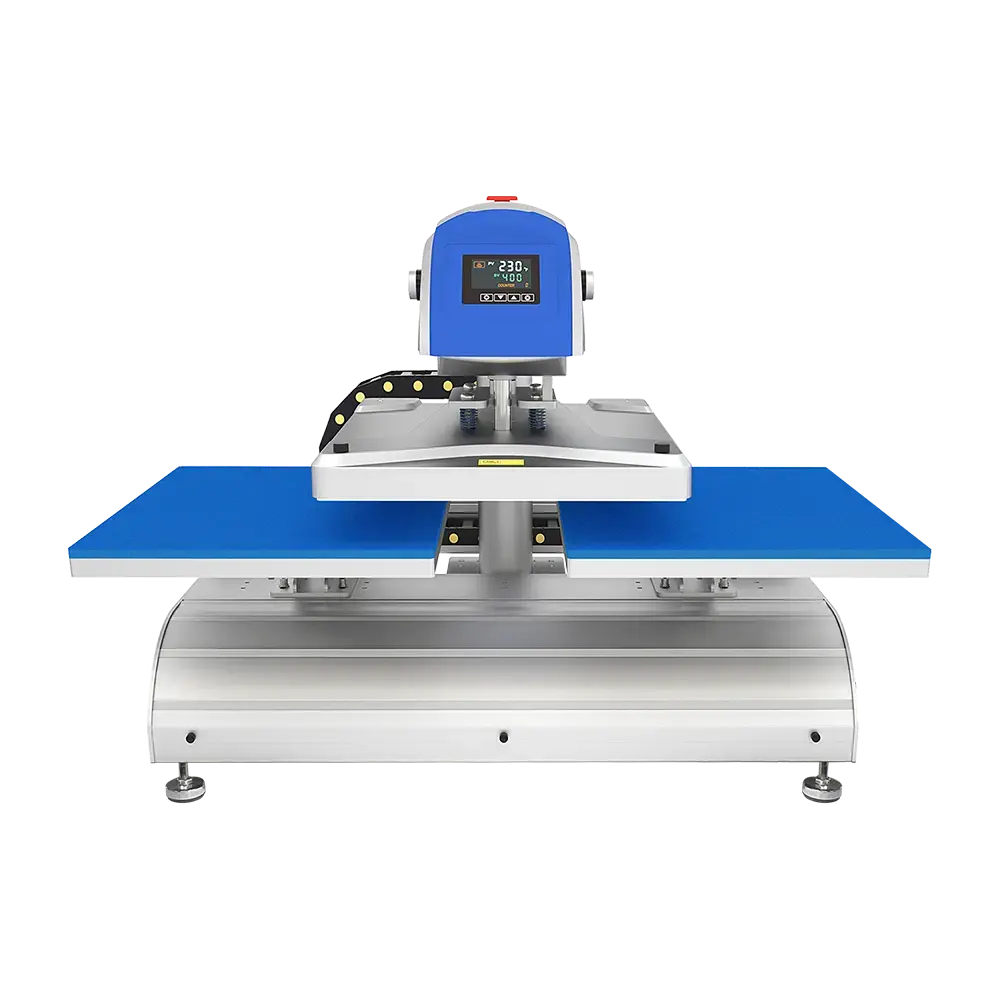
For high-output production environments, motorized dual shuttle configurations represent the production benchmark. While one lower table resides within the pressing chamber undergoing a timed cycle, the secondary table remains fully accessible on the exterior wing. Operators unload finished items, clean the bed, and align upcoming production runs. As the heating timer elapses, the platen lifts, the first bed slides out, and the second bed automatically moves into position. This arrangement doubles daily output without demanding additional thermal energy expenditure.
The continuous evolution of coated materials and technical synthetic textiles has broadened the industrial relevance of wide-format thermal processing beyond conventional sign-making.
Dye-Sublimation Soft Signage and Backlit Graphics: High-density knitted polyester fabrics dominate retail and trade show displays. Achieving deep black levels and vibrant chromatic saturation requires consistent temperature (typically 205°C) across continuous runs up to 3.2 meters wide.
Rigid Aluminum and Metal Photo Panels: High-definition architectural graphics on coated aluminum require precise platen flat-contact. Because aluminum functions as a rapid heat conductor, it draws thermal energy immediately upon contact. Platens must supply sustained thermal replenishment to avoid drop-off during the 60-to-90-second dwell time.
Architectural Acoustic Felt and Non-Woven Felts: Recycled PET acoustic panels rely on heat pressing to calibrate density, smooth surface fibers, and transfer decorative textures or prints into the fiber matrices.
Sports Equipment and Structural Composites: Ski and snowboard manufacturing, carbon fiber pre-preg consolidation, and skateboard decks utilize prolonged heating and high pressure to cure epoxy systems and integrate protective graphics into the outer layers.
Achieving defect-free results in large format processing requires tight process controls. The sheer surface area increases vulnerability to ambient and consumable variables.
Moisture absorption represents a primary hidden cause of transfer defects. Synthetic textiles and protective kraft paper rolls absorb ambient humidity from the plant floor. When subjected to 200°C temperatures, this moisture instantly converts to superheated steam, which disrupts the gaseous migration of dye molecules. This phenomenon manifests as uneven splotches, yellowing, or bleeding along the fiber grain. Facilities operating a large format heat press must control warehouse climate conditions or implement pre-baking protocols—clamping the substrate without transfer paper for 10 to 15 seconds to purge moisture before running the print cycle.
Another process challenge involves exhaust management. Dye-sublimation produces gasified ink components, volatile organic compounds, and residual polyester processing oils during dwell cycles. Industrial machines must feature integrated exhaust ports to route vapors away from the work area. If neglected, condensed chemical residues drop back onto the heated platen, accumulating into carbonized spots that mar subsequent jobs.
Platen thickness directly dictates the thermal storage capacity (thermal mass) of the system. Thin platens (under 1 inch) warm up rapidly from a cold factory start, but they dump their heat just as quickly when they make contact with a cold piece of aluminum or dense fabric. This drops platen temperature below the critical sublimation threshold, requiring longer dwell times or pauses between cycles while the PID controllers replenish the heat. A platen ranging from 1.5 to 2.5 inches in thickness requires a longer initial warm-up sequence, but it acts as a thermal flywheel. It transfers heat to incoming materials with minimal drop in surface temperature, allowing immediate reloading and consistent color reproduction across continuous shifts.
Surface infrared thermometers are insufficient for industrial calibration because variations in surface emissivity (such as coated Teflon vs. bare metal) skew non-contact IR readings. Calibration technicians utilize contact surface probes, multi-channel thermocouple dataloggers, or calibrated thermal imaging sensors. Calibrations verify temperature at a minimum of 9 to 16 mapped grid points across the platen surface. Standards typically dictate that no single coordinate deviates more than ±1.5% from the setpoint across the entire usable pressing surface.
Textiles possess internal compliance; their woven fibers compress to naturally absorb minor deviations in mechanical clearance. Conversely, rigid substrates—like aluminum sheets, composite panels, or MDF boards—exhibit negligible compressibility. If the platen frame deflects or the lower bed sits out of parallel alignment by as little as 0.010 inches across its span, pressure migrates toward the tighter side. The low-pressure area will suffer from under-transfer, washed-out tones, or incomplete adhesive bonding, while the high-pressure side may exhibit crushing, ink blowouts, or physical cracking.
A dual shuttle system minimizes thermal idle time. In a fixed-bed or manual-drawer machine, the heating assembly sits unengaged during the unloading, cleaning, positioning, and taping phases—a sequence that can easily take three minutes on an intricate 10-foot print. Over an 8-hour shift, this idle setup time can account for 40% to 60% of total machine hours, all while the elements consume idle electricity. Dual shuttles decouple preparation from the active dwell cycle. While bed A dwells for 60 seconds, bed B is staged. Transition times between shuttles drop to roughly 15 seconds, raising machine utilization rates and maximizing labor productivity.
Industrial transfer machinery operating at high tonnage requires robust operator protection mechanisms. Key safety provisions include dual optical light curtains spanning the operational bed opening, which cut actuator power instantly if an operator breaks the infrared field during machine closure. Additionally, units incorporate dual-hand tiedown cycle activation buttons, forcing the operator to keep both hands on remote controls until the platen reaches full mechanical closure. Emergency pressure-relief valves and mechanical safety lock-bars prevent the heavy platen from descending in the event of sudden electrical failure or pneumatic line pressure drops during maintenance procedures.
Every commercial production facility works with unique footprint restrictions, substrate sizes, and throughput demands. Purchasing off-the-shelf machinery often leads to compromises in production efficiency, structural rigidity, or heating zone control. Partnering with a dedicated manufacturer like Heat Press Leader provides access to bespoke engineering solutions, including customized platen dimensions, specialized high-tonnage hydraulic options, and fully automated multi-stage inline shuttle conveyors.
To discuss technical specifications, verify substrate compatibility through lab testing, or request an engineered quotation for your production line, reach out to our application team at admin@heatpressleader.com.