Every custom apparel entrepreneur hits a wall with standard home irons and handheld pressing tools. You press a design, wash the shirt twice, and watch the vinyl peel at the collar. Or you land an order for twenty company polos and realize that applying manual body weight for thirty minutes ruins your wrists. If you want to sell custom t-shirts, hoodies, or tote bags on Etsy, Shopify, or local pop-up markets, you need repeatable heat and calibrated downward pressure.
The machinery market has shifted dramatically heading into 2026. Features once reserved for multi-thousand-dollar commercial print houses—such as digital pressure readouts, magnetic auto-release mechanisms, and rapid edge-to-edge heating coils—are now available on entry-level models. Whether you plan to press direct-to-film (DTF) transfers, standard heat transfer vinyl (HTV), or dye sublimation goods, choosing the best beginner heat press determines your scrap rate and your profit margins.
At Heat Press Leader, we manufacture and supply commercial-grade pressing equipment for operations at every stage of growth. If you are sourcing machinery for an apparel brand, print shop, or retail business, contact our sales team for an equipment inquiry and wholesale pricing before making your capital investment.

If you need an immediate reference point before inspecting technical components, use this quick breakdown to steer your purchase:
Tight workspace or spare bedroom: Choose a 15x15-inch clamshell machine. It saves footprint while covering adult garment sizes.
Safety first and thick substrates (hoodies, mouse pads): Choose a swing-away model. It pulls the heating element completely away from your hands and delivers strictly vertical pressure.
High-volume batch printing alone: Pick a model with a magnetic auto-open latch to prevent scorched garments while you prep the next transfer.
All-around business entry point: A standard flat-platen 15x15 unit with cast-in heating elements offers the best return on investment. Avoid cheap 8-in-1 combo units unless you specifically plan to press mugs and hats on day one.
The frame geometry dictates how the top heating plate contacts the lower loading bed. Choosing the wrong mechanism creates bottlenecks in your room layout or ruins thick garments with uneven pressure.
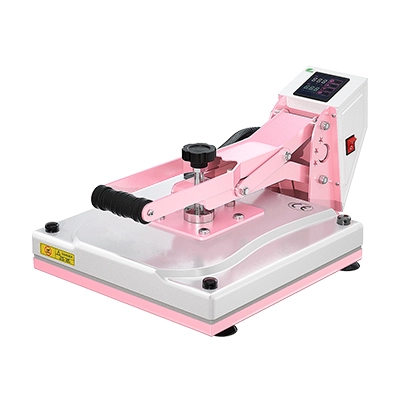
Clamshell presses feature a top platen that opens and closes on a rear hinge, much like a mouth. You load your shirt on the lower platen and pull the lever down to lock it in place.
Strengths:
Small physical footprint. You can run one on a standard 24-inch-deep utility workbench without side clearance.
Fast cycle times. Clamping down and popping up requires minimal arm motion.
Lower structural cost, yielding better internal heating elements for the same retail price.
Weaknesses:
The pinching angle can create uneven pressure near the rear hinge if you press thick blanks like heavyweight fleece hoodies.
Your hands work directly under the hot platen when positioning designs, increasing burn risks.
On a swing-away machine, the top platen lifts straight up and rotates 360 degrees to the left or right, leaving the bottom platen open and accessible.
Strengths:
True vertical down-force. The platen lands flat on your garment, delivering identical pressure to all four corners.
Safer garment setup. With the 400°F heating element swung completely away, you can place transfers and line up collars without singeing your knuckles.
Broad material thickness tolerance. These handles accommodate thick wooden signs, ceramic tiles, and thick canvas without wedging.
Weaknesses:
Requires double the desktop space to allow the swing radius.
Slightly slower production flow when pressing hundreds of identical single-color t-shirts.
Draw-style presses pull the lower platen out toward you on drawer slides, giving you the safety of a swing-away within the narrow footprint of a clamshell.
Combo machines (such as 5-in-1 or 8-in-1 sets) include interchangeable attachments for baseball caps, coffee mugs, and plates. While tempting for beginners, low-cost combo units often suffer from loose wiring connectors and flimsy attachment brackets. If your core product is apparel, invest your capital in a dedicated flat-bed press first. You can add a dedicated mug or cap press when market demand justifies it.
| Press Type | Space Needed | Pressure Uniformity | Safety Clearance | Best Applications |
|---|---|---|---|---|
| Clamshell | Low | Moderate (Pinch risk on thick items) | Moderate (Hands near heat) | T-shirts, tote bags, thin vinyl jobs |
| Swing-Away | High | High (Direct vertical force) | High (Platen swings away) | Hoodies, DTF gang sheets, hard goods |
| Draw Style | Moderate | Moderate to High | High (Lower bed slides out) | Compact production shops, apparel lines |
| Multifunction Combo | Moderate | Low to Moderate | Varies by attachment | Hobbyists testing multiple product types |
Marketing brochures highlight digital screens and bright paint colors. Commercial printers look at thermal mass, structural steel gauges, and heating circuit density. When searching for the best beginner heat press, audit these five technical parameters.
Craft presses often come in 9x9 or 10x12 inches. These dimensions fail quickly once you print adult medium to 2XL garments. Standard adult chest prints measure between 10 to 12 inches wide, while back graphics reach 13 to 14 inches.
If you use a 12x15 platen, you will have to double-press oversized graphics, which leaves heat lines down the center of your designs. A 15x15-inch platen serves as the true commercial baseline. It covers full-front chest prints, large back transfers, and youth apparel in a single press. If you plan to print streetwear or oversized workwear jackets regularly, consider jumping straight to a 16x20-inch model.
Modern transfer methods tolerate little thermal deviation. Sublimation requires a steady 385°F to 400°F to activate inks, while DTF powder adhesives melt between 300°F and 325°F. If the center of your platen hits 320°F while the outer two inches drop to 295°F, your prints will look crisp initially but wash out after one laundry cycle.
Look for platens with dense, serpentine heating elements cast directly into the aluminum platen. Industrial equipment, like the hardware engineered by Heat Press Leader, maintains an edge-to-edge variance of less than 5°F to 10°F. Low-grade hobby machines often show cold drops of 25°F or more along the perimeter.
Heat transfer vinyl requires firm pressure to sink into the fabric weave. DTF transfers require medium, flat pressure to bond adhesive without squeezing the ink into a distorted paste. A dependable press features a center-mounted pressure adjustment spindle with an over-the-center mechanical linkage. This design spreads down-force across the whole plate rather than bending the frame backwards.
Pressing shirts generates heat fatigue. Look for heavy-duty structural steel frames that do not twist when clamped down. The top cover must incorporate a thermal shield so you do not burn your forearm if you accidentally brush the top casing. A long, padded lever handle reduces the physical effort needed to lock the press into high-pressure mode.
An electromagnetic release turns a manual press into a semi-automated production workstation. When the digital timer counts down to zero, an electromagnet releases the clamp, and gas shocks raise the platen automatically. This mechanism prevents scorched garments if a customer calls or your attention drifts to a vinyl weeding table.
Rather than chasing flashy gimmicks, focus on machine classes that balance your capital outlay against manufacturing reliability. Here are the four primary configurations that fit startup merch operations:
This setup works best for home hobbyists who run small batches of custom tees or canvas tote bags. It operates on a standard domestic 110V circuit, fits on a sturdy home desk, and gets your apparel business running with low upfront investment. The key drawback is limited clearance for bulky winter jackets.
If you plan to press thick blanks, leather patches, wood signs, and DTF gang sheets, a 15x15 swing-away configuration is hard to beat. It provides the most consistent mechanical pressure across the substrate. It demands a dedicated, heavy-duty workshop bench with plenty of room on the swing side.
Equipped with a magnetic auto-release and a pull-out lower drawer, this configuration represents the sweet spot for an expanding Etsy apparel business. It protects your designs from over-pressing, eliminates wrist strain, and lets a single operator prep and press items at a rapid pace.
For entrepreneurs aiming to serve custom corporate merch clients, look for a base machine that supports quick-change lower platens (such as shoe platens, sleeve platens, and pocket platens). Swapping the base allows you to print hoodies without pressing over the front kangaroo pocket or zipper.
Buying the best beginner heat press is only half the battle. Your operating habits determine whether transfers survive the wash cycle.
Do not guess your pressure setting. Take four strips of standard printer paper. Place one strip under each corner of the platen, with half of each strip sticking out. Clamp the press down cold at your intended pressure setting. Pull each strip out by hand.
If all four strips pull out with firm, equal resistance without tearing, your platen sits flat and applies even pressure.
If one strip slides out with zero resistance while another tears instantly, your machine is out of alignment, and your transfers will fail on the loose side.
Skipping the Pre-Press: Cotton and poly-blend fabrics hold moisture from ambient air. Press the blank garment for 5 seconds before positioning your design. This drives out steam and flattens fabric wrinkles. Trapped moisture under a transfer causes immediate bubbling and peeling.
Pressing Over Seams, Zippers, and Buttons: A thick seam lifts the metal platen off the graphic, dropping local pressure to zero. Use heat press pillows or raised pressing pads to elevate the print area above seams and collars.
Ignoring Peel Temperature Requirements: Some DTF and screen-print transfer films are warm peel, while others are strictly cold peel. Peeling a cold-peel transfer while it remains hot pulls the adhesive away from the fabric fibers, leaving jagged edges.
Relying on the Factory Temperature Display: Factory thermocouples can drift. Purchase an inexpensive non-contact infrared thermometer or high-temperature test strips to confirm that 320°F on the screen matches the actual temperature on the metal face.
Q1: Can a beginner heat press handle DTF transfers and sublimation?
A1: Yes, provided the press reaches and holds 400°F (for sublimation) and applies stable medium-to-firm pressure (for DTF). Sublimation requires high, consistent heat to turn dye into gas. DTF requires precise, uniform pressure across the entire graphic to fuse powdered hot-melt adhesive into garment fibers without shifting.
Q2: How does a Cricut EasyPress differ from a traditional heat press?
A2: A Cricut EasyPress is essentially a flat, temperature-controlled hand iron without a mechanical clamping frame. The operator must supply down-force by pressing down with their arms and upper body. A traditional heat press uses a mechanical steel lever to generate hundreds of pounds of uniform pressure without operator fatigue, making it the only reliable choice for commercial retail products.
Q3: Can standard household electrical outlets run a commercial beginner heat press?
A3: Most 15x15-inch beginner heat presses draw between 1400 and 1800 watts, pulling roughly 12 to 15 amps on a standard 110V/120V circuit (or 7 to 8 amps on a 220V/240V supply). They run safely on common household circuits, but you should not run a laser printer, embroidery machine, or space heater on the same circuit breaker while the press heats up.
Q4: What is a realistic budget for the best beginner heat press in 2026?
A4: Expect to spend between $200 and $450 for a reliable manual 15x15-inch clamshell or swing-away starter machine. Semi-automated units with magnetic auto-open latches and slide-out lower drawers typically run between $450 and $850. Machines priced below $150 often suffer from thin platen castings, uneven heating elements, and short operational lifespans.
Q5: How do I know if my platen pressure is even across the entire surface?
A5: Perform the four-corner paper pull test using strips of copy paper placed at each corner of the bed. For advanced verification, use thermal imaging paper or run a transfer on a large scrap fabric piece, wash it three times, and check if the corners peel faster than the center.
Starting an apparel or merchandise venture requires dependable tools. While it may feel sensible to purchase the smallest, cheapest device available, upgrading your workspace every six months wastes capital and ruins expensive garments. Choosing the best beginner heat press means securing a machine with reliable thermal consistency, solid steel construction, and enough pressing area to handle adult-sized custom goods.
Plan your purchase around where you expect your business to be six months from now. Select a machine that handles your core apparel needs today while leaving room to run DTF transfers, sublimation blanks, and oversized fleece wear tomorrow.
At Heat Press Leader, we help print shops, startups, and established retail brands select and source high-durability heat press machines built to factory standards. Submit an inquiry to our technical team today to discuss equipment specifications, request bulk quotes, or discover the right machinery setup for your custom apparel production line.