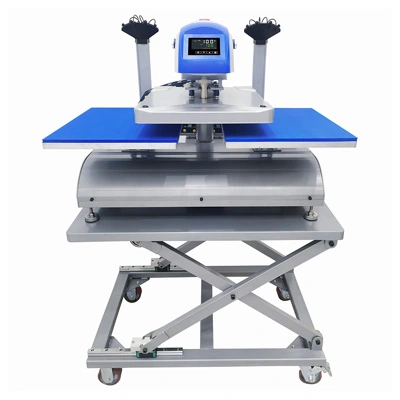
An electric heat press machine uses electric motors to automate part of the mechanical pressing process.
Depending on the machine design, electric drive may control the heat platen, pressure movement, drawer movement, opening and closing, or a complete pressing cycle.
This changes the operator’s role.
Instead of manually creating or releasing pressing force during every cycle, the operator can spend more time loading garments, positioning transfers, checking finished products, and preparing the next order.
However, “electric” does not automatically mean that every electric heat press works the same way.
One machine may use motor-driven pressing but retain a manual loading structure. Another may automate both pressing and drawer movement. Some models add touchscreen controls, pressure feedback, positioning aids, interchangeable platens, or additional heating configurations.
For commercial buyers, the important question is therefore not simply:
Is the machine electric?
A more useful question is:
Which parts of the production cycle are electrically controlled, and how do those functions improve the work performed by the operator?
An electric heat press is most valuable when motor-driven movement removes repetitive actions, makes pressing cycles easier to repeat, and fits naturally into the garment loading and positioning process. Automation should improve the workstation—not simply add more functions to the control panel.
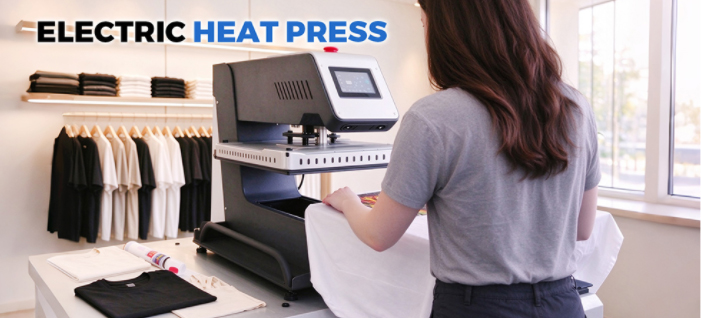
An electric heat press uses an electrically driven mechanical system to perform pressing movements that would otherwise depend on manual force or compressed air.
Depending on the design, the electric system may control:
· Press opening and closing;
· Heat platen movement;
· Pressure application;
· Drawer movement;
· Automatic cycle completion.
This should not be confused with the electrical heating system itself.
Almost every heat press requires electricity to heat the platen. The term electric heat press usually refers to equipment where the pressing or mechanical movement is also electrically driven.
That distinction matters when comparing commercial machines.
A manual heat press may use electricity for heating but still require the operator to physically close and lock the press.
A fully electric machine can use motor-driven movement to perform more of that mechanical work automatically.
“Electric operation” can describe different machine architectures.
Before purchasing, buyers should ask exactly which movements are motorized.
For example, the Cyber Auto Press I MATE450-E is described in the 2026 XINHONG catalogue as a fully electric automatic heat press. The catalogue states that both the heat platen and drawer are motor-driven and also lists one-button workflow, touchscreen control, laser positioning, real-time pressure feedback, and interchangeable platens. 2026欣弘产品手册(电子文件)
That creates a different operating sequence from an electric press where only the pressing action is motorized.
Useful questions include:
· Does the upper platen move automatically?
· Does the lower drawer move automatically?
· How is pressure adjusted?
· Does the machine automatically open after the timer ends?
· Can the operator interrupt or control movement when required?
· Which actions still require manual input?
These questions reveal much more about daily usability than the word “automatic” alone.
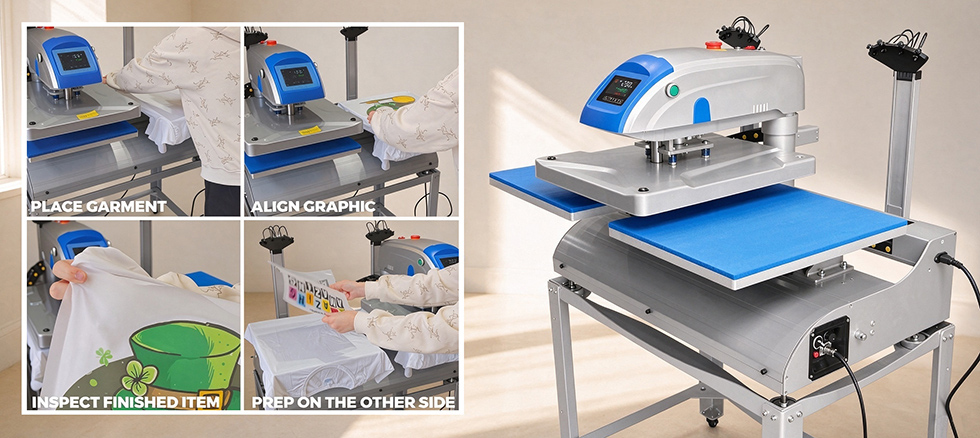
The main practical effect of electric drive is reduced dependence on repetitive manual pressing actions.
Consider a simplified manual workflow:
Load → Position → Manually Close → Lock / Apply Pressure → Wait → Release → Open → Unload
An electric workflow may reduce the number of physical actions required from the operator:
Load → Position → Start Cycle → Machine Presses → Machine Releases → Unload
The exact sequence depends on the machine design.
The benefit is not simply convenience.
In repeated commercial production, removing one manual action from hundreds of cycles can affect:
· Operator fatigue;
· Workflow consistency;
· Training requirements;
· Production rhythm;
· Time available for garment handling.
However, electric drive does not remove every manual task.
The operator still needs to manage the garment, transfer, orientation, application requirements, and finished-product inspection.
A well-designed electric heat press therefore divides work appropriately:
The machine manages repetitive mechanical movement.
The operator manages product preparation and production decisions.
Pressure is one of the main variables in heat transfer production, together with temperature and time.
But “pressure control” can refer to different functions.
Pressure adjustment determines how much pressing force the machine is instructed to apply.
Depending on the system, this may be set mechanically, digitally, or through motor control.
Pressure feedback gives the operator information about the pressure being applied during the cycle.
These are not the same thing.
A machine can allow pressure adjustment without displaying live pressure information.
The MATE450-E catalogue specifically lists real-time pressure feedback, allowing pressure information to be monitored through the control system during operation.
For commercial users, feedback can be useful when:
· Production recipes need to be repeated;
· Several operators use the same machine;
· Different products require different pressure settings;
· The team wants a clearer reference than subjective “light / medium / heavy” pressure.
However, pressure data does not replace application testing.
The correct setting still depends on:
· Transfer material;
· Fabric;
· Garment thickness;
· Product construction;
· Transfer supplier recommendations.
Higher pressure is not automatically better.
A commercial heat press does not need a complicated touchscreen to produce good transfers.
But digital controls can help reduce unnecessary variation when production is repeated throughout the day.
Useful control functions may include:
· Temperature setting;
· Timer setting;
· Pressure adjustment;
· Saved settings;
· Preset workflows;
· Multiple timing stages;
· Pressure monitoring.
The MATE450-E catalogue describes a large touchscreen with temperature control, saved settings, and customizable production workflows.
The practical value becomes clearer when a shop handles repeated jobs.
For example, a production team may regularly switch between:
· DTF T-shirts;
· HTV logos;
· Sportswear;
· Bags;
· Different garment thicknesses.
Stored settings can reduce the need to recreate every operating condition from memory.
The operator still needs to verify the correct production recipe, but the control system can make that recipe easier to reproduce.
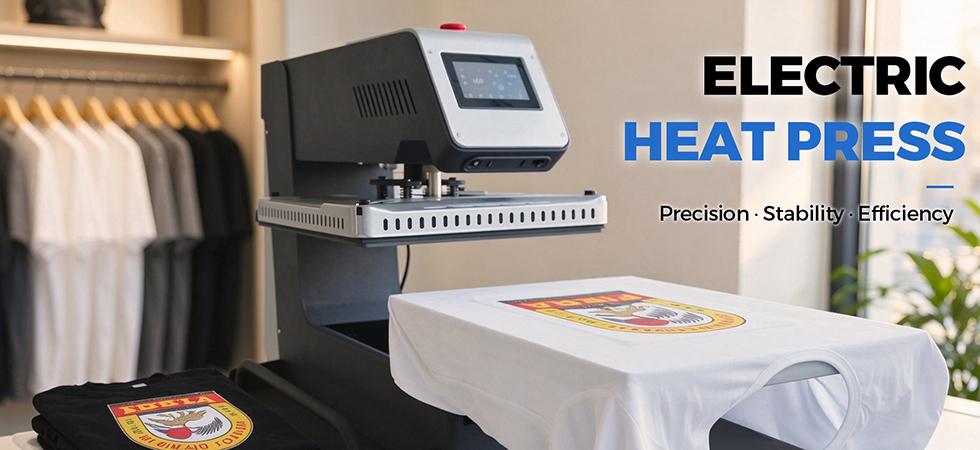
A highly automated pressing system can still be inefficient if garments are difficult to load.
This is why electric heat press evaluation should include the mechanical loading structure.
The Flex AutoPress I B2-N provides a useful example.
According to the catalogue, the B2-N combines fully electric operation with:
· Swing-away and pull-out drawer design;
· Threadable lower platen;
· Interchangeable platens;
· Digital control;
· Electric motor operation without an external air compressor.
This illustrates an important distinction between automation design and loading design.
Automation controls how the machine presses.
Loading design controls how the operator handles the product.
Both affect commercial workflow.
A buyer processing mainly flat T-shirts may prioritize simple, fast loading.
A business handling sleeves, labels, bags, or specialty products may care more about:
· Platen access;
· Threadability;
· Interchangeable platen options;
· Clearance around seams or product edges.
The best electric heat press is therefore not necessarily the machine with the most automated movements.
It is the machine whose automation and loading structure fit the products being produced.
Electric single-station machines remain useful even when dual-station systems are available.
A single station can offer several practical advantages:
· Compact footprint;
· Straightforward operator position;
· Easier product changeover;
· Flexible application handling;
· Lower workflow complexity.
A typical cycle may look like:
Load Garment → Position Transfer → Start Automatic Cycle → Unload → Inspect → Repeat
This structure can work well when:
· Batch sizes are moderate;
· Products change frequently;
· One operator manages the whole process;
· The production team prioritizes flexibility;
· Floor space is limited.
This differs from the dual-station logic covered in XH Article 02.
A dual station uses a second workstation to overlap preparation and pressing.
A single-station electric press instead focuses on making the individual production cycle easier and more repeatable.
That distinction helps buyers decide whether their problem is:
too much manual effort
or
too much waiting between cycles.
If manual operation is the problem, electric automation may be enough.
If press-cycle waiting is the problem, dual workstations may deserve further evaluation.
Electric heat presses can support several heat transfer applications, but the application determines how useful specific features are.
A typical DTF heat press process may involve:
Garment Preparation → Pre-Press → Transfer Placement → Main Press → Peel → Re-Press
Electric automation can simplify repeated pressing actions, but actual DTF efficiency also depends on:
· Film preparation;
· Garment loading;
· Transfer positioning;
· Peel method;
· Re-press requirements.
HTV production may involve frequent changes in artwork, garment size, and application area.
Easy loading and flexible platen options can therefore matter as much as automatic pressing.
For sleeves, bags, labels, patches, and smaller transfer areas, interchangeable platens can make the machine more adaptable.
The catalogue lists interchangeable platen capability for both the MATE450-E and B2-N platforms.
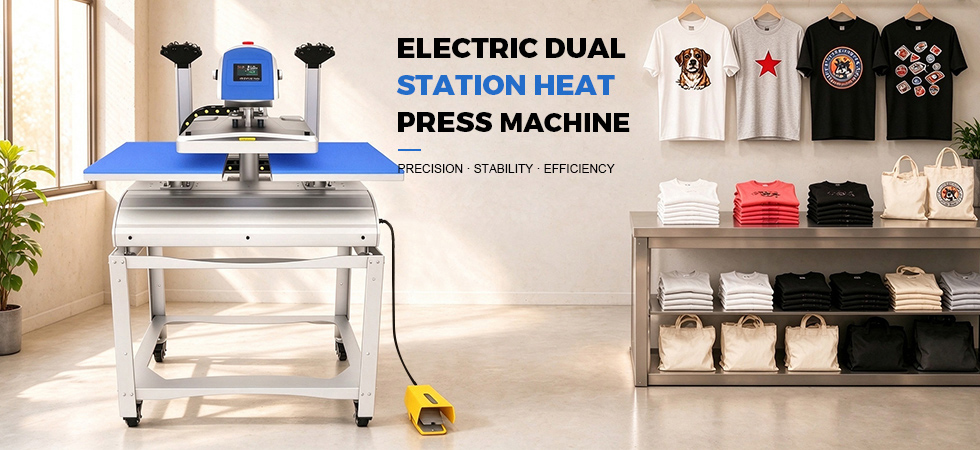
Electric and pneumatic heat presses can both automate pressing movement.
The main difference is how that movement is generated.
An electric system uses electric motors.
A pneumatic system uses compressed air.
For the equipment buyer, this affects more than the machine itself.
Potential considerations include:
· No external compressor for motor-driven models;
· Reduced compressor-related noise;
· Electrical installation requirements;
· Motor and control-system maintenance;
· Digital integration.
Potential considerations include:
· Compressor requirement;
· Air pressure and air consumption;
· Air-line installation;
· Existing factory air infrastructure;
· Pneumatic maintenance capability.
This article does not need to decide which is universally better because the answer depends on the facility.
The important point is that drive system selection should include installation and maintenance conditions, not only pressing performance.
A full Electric vs Pneumatic comparison should be handled separately in a dedicated article.
Automation is useful only when it addresses a real production problem.
An electric heat press cannot automatically solve:
· Slow transfer printing;
· Poor garment organization;
· Inconsistent artwork preparation;
· Limited operator training;
· Incorrect transfer parameters;
· Slow peeling;
· Packaging backlogs.
Consider a workshop where each heat press cycle finishes quickly, but the operator spends most of the time searching for the correct transfer and garment.
Replacing the press with a more automated machine may have little effect on finished output.
Similarly, if garments accumulate after pressing because inspection and packaging cannot keep up, increasing heat press capacity may only create a larger queue.
Before upgrading, businesses should measure where time is actually being lost.
Useful measurements include:
· Garment loading time;
· Transfer positioning time;
· Press cycle time;
· Operator waiting time;
· Product changeover time;
· Peeling and finishing time;
· Finished-order output.
The machine should improve the slowest relevant part of the process.
A product demonstration should show more than an empty machine opening and closing.
Ask to see the complete operating sequence:
1. Load a real garment;
2. Position a transfer;
3. Set or recall the required controls;
4. Start the electric pressing cycle;
5. Observe machine movement;
6. Check pressure control or feedback;
7. Unload the product;
8. Change to another product or platen if required.
Also verify:
· Voltage;
· Power requirements;
· Working area;
· Maximum accepted product thickness where relevant;
· Machine footprint;
· Service access;
· Loading clearance;
· Platen options;
· Available control functions.
If possible, test the machine using the same garments and transfers that will be used in actual production.
That is more useful than judging automation from a specification sheet alone.
XH approaches electric heat press equipment from two connected perspectives:
machine movement and operator workflow.
Different electric machines can solve different production problems.
The Cyber Auto Press I MATE450-E uses a fully motor-driven design with automated platen and drawer movement, touchscreen control, laser positioning, pressure feedback, and interchangeable platens.
The Flex AutoPress I B2-N combines electric motor operation with a swing-away and pull-out drawer structure, threadable lower platen, and interchangeable platen options.
These machines illustrate two different ways electric automation can be applied.
One emphasizes automated machine movement and control.
The other combines electric pressing with flexible garment loading.
For XH, electric heat press design should be evaluated around a practical question:
Which repetitive machine actions should be automated, and which loading tasks still need to remain easy for the operator?
An electric heat press uses electric motor-driven mechanisms to perform part of the mechanical pressing process, rather than relying only on manual force or compressed air.
Most heat presses use electricity to heat the platen, but an “electric heat press” generally refers to a machine where pressing or mechanical movement is also electrically driven.
A fully electric motor-driven model generally does not require an external compressor for its pressing movement. Buyers should still confirm the exact machine configuration.
Pressure adjustment changes the operating pressure setting. Pressure feedback provides information about the pressure being applied during the cycle. They are related but different functions.
Yes, provided the machine’s platen, loading workflow, pressure control, and operating range fit the DTF process being used.
It can reduce repetitive manual actions and make operating cycles easier to repeat. Whether that creates meaningful value depends on production volume, product type, and workflow.
A single station is often practical for varied products and flexible production. A dual station becomes more useful when operator waiting during pressing is a significant bottleneck.
An electric heat press machine should be evaluated by more than its automation label.
The important questions are:
· Which movements are motor-driven?
· How is pressure controlled?
· Can the operator monitor or repeat settings?
· How easily can garments be loaded?
· Does the platen configuration fit the application?
· Does automation remove a real production constraint?
Electric drive can reduce repetitive manual work and standardize pressing movement.
Digital controls can make verified production settings easier to repeat.
Pressure feedback can provide a clearer reference during repeated jobs.
Pull-out drawers, swing-away structures, threadable platens, and interchangeable platens can improve the physical loading process.
But none of these features should be considered in isolation.
For XH, an effective electric heat press combines motor-driven movement, practical controls, accessible loading, and application flexibility into a workstation that makes daily commercial production easier to manage.
Before selecting an electric heat press, identify:
· Which actions operators currently perform manually;
· How often those actions are repeated;
· Whether operator fatigue affects workflow;
· Whether product loading is easy;
· Which platen sizes are required;
· Whether pressure feedback is valuable;
· Whether the business needs single- or dual-station operation;
· Whether compressed-air infrastructure is available.
Suggested CTA Button:
Find the Right Electric Heat Press Configuration