Choosing between a semi-automatic heat press machine and an electric heat press machine is not simply a choice between a basic model and a more advanced model. It is a decision about how much of the pressing cycle should be handled by the operator and how much should be controlled by the machine.
Both systems can produce professional transfers when temperature, time, pressure, materials, and operator procedures are correct. The practical difference appears in the daily workflow: how the press closes, how pressure is set, how the cycle ends, how much physical effort is required, and how easily results can be repeated across shifts.
For a start-up, a compact garment studio, a growing print shop, or an international distributor, the right level of automation should reflect real production conditions rather than a label on a product page.
Before comparing machines, ask:
· How many garments or products must be completed per hour and per shift?
· How often will jobs, materials, pressure settings, or platen sizes change?
· Will one experienced operator use the press, or will several people share it?
· Is reducing repetitive closing effort an important safety or staffing goal?
· Is compressed air available, or is an all-electric workflow preferred?
· How quickly is the business expected to grow?
The most suitable machine is the one that removes the actual bottleneck without adding unnecessary cost or complexity.

In a typical semi-automatic heat press, the operator loads the garment, positions the transfer, and manually lowers the upper platen. An electromagnetic lock holds the press closed during the timed cycle. When the timer finishes, a gas spring or similar assisted mechanism releases and raises the platen automatically.
This design automates the end of the cycle while preserving manual control over closing and pressure setup. It can prevent over-pressing when an operator is preparing another item, and it reduces the need to lift the hot platen at the exact moment the timer ends.
Pressure on many semi-automatic models is adjusted with a manual wheel. The operator therefore confirms the correct setting by process testing and by the feel or position of the adjustment system.
An electric heat press uses a motorized drive to lower the platen, build pressure, hold the cycle, and release it. On models with digital pressure control, the operator can select pressure through the controller rather than relying only on a manual adjustment wheel.
Because the drive is electric, these machines do not require an external air compressor. That can make installation cleaner and quieter than a pneumatic system while still providing a higher level of cycle automation.
The word automatic can be misleading. A single-station electric press may automate platen movement and pressure but still require a person to load, align, peel, and unload every item. A dual-station electric press can automate movement between working areas, yet the operator still prepares one station while the other is pressing.
Fully automatic multi-station systems go further by integrating multiple process steps. They belong to a different production category and should not be confused with a motorized single- or dual-station machine.

A semi-automatic cycle normally follows this sequence:
· Load the garment or substrate.
· Position the transfer and protective sheet.
· Lower and lock the platen manually.
· Allow the timed cycle to run.
· Let the platen release and rise automatically.
· Peel or cool according to the transfer instructions, then unload.
This workflow is intuitive and gives the operator direct control. However, each cycle still includes a manual closing motion. Over hundreds of repetitions, closing force, reach distance, machine height, and workstation design can influence fatigue.
With an electric machine, the operator typically loads and aligns the product, starts the cycle using the control or foot pedal, and lets the motor perform the pressing movement. The machine applies the selected pressure and opens automatically at the end.
The benefit is not only convenience. A controlled movement can reduce physical variability between operators and make training more straightforward. It can also help employees focus on placement, peeling, quality inspection, and preparation of the next item.
· How many closing cycles will one operator perform in a shift?
· Does the work require frequent pressure changes?
· Can the press be positioned at a comfortable loading height?
· Would a foot pedal improve two-handed garment placement?
· Do multiple operators need to reproduce the same setup?
· Could automatic movement reduce fatigue enough to improve sustained output?
For occasional pressing, the manual closing step may not be a meaningful limitation. For long shifts or multi-operator production, it may become one of the strongest reasons to move to electric control.
Buyers often compare timer settings as if they determine hourly output. In practice, the heat-transfer recipe sets the pressing time, while total throughput also depends on loading, alignment, pre-pressing, peeling, unloading, inspection, and the movement of the platen or drawer.
A faster opening mechanism does not solve slow artwork placement. A dual-station machine does not create value if the operator cannot keep both stations supplied. The entire work cell must be considered.
Semi-automatic machines are often effective for short and medium production runs, made-to-order work, sampling, mixed garments, and shops that change designs frequently. The automatic release protects the timed cycle while the operator prepares the next transfer or handles another nearby task.
Electric control becomes more valuable when repetitive closing is a constraint, consistent pressure settings must be reproduced, or production runs are long enough to benefit from a standardized cycle. A dual-station electric heat press can further reduce idle time because one platen area can be loaded while the other is pressing.
Consider the following production signals:
· Orders are becoming larger and more repetitive.
· The press is staffed for several hours without long breaks.
· Different operators produce visibly different results.
· The operator regularly waits for the press instead of preparing the next item.
· The business plans to add a second shift or a second work station.
· Reducing handling time is more important than minimizing initial purchase price.
If these conditions are not present, a well-designed semi-automatic press may provide a better return than paying for automation that remains unused.

Transfer quality depends on the correct combination of temperature, time, and pressure. Insufficient pressure can lead to poor adhesion, incomplete edges, or reduced wash durability. Excessive pressure can mark fabrics, force adhesive beyond the artwork, or damage sensitive materials.
A manual pressure wheel is simple, familiar, and effective when the operator understands the application. It works especially well when the same garment and transfer process are used repeatedly. The limitation appears when pressure must be changed often or reproduced precisely after another job.
Good operating procedures can reduce this risk. Record the garment, transfer type, platen, temperature, time, pressure position, and test result for every approved recipe.
Digital pressure control can make changeovers more repeatable. An operator can select a defined pressure setting, confirm it on the controller, and use the same recipe on a later run. This is useful for multi-step applications, thicker products, several operators, and businesses that need documented process settings.
An electric drive does not automatically correct an uneven platen, an unsuitable pad, inaccurate temperature, poor artwork placement, or the wrong transfer instructions. Buyers should evaluate:
· Temperature accuracy and distribution across the working area.
· Pressure uniformity and the usable thickness range.
· Frame stability and platen alignment.
· Controller accuracy, timer functions, and recipe repeatability.
· Availability of interchangeable lower platens and protective accessories.
· Real transfer samples produced with materials similar to their own.
The best comparison is a controlled test using the same transfer, substrate, settings, and inspection criteria on both machines.

Both semi-automatic and electric heat presses require a suitable electrical supply for the heating system. Electric-drive models also power the motorized motion system. Confirm voltage, frequency, plug type, rated power, circuit capacity, and grounding requirements for the destination market before ordering.
A major advantage of electric automation is that it can deliver automated pressure without a pneumatic air supply. This avoids the purchase, floor space, noise, air lines, moisture control, and routine servicing associated with an air compressor.
This comparison is especially important when a buyer is choosing between electric and pneumatic equipment. A semi-automatic press also does not require an air compressor, but it achieves its assisted cycle through manual closing, an electromagnetic lock, and a release mechanism rather than a motorized pressure system.
Semi-automatic machines have a relatively direct mechanical operating system, but the gas spring, magnetic lock, hinges, wiring, pad, controller, and heating components still require inspection. Electric presses add motors, drive mechanisms, sensors, and control components that should be supported with clear service information and available replacement parts.
Before purchase, ask for:
· The user manual and maintenance schedule.
· A spare-parts list with part identification.
· Troubleshooting procedures for the controller and drive system.
· Warranty coverage and the replacement-part process.
· Remote diagnostic support and operating videos.
· Packaging dimensions and gross weight for installation planning.
A machine should be selected around what will actually be pressed. T-shirts, hoodies, sportswear, tote bags, patches, labels, caps, and rigid sublimation products do not all require the same platen, access, pressure, or loading method.
Confirm compatibility with the intended process, such as DTF, HTV, sublimation, transfer paper, embroidered patches, or curing steps. The transfer supplier's instructions should remain the starting point for temperature, time, and pressure.
A pull-out drawer keeps the operator's hands farther from the hot upper platen and provides a clear surface for garment positioning. A swing-away structure can offer even more access, especially for thicker products or applications that need careful placement.
Threadable lower platens and interchangeable platen sizes can reduce seams, zippers, buttons, or pockets from interfering with pressure. They may provide more practical flexibility than moving immediately to a higher automation level.
Measure the press when closed, open, and fully extended. Include clearance for a drawer, swing arm, dual stations, operator movement, finished-product racks, transfer storage, and maintenance access. A compact machine can be more productive than a larger one if the larger system disrupts the work cell.
For dual-station equipment, plan the direction of garment flow so the operator can load, activate, unload, and inspect without crossing paths or repeatedly turning away from the machine.
Semi-automatic machines generally require a lower initial investment than electric machines with motorized pressure control. That can preserve cash for transfers, garments, pretreatment, a printer, finishing tools, or marketing during the early stage of a business.
Electric automation may justify its higher purchase price when it reduces repetitive effort, improves consistency between operators, or supports enough additional output to absorb the cost. Calculate the value using realistic orders, staffing, shift length, and selling margins rather than a theoretical maximum speed.
A machine that cannot be repaired quickly can become expensive regardless of its purchase price. Compare the availability of common parts, diagnostic guidance, controller support, heating components, drive-system parts, and international shipping of replacements.
· Machine and included accessories.
· Freight, customs preparation, handling, and installation.
· Electrical work, stands, tables, carts, or floor-space changes.
· Operator time, training, and ergonomic impact.
· Maintenance, wear parts, and expected replacement components.
· Scrap, rework, and production lost during downtime.
· Capacity that may be needed during the next one to three years.
The better investment is the system that delivers the lowest practical cost per acceptable transfer at the required production volume.
Use the following comparison as a starting point. The final decision should be confirmed with the exact model, application, voltage, platen configuration, and production test.
Decision Area | Practical Comparison |
Closing and opening | Semi-automatic: manual close, timed automatic release. Electric: motorized close, pressure, hold, and release. |
Pressure setting | Semi-automatic: commonly adjusted by a manual wheel. Electric: commonly set or monitored through a digital controller. |
Operator effort | Semi-automatic: repeated manual closing. Electric: reduced closing effort and a more standardized cycle. |
Typical fit | Semi-automatic: start-ups, mixed jobs, short-to-medium runs. Electric: longer runs, multi-operator shops, growth-focused commercial production. |
Utilities | Both require suitable electrical power. Neither electric nor semi-automatic designs normally require an air compressor. |
Changeovers | Semi-automatic: simple but manual pressure reset. Electric: digital pressure can improve recipe repeatability. |
Investment | Semi-automatic: lower entry cost. Electric: higher cost that should be justified by labor, consistency, or capacity benefits. |
Maintenance | Semi-automatic: assisted mechanical and magnetic system. Electric: motor, drive, sensors, and added controls require supplier support. |
Best question | Which system removes the current production bottleneck and still supports the next stage of growth? |
· Daily volume is moderate and jobs change frequently.
· A lower initial investment is important.
· One trained operator is comfortable setting pressure manually.
· Automatic opening solves the main timing and scorching risk.
· Simple, flexible single-station production is the priority.
· The press will operate for long, repetitive production periods.
· Reducing manual closing effort is a meaningful operational goal.
· Several operators must reproduce documented pressure settings.
· Frequent changeovers benefit from digital pressure control.
· A single- or dual-station workflow is needed without an air compressor.

A professional heat press manufacturer should help buyers connect machine features to real applications. Before confirming an order, ask:
· Which semi-automatic or electric model matches the target hourly and daily output?
· What part of the operating cycle is automated on this exact model?
· How is pressure set, displayed, tested, and repeated?
· What are the platen size, usable thickness, temperature range, and rated power?
· Which voltage and plug configuration will be supplied?
· Which lower platens, stands, pedals, covers, or alignment accessories are standard or optional?
· Can the supplier demonstrate a full production cycle using a similar transfer and substrate?
· What safety mechanisms and over-temperature protections are included?
· Which certifications apply to the exact model and destination market?
· Which spare parts are stocked, and how quickly can they be shipped?
· What documentation, warranty, troubleshooting, and remote support are provided?
· What are the package dimensions, gross weight, lead time, and shipping method?
For larger orders, request a production video, specification confirmation, sample test, packaging evidence, and pre-shipment inspection plan. Automation claims should be demonstrated in a complete operating cycle, not inferred from a product name.
Heat Press Leader has developed heat press solutions since 2002 and presents a broad portfolio for craft, commercial, and industrial users. The current range includes craft presses, Ultra presses, dual heat presses, hat and cap presses, mug and tumbler presses, label and tag presses, rosin presses, accessories, and higher-output automatic equipment.
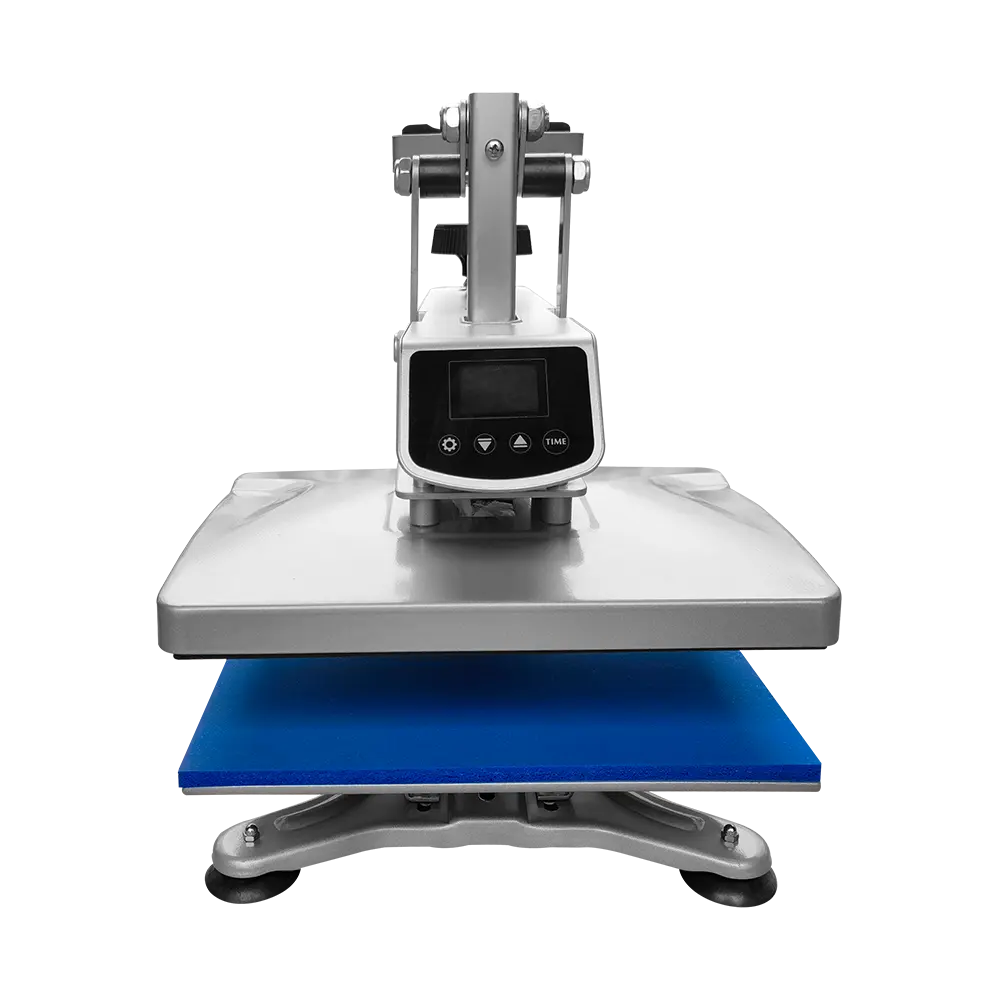
Within the 40 x 50 cm / 16 x 20 inch garment category, the HP3804D-3 illustrates the semi-automatic approach: manual pressure adjustment, assisted locking, automatic opening, a pull-out drawer, quick or interchangeable platen options, and a workflow designed to reduce over-application while keeping operation straightforward.
The B2-N illustrates the electric single-station approach, combining an electric drive, swing-away access, a pull-out work area, digital pressure control, and operation without an external air compressor. For buyers who need overlapping preparation and pressing, the B2-2N electric dual-station configuration adds two work areas and automated station movement.
These examples show why buyers should choose an automation level as part of a production plan. A semi-automatic model can be the right commercial tool when flexibility and investment control matter. An electric or dual-station system can be the better step when labor, repeatability, and sustained throughput have become the limiting factors.
Heat Press Leader's website presents OEM/ODM project support, technical information, accessories, product documentation, and model-specific certification information for international buyers. Exact voltage, configuration, included accessories, certification scope, packaging, and service terms should always be confirmed in the quotation for the destination market.

No. Electric automation is valuable when it solves a labor, repeatability, or capacity problem. For mixed short runs and moderate daily volume, a semi-automatic press may be more economical and equally capable of producing professional transfers.
In many product categories, semi-automatic refers to a press that the operator closes manually and that opens automatically after the timer ends. Confirm the exact mechanism because terminology can vary between manufacturers.
No. The defining benefit of an electric drive is that motorized pressure and movement are produced electrically. Pneumatic heat presses are the models that require a suitable compressed-air supply.
It can, especially when manual closing, pressure changeovers, operator fatigue, or single-station waiting time is the bottleneck. Output will not improve automatically if loading, artwork placement, peeling, or downstream handling remains slower than the press cycle.
Both machine types can support DTF and HTV when they provide the required temperature, time, pressure, platen access, and consistency. Choose based on the transfer supplier's process requirements and the volume and workflow of the shop.
Consider dual stations when production runs are repetitive enough for one station to be loaded while the other is pressing, and when the operator can maintain the pace. The benefit should be validated with a realistic cycle study.
Confirm voltage, frequency, plug, rated power, model and configuration, certification scope, package size, gross weight, spare parts, manuals, warranty, lead time, and the pre-shipment test. Do not rely on a general product-family description.
A semi-automatic heat press machine and an electric heat press machine can both be strong commercial tools. The difference is not simply how modern the machine appears. It is how the operating cycle fits the people, products, production volume, workspace, and growth plan around it.
Choose semi-automatic operation when automatic release, flexible job changes, and controlled investment solve the current need. Choose electric control when reduced closing effort, digital pressure repeatability, standardized operation, or dual-station capacity produces measurable value.
The best purchasing decision starts with a real workflow study and ends with a test of the exact machine configuration.
Explore our semi-automatic and electric heat press solutions at www.heatpressleader.com, or contact the Heat Press Leader project team to match platen size, voltage, pressure system, accessories, and automation level to your application.