A garment decoration business can have the right artwork, ready-to-use transfers, and enough customer orders, yet still lose valuable production time at the heat press. The delay often appears between transfers, when the operator removes one garment, loads the next, and positions the design before pressing can begin again.
An electric dual station heat press machine creates a second preparation area. While one workstation is pressing, the operator can prepare the other. This overlap helps the press move from one ready garment to the next with less waiting, making a more continuous workflow possible.
For print shops and garment customization businesses with regular batch orders, that change can be more useful than a higher maximum temperature or a longer feature list. Understanding where time is saved helps buyers choose equipment that fits the way their business actually produces.
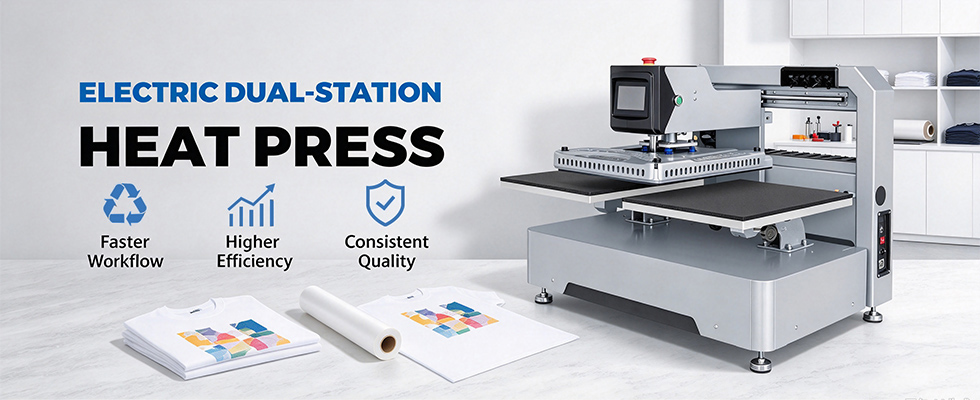
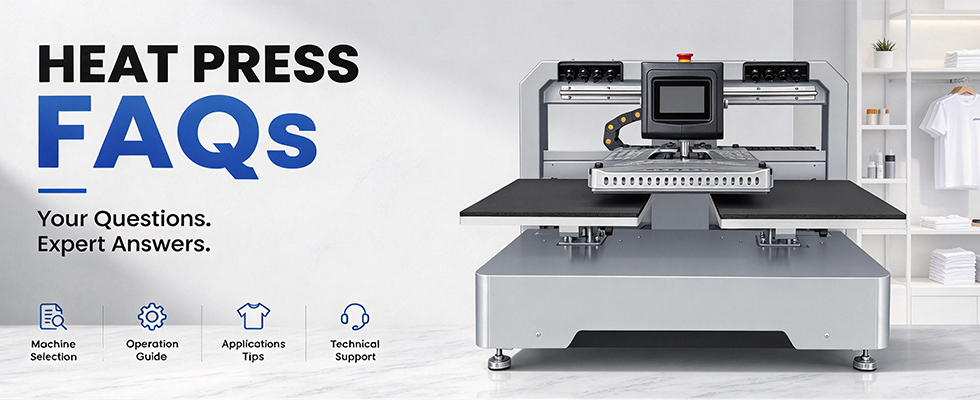
A common dual-station configuration uses two lower platens and one upper heating platen that moves between them. The lower platens hold the garments, while the heating platen applies the heat and pressure required for the transfer.
The two stations perform different jobs at the same time: one holds the item being pressed, and the other gives the operator space to unload and prepare the next item. In this shared-head design, the stations take turns pressing; having two workstations does not mean both garments are pressed simultaneously.
Electric operation refers to the drive system used for pressing, rather than simply the electricity used to heat the platen. An electrically driven pressure mechanism can reduce repeated manual closing and locking actions. A fully electric pressure system can also operate without an external air compressor.
Automatic pressing, automatic opening, and automatic movement between stations are separate functions. Buyers should confirm which actions the selected model performs and which remain with the operator. The most useful specification is the actual sequence of work, from loading a garment to starting the next transfer.
On a single-station machine, the garment occupies the only pressing surface until its cycle is complete. The operator may organize transfers nearby, but loading and positioning the next garment on that platen must wait. A second workstation makes those tasks possible during the active pressing cycle.
Production Step | Single Workstation | Dual Workstations |
Load and align | Uses the only platen between pressing cycles | Uses the available second platen during pressing |
Press the transfer | The platen is occupied throughout the dwell time | One station presses while the other is prepared |
Remove and reload | Must finish before the next garment can press | Can overlap the opposite station's pressing cycle |
Start the next cycle | Waits for garment preparation | Can start after changeover if the next garment is ready |
Main opportunity | Improve handling at one workstation | Reduce the time between successive pressing cycles |
In practice, the operator loads Station A and starts pressing, prepares Station B during that dwell time, and then alternates between the stations. After the heating platen moves to B, the operator removes the finished garment from A and prepares its replacement, following the machine's operating and safety instructions.
The transfer still receives its required pressing time. The gain comes from using that time to complete work that would otherwise delay the next cycle.
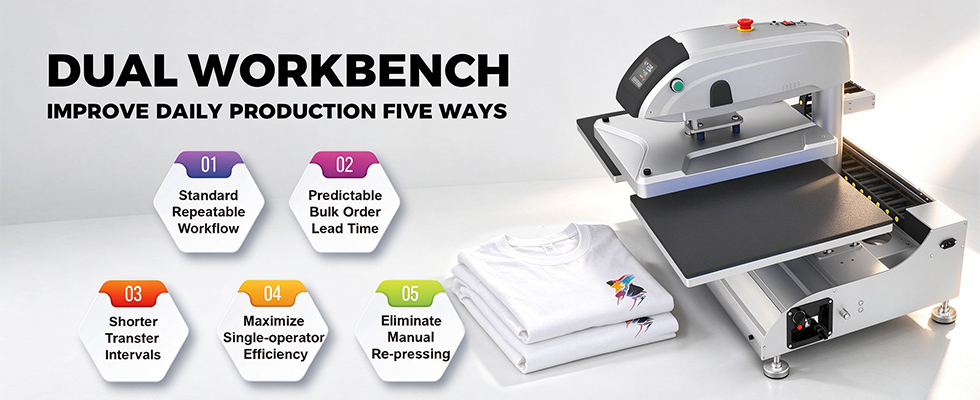
A prepared second station gives the heating platen a ready destination. On repeat orders, this can reduce the pauses caused by loading garments and aligning transfers after every press cycle. Small reductions in these pauses become meaningful when the same task repeats throughout a shift.
An operator who would otherwise wait for the platen to open can use the available station to prepare the next piece. Where access and cycle timing allow, one person can manage the alternating workflow. This makes dual stations worth evaluating for small teams that want more output from the labor they already have.
Electric actuation can remove some of the forceful closing and opening actions associated with manual presses. Across a batch, fewer repeated actions can reduce physical effort and help the operator maintain a workable pace. Garment loading and transfer alignment still need an efficient layout and a repeatable method.
Alternating stations creates a clear routine for loading, pressing, unloading, and inspection. Combined with recorded settings and consistent garment placement, that routine can make repeat orders easier to reproduce across operators. Check both lower platens and test samples before a batch so the two stations deliver acceptable results.
When the interval between finished pieces becomes more stable, the team can estimate batch completion and plan packing with greater confidence. That can help during seasonal peaks or time-sensitive promotional orders. The scheduling benefit depends on the entire line keeping pace, including transfer preparation, peeling, inspection, and packing.
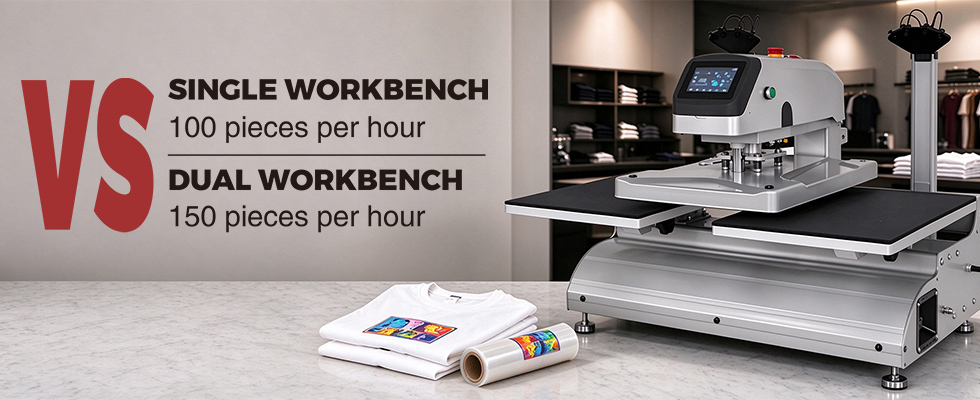
Consider a simplified order with 12 seconds of garment handling and alignment, 20 seconds of pressing dwell, and 4 seconds of opening and changeover. These are illustrative assumptions, not recommended transfer settings or measured performance for a particular machine.
With one workstation, the sequence takes 12 + 20 + 4 = 36 seconds per piece. In an ideal alternating workflow, the 12-second preparation task fits inside the opposite station's 20-second pressing dwell. After startup, the interval becomes approximately 20 + 4 = 24 seconds per piece, assuming both setups have the same 4-second changeover allowance.
Illustrative Measure | Single Workstation | Dual Workstations |
Handling and alignment | 12 seconds before pressing | 12 seconds overlapping pressing |
Pressing dwell | 20 seconds | 20 seconds |
Opening and changeover | 4 seconds assumed | 4 seconds assumed |
Interval per piece | 36 seconds | 24 seconds after startup |
Theoretical output | 100 pieces per hour | 150 pieces per hour |
In this example, the theoretical output increases by 50 percent because preparation and pressing overlap. Actual production will be lower once breaks, startup, rework, material changes, pre-pressing, peeling, and any second press are included. A trial using your own garments and transfers will show how much of the potential gain is achievable.
Orders with the same artwork, placement, and transfer settings offer a straightforward opportunity to establish an alternating rhythm. Branded T-shirts, staff uniforms, and event merchandise often contain this kind of repeated work. Grouping garments by size or placement requirements can reduce interruptions during the batch.
Direct-to-film transfers and heat transfer vinyl can benefit when garments and prepared designs are supplied in a steady sequence. The complete process still matters. A transfer that requires cooling before peeling or a second press may need an additional handling area and a different station schedule.
Canvas bags and other flat products can also suit dual-station production when the platen supports the print area and the seams or handles do not disrupt contact. Product compatibility depends on the substrate, transfer method, platen arrangement, and required pressure. Test the actual product before planning a production run.
The clearest reason to upgrade is a measurable delay at the existing heat press. If garments are waiting to be pressed while the operator repeatedly loads and aligns each new piece after the previous cycle, a second workstation directly addresses part of that delay.
Useful signs include a regular queue at the press, unused operator time during pressing, and repeat orders large enough to sustain an alternating routine. A business that can sell the additional output may also gain more from the upgrade than one whose press already has spare capacity.
For occasional orders or highly varied one-off work, a capable single-station press may remain a practical choice. Dual stations deserve closer attention when repeated garment preparation is holding back otherwise ready production. Compare the expected time savings with equipment cost, available space, and the workload you can realistically support.
HEAT PRESS LEADER's B2-2N combines an electrically driven pressing system with twin lower platens. The configuration brings garment preparation and pressing into one coordinated workflow, giving workshops a way to move beyond sequential garment handling.
The B2-2N offers LCD control of temperature, time, and pressure, multi-stage timer functions, and threadable, interchangeable lower platen options. Its fully electric pressure system requires no external air compressor. These features can support organized garment handling and repeatable setup when matched to the application.
The best way to assess the machine is to run a representative order. Observe how comfortably the operator reaches both stations, how the platen changes position, and whether the next garment is ready when pressing finishes. A useful demonstration should include the entire transfer process and the products your business actually sells.
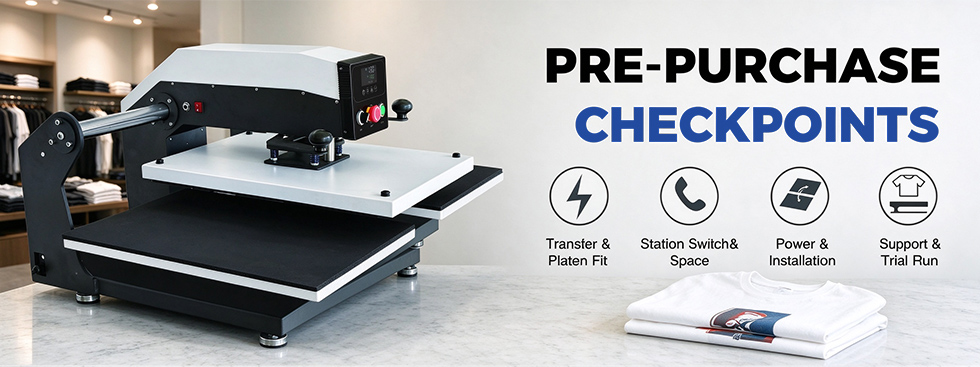
Confirm the required print area, garment thickness, and how seams, zippers, or buttons will affect pressing contact. Ask which lower platens are available and whether the machine suits the transfer method you use. Verify results with your own materials rather than relying only on the maximum temperature or pressure rating.
Watch a complete cycle and identify every manual action. Check the travel space around the heating platen, safe access to the available station, and where incoming garments and finished pieces will sit. Clear material flow helps prevent the operator from losing the saved seconds to reaching, walking, or sorting.
Confirm the machine's voltage, electrical load, support surface, and operating footprint. Verify whether compressed air is required by the selected configuration. The workshop should have enough room for the machine's full movement and for the operator to work according to the manufacturer's instructions.
Ask about replacement parts, maintenance access, platen availability, and operating guidance. During a trial, record acceptable finished pieces over a representative period, including peeling and re-pressing where required. This gives a more useful purchasing measure than the number of automatic functions listed in a brochure.
The improvement depends on how much garment handling can overlap pressing and how long changeover takes. Dual stations can substantially reduce waiting in a suitable workflow, but output must be measured with the full transfer process. Two workstations alone do not establish a fixed productivity increase.
One operator can manage many alternating workflows when garment preparation fits the pressing cycle and both stations are accessible. More complex alignment, peeling, or multi-step applications may require a different layout or additional help. A production trial will show what is practical for the order.
A fully electric pressure system such as the B2-2N does not require an external air compressor. Pneumatic models require a compressed-air supply, even though their heating platens use electricity. Confirm the pressing drive system rather than assuming that every machine described as automatic is compressor-free.
In a shared-head design, the stations use the same upper heating platen. They should not be treated as two independently heated presses. Check the controller's supported settings and sequence before combining products, and group orders with compatible requirements whenever possible.
A faster workflow can maintain quality when it reduces handling delays while preserving the validated pressing time, temperature, pressure, and peel procedure. Inspect trial pieces from both stations. Increasing speed by shortening an unverified pressing cycle can create failures and add rework.
An electric dual station heat press machine improves production efficiency by giving garment preparation a place to happen while pressing is underway. For businesses with repeated orders and a busy heat press station, that overlap can help turn waiting time into productive work and create a steadier flow of finished garments.
If loading and alignment are slowing your current operation, evaluate an electric dual-station setup with a representative batch. HEAT PRESS LEADER's B2-2N provides an option to explore. Discuss your garments, transfer process, and production target with the supplier so the machine and platen configuration fit the orders you need to deliver.


