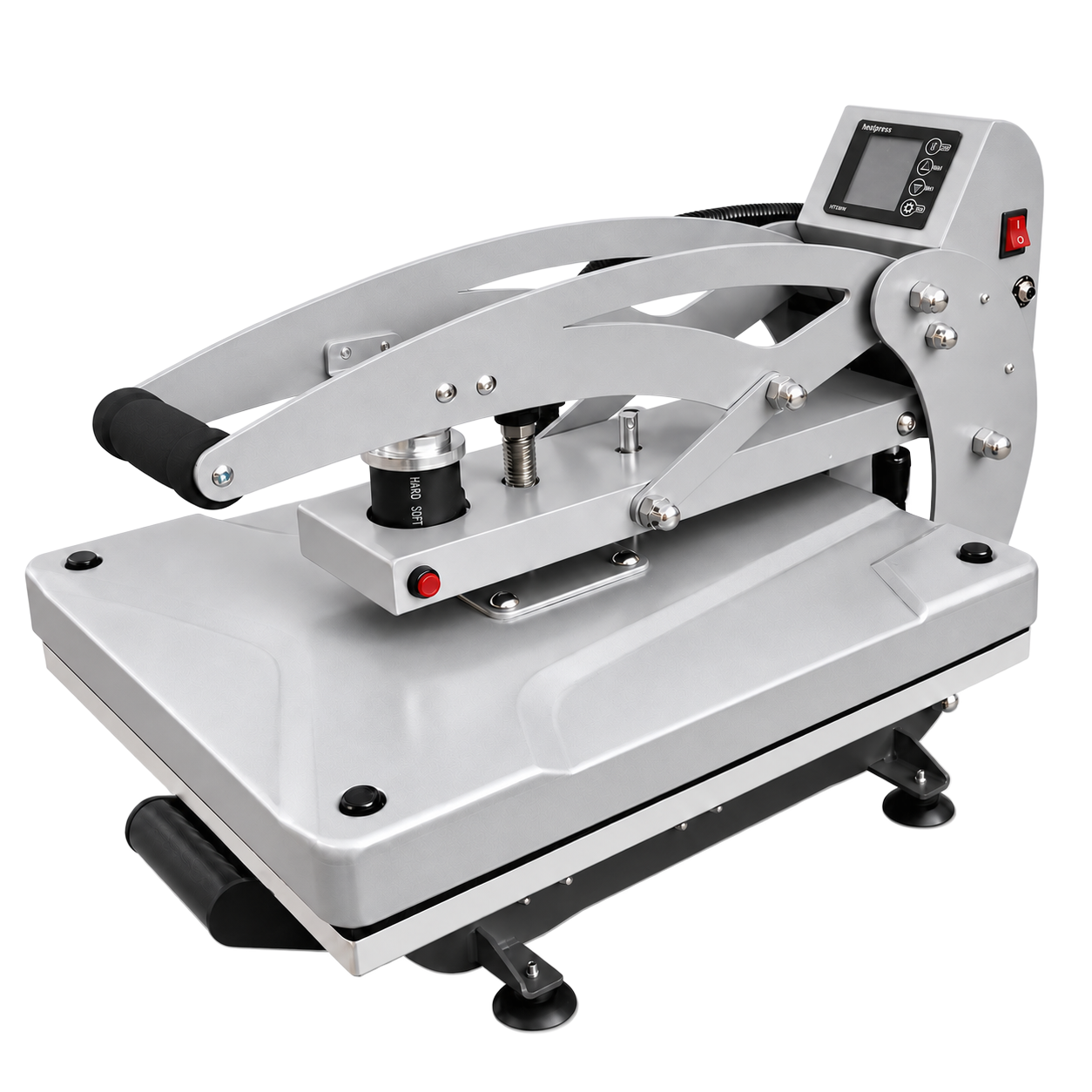
Most quotes list platen size and price. They rarely show the swing radius, the real cycle time, or the cost of a bad loading position.
This guide covers the checks that matter before you buy, the buyer types that benefit most, and the installation details that decide whether the machine earns its space.
Heat Press Leader builds manual and semi-automatic swing-away presses for apparel decorators. If you are sourcing for a team, send your floor plan, substrate mix, and weekly volume early. A short brief gets you a machine recommendation and a quotation instead of a generic spec sheet.

What a swing away heat press machine changes on the floor
The mechanism changes three things: loading access, heat separation, and floor space. Each one affects how the shop works, not just how the machine looks.
Loading access: the lower platen is open, so the operator can smooth a shirt, center a print, and check seams without reaching around hot metal.
Heat separation: the heated surface moves away from the hands during loading. That does not replace safe practice, but it reduces the chance of a careless burn.
Floor arc: the arm needs side clearance. A clamshell may fit a narrower bay; a swing-away may need more room to the side.
Throughput: the next piece can be positioned while the previous one cools, especially when the press has a slide-out drawer.
Operator stance: the loading position should let the operator stand square to the platen, not twist at the waist for every piece.
A clamshell may fit a tighter footprint. A swing-away may reduce awkward reaching and make thick goods easier to load. The trade-off is real, so measure both before you decide.
Press safety deserves its own review. ISO 12100:2010 sets the general principles for identifying hazards and reducing risk in machine design, and that includes the swing arc, the clamp, and the heated platen.
Swing away heat press machine recommendations by user group
The same mechanism serves different shops differently. Use these profiles to narrow the field before you compare prices.
One-person studios
A manual swing-away press is the simplest fit. It costs less, takes one operator, and gives direct feedback through the handle. For low volume and mixed jobs, that feel is useful.
Put the budget into a stable frame and a controller that holds temperature. Those details affect reject rates more than extra features. Write down the pressure setting and dwell time, and check the first piece from every batch.
Growing apparel brands
A semi-automatic swing-away press reduces the physical work of every cycle. The operator still loads and positions the garment, but the machine applies the clamp. That helps when the same person also handles orders, packing, and customer service.
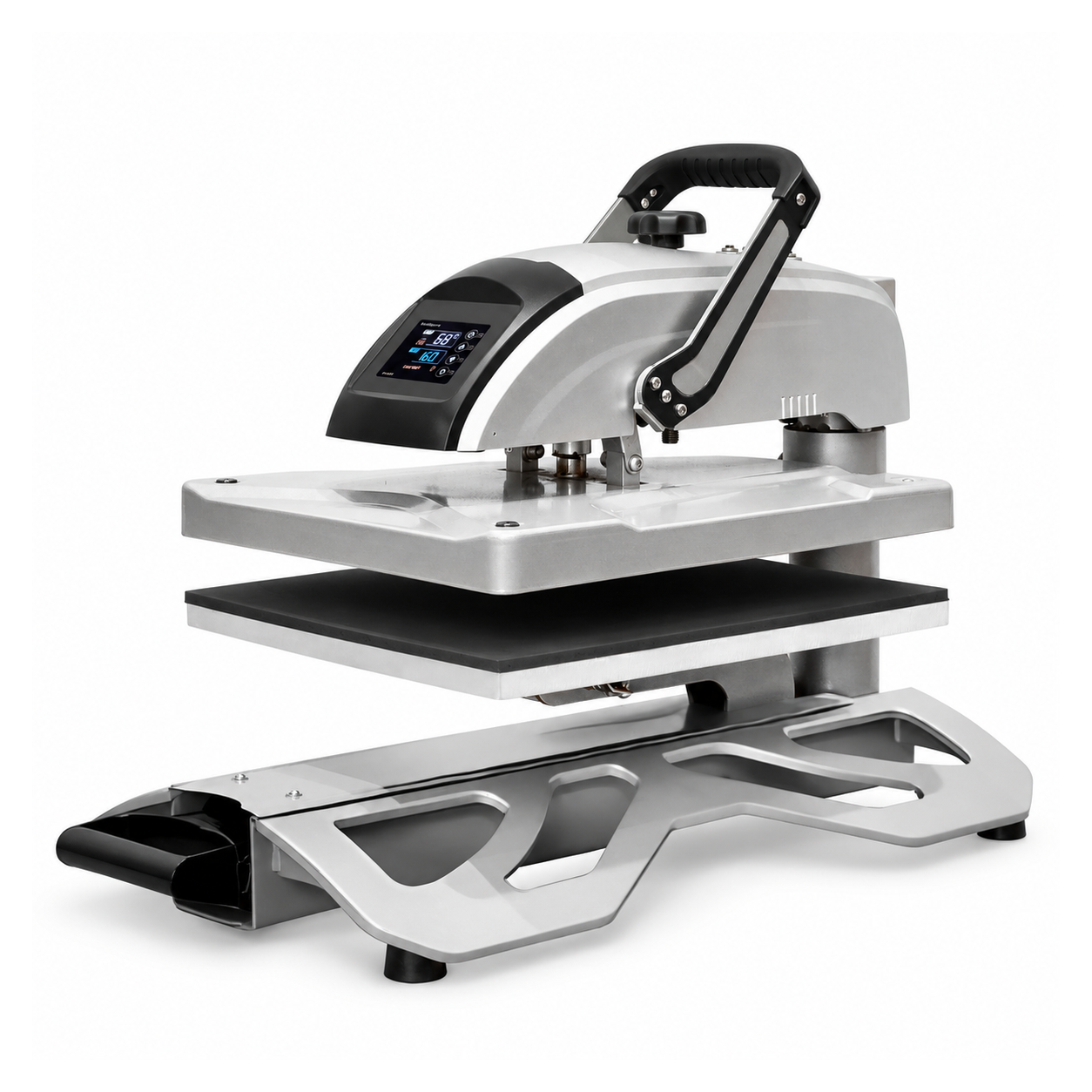
A slide-out drawer can make loading easier on long runs. It brings the lower platen toward the operator, then the platen swings in for the press. The result is less reach and a more repeatable loading position.
Screen printers and embroidery shops
These shops add heat transfer for names, numbers, and short runs. A semi-automatic swing-away applies the clamp with a controlled stroke, which reduces operator-to-operator variation.
Consistency matters more than raw speed here. A press that repeats pressure and dwell time protects the shop's reputation when several staff members share it across a week. The swing arm also keeps the heat away from the loading area during mixed work.
Promotional suppliers and team dealers
Repeat orders expose small differences. A semi-automatic swing-away with a stable frame and a clear controller keeps pressure and dwell time closer across batches.
Look for simple controls and a loading area that does not slow down the next piece. Operator turnover is common, so training time matters as much as top speed. A machine that requires a specialist to set up every job is a bottleneck.
Shops with limited floor space
A swing-away machine needs side clearance for the arm, but it can take less front-to-back depth than a larger dual-station press. A slide-out drawer can further reduce the reach required at the front.
Measure the arc, the drawer travel, and the operator's stance. A press that fits the wall but not the person is not a space saving. Confirm the full swing path before delivery.
Training studios, makerspaces, and sampling labs
Shared equipment needs clear controls and predictable behavior. A manual swing-away lets a new operator see the whole load and unload step, which makes it easier to teach.
A semi-automatic model reduces fatigue during all-day classes, but only if the controls are simple enough for occasional users. Label the settings and keep a sample piece beside the press as a reference.
Seven checks before you sign
These checks separate a machine that fits the brochure from one that fits the work.
1. Swing arc and clearance
Measure the radius, the handle height, and the space behind the machine. The arm needs room to rotate, and the operator needs a stable stance. Check the clearance above the press if the arm lifts before it swings.
2. Frame rigidity
A swing-away press takes repeated force at the end of an arm. A light frame moves under load, and that movement shows up as uneven pressure. Check the base, the column, and the pivot point.
3. Platen size and flatness
Check the usable heating area, not only the nominal size. A 16 x 20 inch platen covers most adult fronts and backs; a 15 x 15 inch platen fits smaller spaces and lighter work. Run a straight edge or a test transfer across the surface.
4. Pressure system
Manual presses rely on a knob, spring, or gas strut. Semi-automatic presses use a controlled stroke. In both cases, the setting must be repeatable. A numbered control helps operators record a recipe instead of starting from zero.
5. Heat uniformity
Ask for a temperature map at production heat. A display reading at the sensor does not guarantee the corners. Cold corners cause peeling; hot spots scorch polyester and leave shiny marks that cannot be fixed.
6. Controller and dwell time
The controller should hold temperature, count dwell time, and signal the end of the cycle. A clear display reduces training time. A lockable setting prevents accidental changes between shifts.
7. Electrical and safety
Electrical equipment should follow IEC 60204-1, the international reference for the electrical equipment of machines, including emergency-stop and protective bonding requirements. Confirm the voltage, circuit capacity, and plug type before delivery.

Total cost of ownership: what the quote does not show
The purchase price is only one line. The machine earns or loses money through cycle time, reject rate, and floor space.
Floor space: the swing arc and loading area may take more room than the machine itself.
Installation: electrical work, ventilation, and a stable bench can add cost before the first press.
Training: a clear controller and a written setup sheet shorten the learning curve.
Reject rate: uneven heat or pressure shows up as peeled transfers and remakes.
Cycle time: loading, pressing, and unloading all count, not only the dwell time.
Service access: the machine should allow inspection and adjustment without dismantling the work area.
A cheap machine that needs a second operator or creates rework is not cheap. A slightly higher price with a stable frame and repeatable controls often pays back faster.
Installation and floor plan
Measure before delivery. The machine needs the swing arc, the operator stance, and a loading table that does not block the next step.
Swing path: mark the full arc on the floor and check it against walls, racks, and walkways.
Power: confirm voltage, circuit capacity, and the distance to the outlet.
Ventilation: heat and fumes need room to clear, especially in a small room.
Bench height: the operator's forearms should stay level during loading and unloading.
Workflow: keep blank goods on one side and finished pieces on the other, so the operator does not cross the swing path.
A machine that fits the wall but not the person becomes a daily frustration. Test the stance with a spare platen-sized board before the machine arrives.
Where Heat Press Leader fits
Heat Press Leader, operated by Fujian Mech & Elec Co., Ltd., manufactures heat transfer equipment for apparel decorators. The swing away heat press machine range covers manual, drawer, and semi-automatic configurations.
Manual 16 x 20 swing-away press: flexible small-batch work, sampling, and shops with one main operator.
16 x 20 swing-away with slide-out drawer: easier front loading and tighter work areas.
16 x 20 semi-automatic swing-away: repeat orders and teams that need consistent clamp pressure.
Ask about voltage, plug type, lead time, and OEM or private-label options for your market. Those details affect installation and resale more than a headline speed number. The company's manufacturing background is worth reviewing before you shortlist.
Common mistakes
Most bad purchases trace back to a handful of avoidable choices.
Buying on price per square inch. A low-cost platen on a light frame still gives uneven pressure.
Ignoring the swing arc. The machine fits the wall but not the operator's stance, so every load feels awkward.
Measuring the machine, not the work. The loading table, blank racks, and finished-goods bin need space too.
Setting pressure by feel. Without a recorded setting, the next operator starts from zero.
Skipping a temperature map. The display can be right at the sensor and wrong at the edge of the platen.
Testing on the wrong fabric. A stiff sample shirt hides problems that appear on soft blends and mesh.
Forgetting training. The same press gives different results when nobody agrees on load position and dwell time.
A sample run, a floor-plan check, and a written setup sheet prevent most of these problems. None of them takes long compared with a rejected order.
Frequently asked questions
Q1: What is a swing away heat press machine?
A1: It is a heat press whose heated platen swings to the side instead of lifting straight up. The design clears the loading area and moves heat away from the operator's hands during loading. It is common in apparel decoration, promotional products, and sampling labs.
Q2: Is a swing-away machine better than a clamshell?
A2: It depends on how you load and what you press. A swing-away clears the loading area and helps with thick goods. A clamshell may fit a tighter footprint. Compare the swing arc, the operator stance, and the loading table before you decide.
Q3: Manual or semi-automatic?
A3: For low volume and one operator, manual is often enough. For repeat orders, multiple operators, or consistent pressure, semi-automatic is the better fit. The price difference buys consistency, not just speed.
Q4: What platen size should I choose?
A4: A 16 x 20 inch platen covers most adult fronts and backs. A 15 x 15 inch platen suits smaller spaces and lighter work. Measure your largest common design and add a margin for positioning.
Q5: How do I verify heat, pressure, and wash durability?
A5: Ask for a temperature map at production heat, test pressure with your own fabric, and record the settings that work. For wash durability, follow a recognized method such as ISO 105-C06, then wash a sample the way your customer will.
Request a machine recommendation
A useful inquiry includes more than a request for price. Tell the team what you press and how the work flows.
The substrates you handle most often, such as cotton, polyester, fleece, canvas, or blends.
The largest transfer size you sell, in inches or centimeters.
Average and peak weekly volume, plus the number of operators per shift.
Available floor space, including the swing arc, loading table, and walkways.
Voltage, plug type, and circuit capacity at the installation site.
Destination country, expected delivery date, and any OEM or private-label requirement.
Send those details to Heat Press Leader and ask for a comparison of two or three suitable models. The right swing away heat press machine is the one that fits the floor, the operator, and the order mix, not the one with the longest feature list.
Sources and further reading
ISO 12100:2010: Safety of machinery — General principles for design — Risk assessment and risk reduction — the basis for press hazard identification and risk reduction.
IEC 60204-1:2016/AMD1:2021: Safety of machinery — Electrical equipment of machines — Part 1: General requirements — the international reference for machine electrical equipment.
ISO 105-C06:2010: Textiles — Tests for colour fastness — Colour fastness to domestic and commercial laundering — a recognized wash-test method for transfer durability.