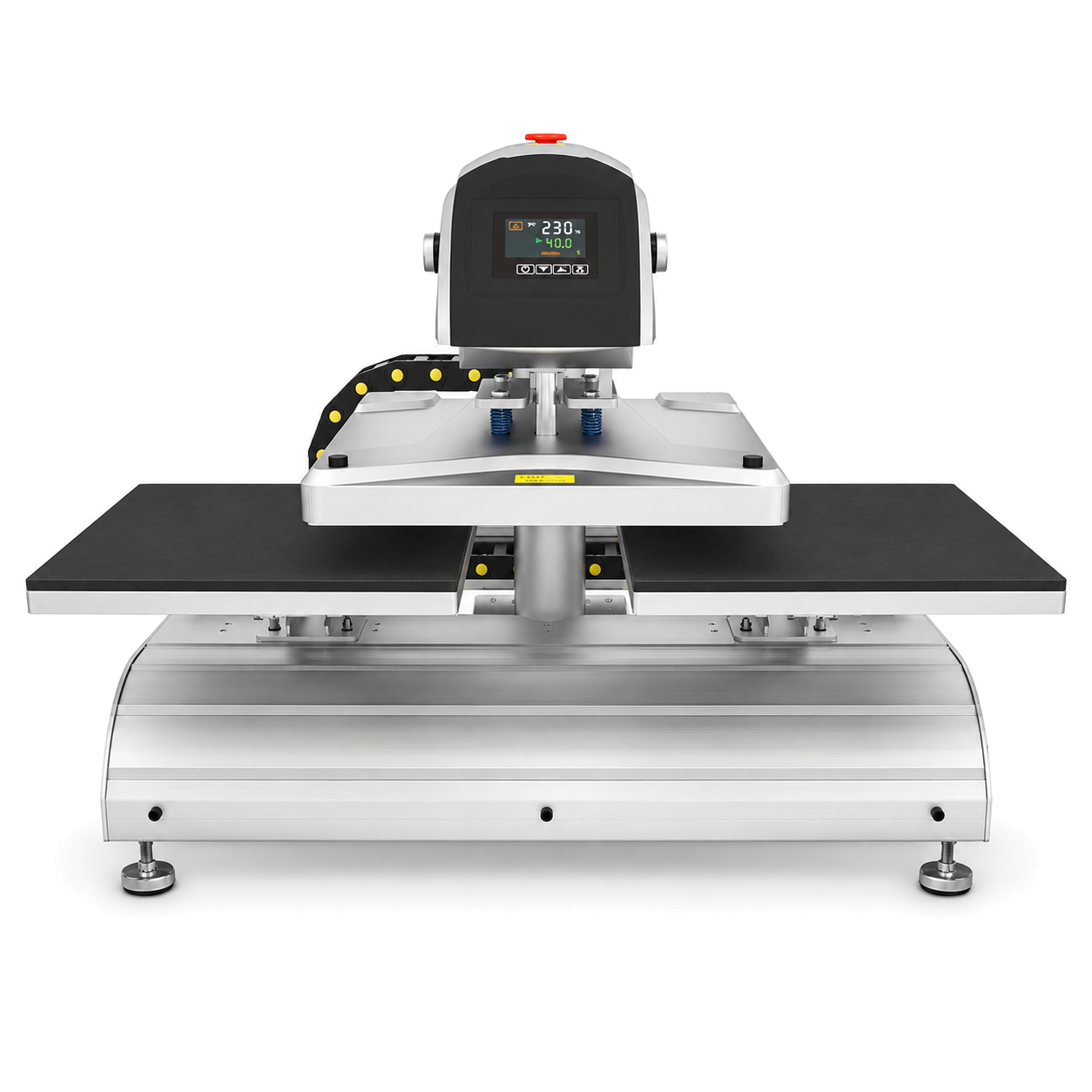
A 16 x 20 inch platen has become the default size for adult apparel. A swing-away arm has become the default way to clear the loading area. Put the two together and you get a heat press 16x20 swing away machine that fits a wide range of shops, from a one-person studio to a team dealer.
But the category is not one machine. Manual, slide-out drawer, and semi-automatic versions solve different problems. The right choice depends on who loads the press, how often, and what else shares the workspace.
This guide breaks the category down by user group and by the details that affect daily output. It also shows where a 16 x 20 platen is enough and where it is not.
Heat Press Leader builds manual and semi-automatic 16 x 20 swing-away presses for apparel decorators. If you are sourcing for a team, send your substrate mix and weekly volume early. A short brief gets you a specific recommendation and a quotation instead of a generic spec sheet.

Sixteen by twenty inches is large enough for adult fronts and most back prints, yet small enough to heat quickly and fit a modest bench. The swing-away arm clears that platen from the loading zone, so the operator can position a shirt without reaching under hot metal.
The combination is popular for a reason. It covers the most common garment work, and it reduces the awkward reach that makes clamshell presses tiring on thick goods.
For a deeper look at the mechanics, Heat Press Leader's guide to swing-away heat press engineering covers the geometry and commercial applications behind the format.
One safety note belongs here. ISO 12100:2010 sets the general principles for identifying hazards and reducing risk in machine design, and that includes the swing arc, the clamp, and the heated platen.
The same 16 x 20 footprint can serve very different shops. Use these profiles to narrow the field before you compare prices.
A manual 16 x 20 swing-away press is the simplest fit. It costs less, takes one operator, and gives direct feedback through the handle. For fewer than twenty pieces a week, automation rarely pays back.
Spend the difference on a stable frame and a controller that holds temperature. Those two details affect reject rates more than extra features. Write down the pressure setting and dwell time, and check the first piece from every batch.
A 16 x 20 manual or semi-automatic press covers adult fronts, backs, and most totes. If designs change often, a slide-out drawer reduces reach and makes loading faster.
A semi-automatic model helps when the same person also handles orders, packing, and customer service. Less time on the handle means more time elsewhere. The 16 x 20 platen is still large enough for most direct-to-film and heat-transfer work.
These shops add heat transfer for names, numbers, and short runs. A semi-automatic 16 x 20 swing-away applies the clamp with a controlled stroke, reducing operator-to-operator variation.
The 16 x 20 platen handles most placement work without the floor space of a dual-station machine. That matters in a shop where every square foot is already used. Consistency also matters more than raw speed when several staff members share the press.
Repeat orders expose small differences. A semi-automatic press with a stable frame and a clear controller keeps pressure and dwell time closer across batches. That is the difference between a consistent run and a batch that needs rework.
Look for simple controls and a loading area that does not slow down the next piece. Operator turnover is common, so training time matters as much as top speed.
A 16 x 20 swing-away needs side clearance for the arm, but it takes less front-to-back depth than many larger presses. A slide-out drawer can further reduce the reach required at the front.
Measure the arc, the drawer travel, and the operator's stance. A press that fits the wall but not the person is not a space saving. Confirm the full swing path before delivery.
Shared equipment needs clear controls and predictable behavior. A manual 16 x 20 swing-away lets a new operator see the whole load and unload step, which makes it easier to teach.
A semi-automatic model reduces fatigue during all-day classes, but only if the controls are simple enough for occasional users. Label the settings and keep a sample cap or shirt beside the press as a reference.
These three configurations are often compared as if they were trim levels. They are not. Each one changes the workflow.
Manual swing-away: lowest cost, direct feel through the handle, and simple service. Best for low volume, sampling, and one experienced operator.
Manual with slide-out drawer: brings the lower platen forward before pressing, which reduces reach. Best for tight spaces and operators who load a lot of pieces.
Semi-automatic swing-away: applies the clamp with a controlled stroke, so pressure is less dependent on the operator. Best for repeat orders and shared presses.
Semi-automatic with drawer: combines repeatable clamp force with easier loading. Best for shops that run several operators and change designs often.
A simple test: if the operator waits for the press more than the press waits for the operator, add capacity. If loading and positioning take most of the cycle, a drawer or a second station helps more than a faster heating element.
The category has a standard footprint, but not standard execution. These are the details that separate a smooth daily tool from a source of rework.
16 x 20 inches is the nominal size. Check the usable heating area and the actual clearance around the edges. Some designs lose effective area at the corners, which matters when a design runs close to the platen boundary.
Measure the radius, the handle height, and the space behind the machine. The arm needs room to rotate, and the operator needs a stable stance. Also check the clearance above the press if the arm lifts before it swings.
Manual presses rely on a knob, spring, or gas strut. Semi-automatic presses use a controlled stroke. In both cases, the setting must be repeatable. A numbered control helps operators record a recipe instead of starting from zero.
Ask for a temperature map at production heat. A display reading at the sensor does not guarantee the corners. Cold corners cause peeling; hot spots scorch polyester and leave shiny marks that cannot be fixed.
The controller should hold temperature, count dwell time, and signal the end of the cycle. A clear display reduces training time. A lockable setting prevents accidental changes between shifts.
Check the frame, base, and handle. A 16 x 20 press takes repeated force. Electrical equipment should follow IEC 60204-1, the international reference for the electrical equipment of machines, including emergency-stop and protective bonding requirements.
Set the work surface so the operator's forearms stay level. A press mounted too low causes shoulder strain over a full shift, even when the machine itself is capable.
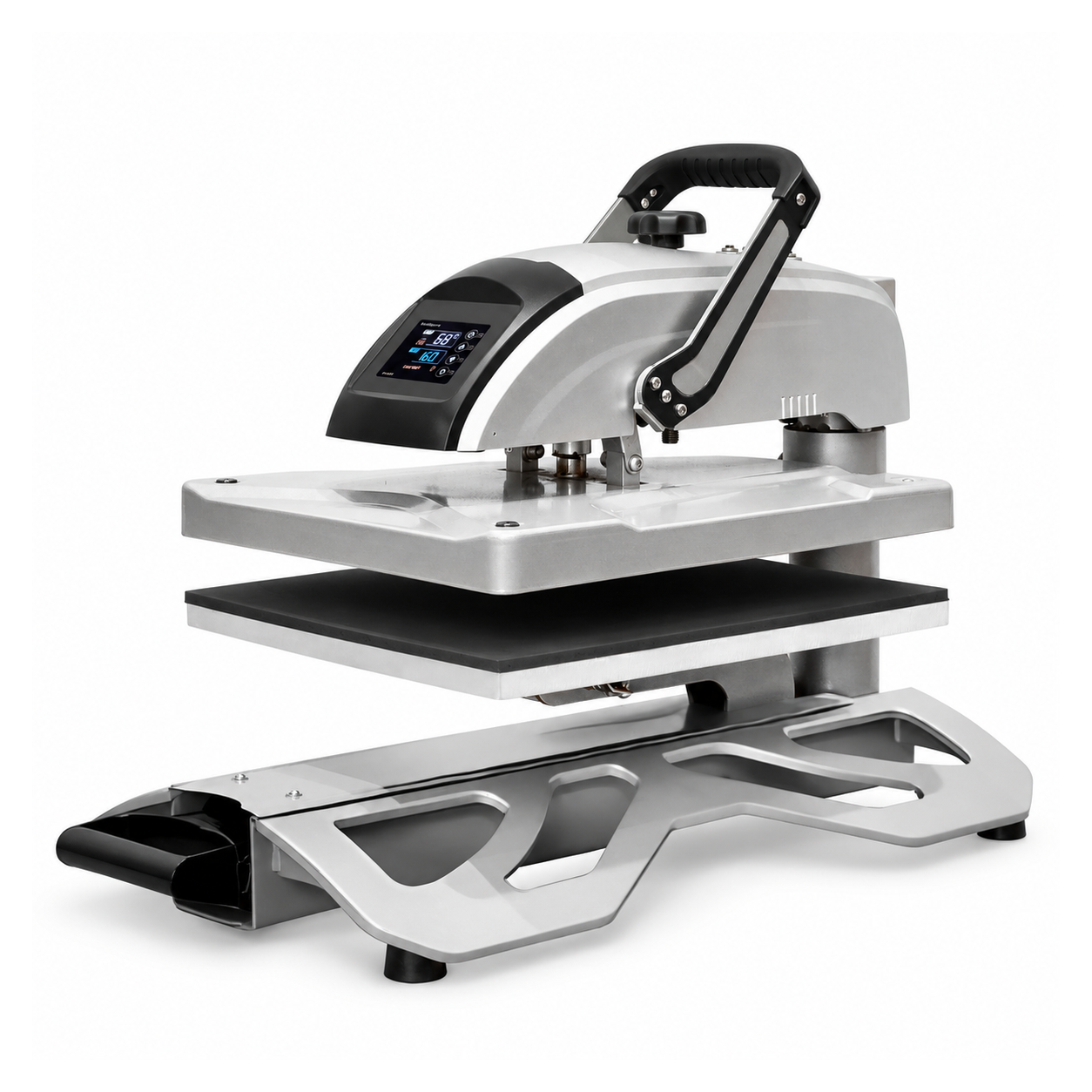
A 16 x 20 platen is versatile, but it is not universal. Match it to the largest common design and the thickest substrate.
Adult fronts and backs: 16 x 20 covers most standard placements with room to position the artwork.
Youth and small goods: a 15 x 15 platen may be easier to position, but a 16 x 20 still works with careful placement.
Sleeves and legs: a 16 x 20 platen can be awkward on narrow areas; plan the load or use a smaller platen.
Totes and canvas: 16 x 20 covers most flat totes. Watch seams, handles, and thickness during loading.
Hoodies and fleece: thickness needs clearance and pressure adjustment. A press that cannot open wide enough leaves a weak bond.
If your work is mostly small goods, a 16 x 20 press may be more platen than you need. If your work is mostly adult apparel, it is the safer default. Test with the fabric and transfer you actually sell; a vendor demo on a perfect blank shirt tells you less than one test on the material that gives you trouble.
Heat Press Leader, operated by Fujian Mech & Elec Co., Ltd., manufactures heat transfer equipment for apparel decorators. The heat press 16x20 swing away range covers three common configurations.
Manual 16 x 20 swing-away press: flexible small-batch work, sampling, and shops with one main operator.
16 x 20 swing-away with slide-out drawer: easier front loading and tighter work areas.
16 x 20 semi-automatic swing-away: repeat orders and teams that need consistent clamp pressure.
Ask about voltage, plug type, lead time, and OEM or private-label options for your market. Those details affect installation and resale more than a headline speed number. The company's manufacturing background is worth reviewing before you shortlist.

Most bad transfers trace back to a handful of avoidable choices.
Buying on price per square inch. A low-cost platen on a light frame still gives uneven pressure.
Ignoring the swing arc. The machine fits the wall but not the operator's stance, so every load feels awkward.
Assuming 16x20 is enough for every job. It covers most adult work, but not every small or narrow item.
Setting pressure by feel. Without a recorded setting, the next operator starts from zero.
Skipping a temperature map. The display can be right at the sensor and wrong at the edge of the platen.
Testing on the wrong fabric. A stiff sample shirt hides problems that appear on soft blends and mesh.
Forgetting training. The same press gives different results when nobody agrees on load position and dwell time.
A sample run and a written setup sheet prevent most of these problems. Neither takes long, and both make the next order easier.
Q1: What should I check first on a heat press 16x20 swing away?
A1: Start with the largest design you sell, your busiest week, and the space around the machine. Those three answers set the platen size, the press type, and the swing clearance. After that, compare pressure repeatability and temperature uniformity.
Q2: Is a 16x20 platen big enough for adult shirts?
A2: It covers most adult fronts and backs, but placement matters. Measure the actual artwork and add a margin. If you routinely press oversized back prints or long designs, check the usable area rather than the nominal size.
Q3: Manual or semi-automatic for a small shop?
A3: For low volume and one operator, a manual 16 x 20 swing-away is often enough. For repeat orders, multiple operators, or consistent pressure, a semi-automatic model is the better fit. The price difference buys consistency, not just speed.
Q4: Does a slide-out drawer make a real difference?
A4: Yes, when loading and positioning take most of the cycle. The drawer brings the lower platen toward the operator, which reduces reach and makes it easier to smooth thick goods. Check the drawer travel and the space in front of the machine before you commit.
Q5: How do I verify temperature and wash durability?
A5: Ask for a temperature map at production heat, then test the center and corners with a calibrated probe or heat-sensitive strips. For wash durability, follow a recognized method such as ISO 105-C06, then wash a sample the way your customer will.
A useful inquiry includes more than a request for price. Tell the team what you press and how the work flows.
The substrates you handle most often, such as cotton, polyester, fleece, canvas, or blends.
The largest transfer size you sell, in inches or centimeters.
Average and peak weekly volume, plus the number of operators per shift.
Available floor space, including the swing arc and drawer travel.
Voltage, plug type, and circuit capacity at the installation site.
Destination country, expected delivery date, and any OEM or private-label requirement.
Send those details to Heat Press Leader and ask for a comparison of two or three suitable models. The right heat press 16x20 swing away machine is the one that repeats your best sample on a busy Friday, not the one with the longest feature list.
ISO 12100:2010: Safety of machinery — General principles for design — Risk assessment and risk reduction — the basis for press hazard identification and risk reduction.
IEC 60204-1:2016/AMD1:2021: Safety of machinery — Electrical equipment of machines — Part 1: General requirements — the international reference for machine electrical equipment.
ISO 105-C06:2010: Textiles — Tests for colour fastness — Colour fastness to domestic and commercial laundering — a recognized wash-test method for transfer durability.